Chapter 8: The Truth Beneath the Concrete
The independent audit took nearly three months.
During that time, Brookhaven began changing in small but noticeable ways.
The new board published meeting schedules in advance.
Homeowners could review financial summaries.
Violation notices were examined for consistency.
Several questionable fines were suspended pending review.
Residents who had once avoided HOA meetings began attending.
Linda Foster encouraged disagreement, provided it remained respectful.
She believed a healthy community didn’t require everyone to agree.
It required everyone to be heard.
Daniel returned to his ordinary routines.
He worked from his home office.
He drove Sophie to school activities.
He repaired a loose kitchen cabinet.
He helped Walter set up online banking.
Some days, he barely thought about Patricia.
Other days, the memory returned without warning.
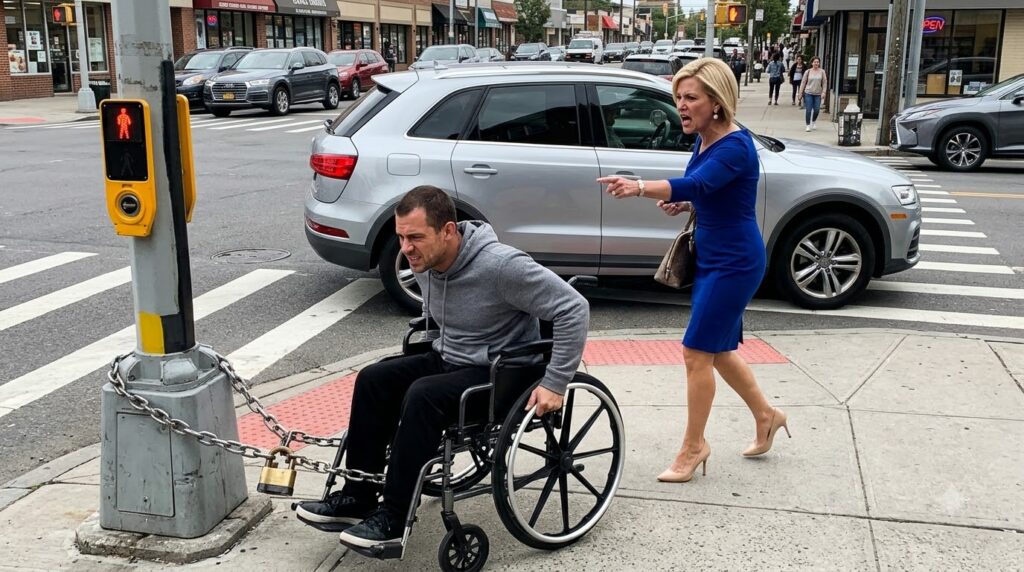
The metallic click.
The sudden pull of the chain.
The feeling of being unable to move.
His wrists had healed, but the experience had left him more cautious in crowded public spaces.
He began meeting with a counselor who specialized in trauma.
He didn’t consider that a weakness.
He considered it maintenance, much like the physical therapy he had continued after his accident.
Meanwhile, Reed kept him informed about the criminal case.
Patricia’s attorneys negotiated with prosecutors.
The evidence remained substantial.
The video was clear.
Multiple witnesses had given consistent statements.
Daniel’s medical records documented his injuries.
The prosecution was prepared to proceed.
Then the audit findings became public.
The report identified serious weaknesses in financial oversight.
It found that several payments had been approved without adequate documentation.
Certain invoices contained descriptions that did not match verified work.
Some vendor records raised questions about whether services had been provided as billed.
The auditors also identified payments to businesses with connections to individuals associated with Whitmore Property Services.
The report did not declare Patricia guilty of theft.
Auditors were not a criminal court.
But the findings supported referring the matter for further investigation.
The new board did so.
Investigators obtained additional records through lawful procedures.
Over the following months, they interviewed contractors, former board members, and business associates.
The inquiry eventually established that a portion of the association’s funds had been diverted through false invoices and inflated charges.
A former manager connected to Whitmore Property Services agreed to cooperate.
He provided records showing that Patricia had approved payments for work she knew had not been completed.
He also described pressure to keep certain transactions away from ordinary board review.
Those statements were tested against bank records, emails, and other evidence.
The case expanded.
Patricia faced separate financial charges.
Her attorneys disputed parts of the allegations, and the legal process continued.
Daniel followed the developments without celebrating.
He had never wanted to become the center of a scandal.
He had wanted to cross a street.
One afternoon, Linda invited him to visit the intersection at Maple and Third.
City engineers had reviewed the accessibility concerns.
They confirmed that the municipality was responsible for the public curb ramp and surrounding sidewalk.
The city scheduled improvements, while the HOA agreed to address adjacent common-area issues within its responsibility.
The work included correcting uneven pavement and improving the approach to the crossing.
The new board also adopted a policy requiring accessible routes to remain unobstructed during association activities.
Daniel appreciated the practical changes.
He was less interested in ceremonies.
But Linda insisted on showing him the completed work.
When he arrived, Walter and Margaret were waiting.
Emily Carter had brought coffee from the shop.
Sophie stood beside her father.
The curb ramp was smooth.
The sidewalk was level.
The pedestrian signal worked properly.
There was no parked SUV blocking the entrance.
Daniel rolled toward the crossing.
He stopped at the curb.
For a moment, he remembered the chain.
Then the pedestrian signal changed.
A white walking figure appeared.
Daniel pushed forward.
His wheelchair moved smoothly across the intersection.
No one stopped him.
No one demanded permission.
No one told him to wait until he showed respect.
He reached the opposite sidewalk and turned around.
Sophie was smiling.
Walter raised his coffee cup.
Margaret wiped her eyes.
Daniel laughed softly.
It was such an ordinary thing.
Crossing a street.
And that was exactly why it mattered.
Later that evening, Reed called.
Patricia’s attorneys had reached an agreement with prosecutors in the unlawful-restraint case, subject to court approval.
The proposed resolution included a guilty plea, probationary supervision, restrictions on contacting Daniel, community service, and financial obligations determined by the court.
The separate financial case remained pending.
Daniel listened carefully.
He knew no sentence could erase what happened.
But accountability was becoming real.
Before hanging up, Reed asked whether Daniel wanted to submit a victim impact statement.
Daniel looked toward the living room.
Sophie was sitting on the floor, helping Walter’s granddaughter assemble a puzzle.
He thought about what he wanted the judge to understand.
Then he answered.
“Yes. I do.”