Chapter 6: The Money Behind the Rules
Robert Hale lived in a retirement community twenty minutes outside Brookhaven.
At seventy-six, he moved slowly and used a cane, but his mind remained sharp.
He had spent forty years working in commercial banking.
Numbers were familiar territory.
So were irregularities.
Daniel and Reed met him in the community’s small conference room.
Robert arrived carrying a worn leather briefcase.
He placed it on the table and removed several folders.
“I never thought I’d need these again,” he said.
The documents included copies of bank statements, invoices, and internal correspondence from his time as HOA treasurer.
Robert explained that he had become concerned after several large payments were approved without adequate supporting documentation.
The accessibility project was one of them.
Whitmore Property Services had submitted invoices totaling $38,000.
Some line items described concrete replacement and curb ramp improvements.
Others listed project management fees and site inspections.
Robert had requested proof of completion before authorizing the final payment.
According to his records, Patricia instructed him to release the money anyway.
He refused.
A special board meeting followed.
Robert was accused of delaying essential maintenance.
The board voted to authorize payment over his objection.
Shortly afterward, he resigned.
Reed examined the documents carefully.
The invoices contained an unfamiliar subcontractor’s name.
Daniel recognized the address.
It belonged to a commercial building that had been vacant for years.
That didn’t prove fraud.
Companies sometimes used old mailing addresses or shared offices.
But it justified further investigation.
Robert then showed them a copy of an email.
It appeared to be from a representative of the subcontractor, confirming that certain work had been completed.
The message was brief.
Too brief, Robert had thought.
He had tried calling the company.
The telephone number was disconnected.
He contacted the state business registry and found that the subcontractor had been dissolved before the date of the invoice.
Reed studied the record.
“Did you report this?”
Robert nodded.
“I raised it with the board. I also sent a complaint to the appropriate state office, but I didn’t have enough information to establish what happened.”
He looked down at his hands.
“After my wife got sick, I stopped fighting.”
Daniel understood immediately.
There were moments when family mattered more than a battle over paperwork.
Robert’s wife had died the previous year.
He had kept the files because he couldn’t bring himself to throw them away.
Now he wanted the truth established.
Reed arranged to have the documents reviewed by a forensic accountant.
The committee also requested records through the procedures provided in the association’s governing documents and applicable law.
Meanwhile, the criminal case involving Patricia’s treatment of Daniel continued.
Prosecutors reviewed the video, witness statements, and medical documentation.
Patricia retained an attorney.
Her defense suggested the incident had been exaggerated online.
They argued that she had acted impulsively during a heated disagreement.
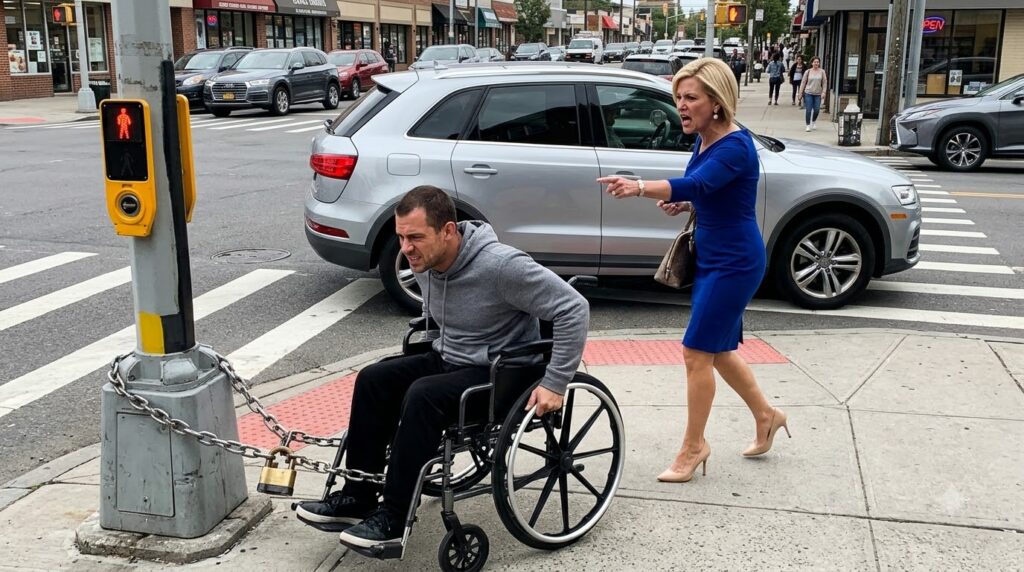
But the video showed something difficult to explain away.
She had brought a chain from her vehicle.
She had secured it around Daniel’s wheelchair.
She had locked it.
And she had walked away while he remained trapped.
The prosecution ultimately filed charges based on the evidence and applicable law, including unlawful restraint and related offenses.
Patricia was released pending further proceedings under conditions imposed by the court.
She was instructed not to contact Daniel.
For several days, the neighborhood became quieter.
Then the HOA board issued a statement.
It described Patricia as a dedicated volunteer who had served the community for years.
It expressed concern about the incident but urged residents not to rush to judgment.
The statement did not address the financial questions.
That omission frustrated many homeowners.
Still, Daniel insisted the committee remain focused.
They could not assume every board member knew about the questionable payments.
They needed to distinguish poor oversight from deliberate misconduct.
The forensic accountant’s preliminary findings arrived two weeks later.
Several payments required additional explanation.
Some invoices lacked supporting documentation.
One vendor appeared to have billed for work at locations where municipal records showed the city had already completed similar repairs.
There were also discrepancies between approved project budgets and amounts paid.
The findings were not a final determination of fraud.
But they were significant enough for Reed to recommend referring the records to appropriate authorities.
The committee agreed.
A formal request for an independent HOA audit followed.
Patricia’s supporters accused the group of trying to destroy the neighborhood’s reputation.
Daniel saw it differently.
A neighborhood’s reputation, he believed, depended on how it handled wrongdoing—not how successfully it concealed complaints.
One evening, while reviewing documents at home, Daniel received a call from Officer Collins.
Investigators had made progress identifying the source of the anonymous threat.
The number had been associated with a prepaid phone.
But other evidence had led them to a person connected to Patricia.
Collins could not share every detail.
She did, however, tell Daniel that the investigation was continuing and that officers had interviewed an individual who worked with Whitmore Property Services.
Daniel thanked her.
After hanging up, he sat quietly.
The case was becoming more serious than he had imagined.
What began with an illegally parked SUV had uncovered questions about money, authority, and intimidation.
But the greatest surprise was still ahead.
The next morning, Patricia Whitmore announced that she would seek another term as HOA president.