Chapter 7: The Vote Patricia Never Expected
Patricia’s reelection announcement arrived in every homeowner’s mailbox.
The letter was printed on thick cream-colored paper with the Brookhaven Estates logo at the top.
It praised her years of service.
It highlighted landscaping improvements, neighborhood beautification projects, and efforts to maintain property values.
It made no mention of the pending criminal case.
It made no mention of the financial review.
Instead, Patricia warned residents against allowing outside interests to destabilize the association.
Daniel read the letter at his kitchen table.
Sophie stood beside him.
“She’s really running again?”
“Apparently.”
“After everything?”
Daniel folded the letter.
“An accusation doesn’t automatically remove someone from office. The association has procedures.”
Sophie frowned.
“That doesn’t make it right.”
“No,” Daniel replied. “But it means we have to do this properly.”
The accountability committee had already begun reviewing the association’s bylaws.
They discovered that homeowners could nominate alternative candidates and request certain records before the annual election.
The process required deadlines, written notices, and verified eligibility.
Walter Benson volunteered to coordinate the paperwork.
Margaret helped residents understand the voting rules.
Robert Hale offered advice about financial oversight.
The committee needed a candidate.
Several people suggested Daniel.
He refused.
Not because he was afraid.
He simply knew he didn’t want the job.
He wanted the association to be run by people willing to listen, share records, and respect the limits of their authority.
After several discussions, the group approached Linda Foster.
Linda was sixty-one, a retired public school principal who had lived in Brookhaven for eighteen years.
She had served on school committees, managed budgets, and mediated disputes between parents, teachers, and administrators.
She was respected by residents with very different opinions.
At first, she hesitated.
Her husband had recently retired, and they had hoped to travel more.
But after reviewing the association’s financial concerns and speaking with homeowners, she agreed to run.
Her campaign was simple.
Transparent finances.
Fair enforcement.
Regularly published meeting minutes.
Clear procedures for residents to appeal violations.
And an independent review of accessibility issues throughout the neighborhood.
She promised no miracles.
She promised to do the work.
Patricia responded aggressively.
She accused Linda’s supporters of spreading rumors.
She claimed the committee wanted to eliminate neighborhood standards.
She suggested that Daniel was exploiting his disability for attention.
That last accusation angered many residents who had previously remained neutral.
Daniel refused to respond publicly.
He had learned that some arguments were best answered with facts and patience.
The election meeting took place on a Tuesday evening at the Brookhaven Community Center.
More than two hundred homeowners attended in person or participated through permitted voting procedures.
The room was crowded.
Some residents stood along the walls.
Others waited outside.
Patricia arrived wearing a bright red jacket and carrying a leather portfolio.
She walked to the front with the confidence of someone accustomed to controlling meetings.
Linda sat quietly beside her husband.
Daniel positioned his wheelchair near the center aisle.
Margaret sat on one side of him.
Walter sat on the other.
The meeting began with routine business.
Then came questions about the financial records.
Patricia attempted to dismiss them as irrelevant to the election.
But several homeowners insisted that the association’s finances were directly relevant to its leadership.
The meeting chair, following the adopted procedures, allowed a limited discussion.
Linda spoke briefly.
She did not accuse Patricia of crimes.
She explained that residents deserved accurate records and independent oversight.
She promised that, if elected, she would support a professional audit and publish the results as far as legally permitted.
The room responded with sustained applause.
Patricia’s face tightened.
When the voting began, volunteers distributed and collected ballots according to the association’s rules.
The counting took nearly an hour.
Daniel waited beside Sophie, who had come to support him.
He wasn’t thinking about Patricia.
He was thinking about the people who had spoken during the past several weeks.
The widow who feared losing her home over fines.
The veteran who needed a wider driveway.
Margaret, who had kept documents for years.
Robert, who had carried his concerns into retirement.
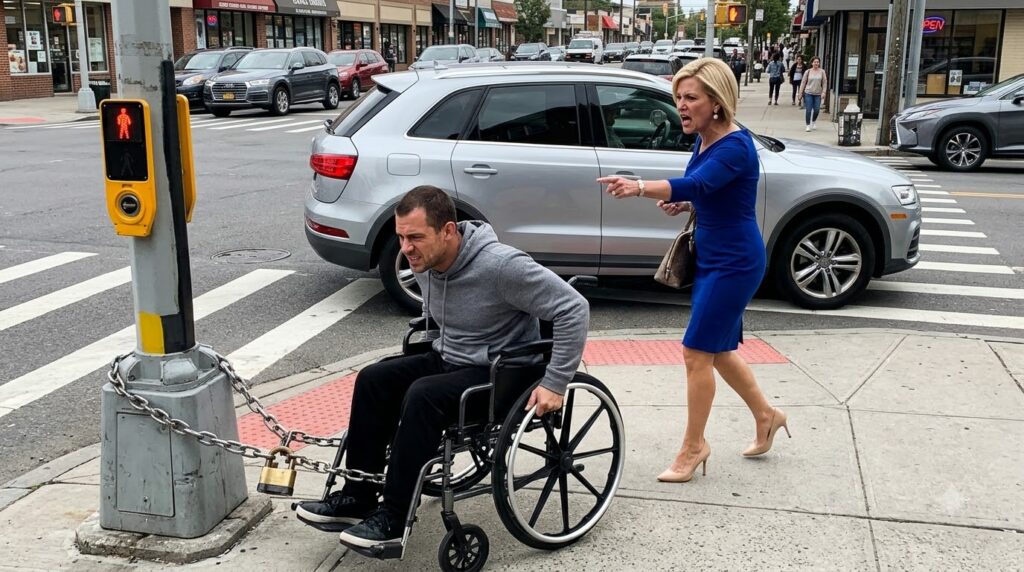
And Walter, who had stood beside a stranger chained to a traffic pole.
Finally, the election supervisor returned to the microphone.
The results were announced.
Linda Foster had won by a decisive margin.
Patricia had lost.
For a moment, the room was silent.
Then applause spread through the crowd.
Some people stood.
Others wiped tears from their eyes.
Margaret reached for Daniel’s hand.
Patricia remained seated.
Her face had lost its color.
She demanded a recount.
The election supervisor explained the procedures available to challenge the results.
Patricia announced that she would consult her attorney.
Then she gathered her belongings and left.
Daniel watched her walk through the doors.
There was no satisfaction in seeing her humiliated.
Only relief.
For years, residents had believed they had no choice.
Now they had made one.
Linda approached Daniel after the meeting.
“Thank you,” she said.
He shook his head.
“Thank the people who voted.”
Linda smiled.
“I intend to.”
But the election did not end the investigation.
Three days later, the independent auditors requested access to additional financial records.
And what they discovered would turn a neighborhood dispute into a much larger legal problem.