
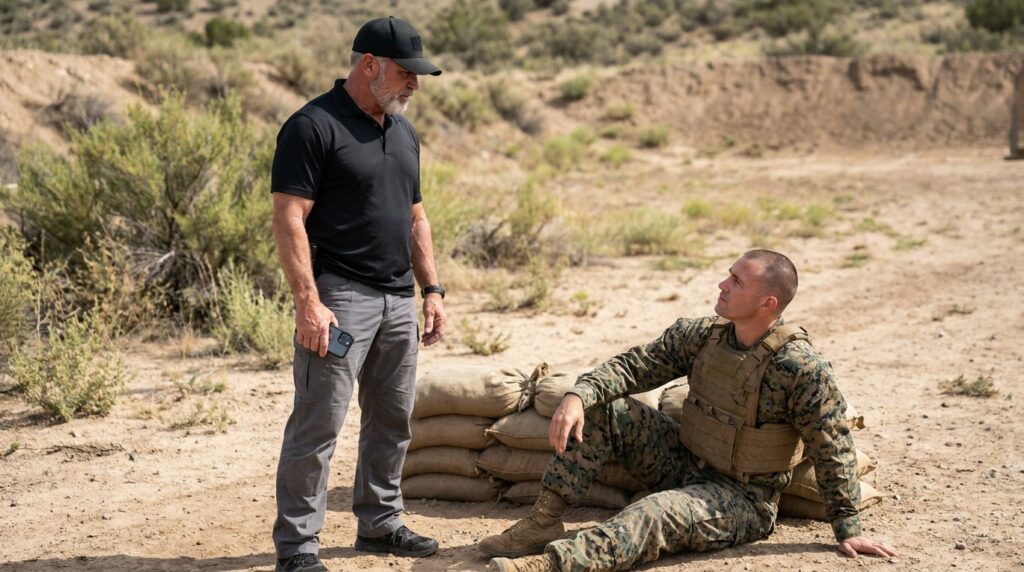
CHAPTER 9: THE INK AND THE BLOOD
“You should have stayed in Texas, Arthur.”
The sound didn’t come from the primary aisle. It slid through the perforated steel mesh of Sector C’s storage partitions, flat and completely devoid of acoustic lift. Stafford stayed anchored against the door frame of Locker 4402, his knuckles loosely resting on the nylon strap of his kit bag. He didn’t turn his head toward the pitch-black corridor. He calculated the distance by the subtle click of the speaker’s tongue against their teeth—nine feet, slightly elevated by the concrete drainage step near the main junction.
“The air is cleaner here,” Stafford said. His voice was a dry, level baseline that didn’t rattle the loose sheet-metal panel beside his shoulder. “The paper doesn’t burn as fast when the humidity is high.”
A small, high-intensity penlight flared twenty feet to his left. It didn’t track to his face; it illuminated the concrete floor three inches before Stafford’s boots, revealing the fine layer of gray limestone sand he had carried all the way from the range floor. Behind the beam stood a woman in a dark gray administrative blazer, her shoulder-length brown hair pulled back with a plain plastic band. Her right hand remained inside the deep pocket of her coat, the heavy, blocky outline of an issued subcompact frame altering the hang of the fabric.
“The board didn’t authorize a second retrieval run,” she said. Her features were sharp, hard-edged under the harsh ricochet of the white light. Her left hand held a thick folder of heavy, ink-stamped government credentials. “Director Vance thinks you’re hunting for old invoices, Colonel. He doesn’t know you kept the original field tokens from the Arghandab.”
“He knows,” Stafford replied softly. “That’s why he bought the facility. He wanted the stencils on the crates to match the inventory he filed in Washington before the logs were redacted.”
The woman—Major Sarah Miller, an administrative analyst from the procurement bureau’s oversight branch—took one slow, measured step onto the drainage step. Her leather soles made no sound on the damp concrete. Her eyes were dark, unblinking, and entirely locked onto the pulsing green LED of the live router inside the open locker.
“The tenth district logs weren’t redacted, Arthur,” she said, her voice dropping into a tight, transactional murmur that barely vibrated through the metal mesh. “They were cloned. Vance didn’t erase your unit from the registry to hide a failure. He needed the serial numbers for a shadow manifest that was already signed off by the deputy chair six months before your perimeter collapsed.”
The revelation hit the silence like a cold iron weight. Stafford’s left hand remained stationary near his belt, his thumb brushing the knurled rim of his steel stopwatch. His internal pulse didn’t jump its forty-eight baseline. He didn’t ask for names or dates; he let the subtext fill the space between them. The physical evidence inside the locker wasn’t an illicit surplus transaction; it was a live administrative mirror—a duplicate procurement terminal drawing active data from the central bureau to validate assets that had theoretically been destroyed on a ridge in Afghanistan four years ago.
“The men weren’t left behind because the trucks turned around,” Stafford murmured, his gaze cutting through the dark to trace the sharp outline of her blazer. “The trucks never existed on the real ledger.”
“They were logged as delivered,” Sarah said, her jaw tightening as she shifted her weight, the fabric of her coat rustling against the partition. “Seven thousand crates of high-grade munitions, completely cleared through the Bagram transit yard and signed for using your automated command stamp. If those numbers surface in a domestic compliance check, your legacy isn’t the only thing that goes into the shredder. My department signed the verification variance.”
The circle was closing. The equal intellect of the opposition hadn’t just anticipated his trajectory; they had built the legal and institutional framework of his entire career into the trap. The administrative clerk standing before him wasn’t an investigator sent to assist; she was a witness whose own career was anchored to the very paper trail he was trying to tear down.
A sudden, metallic scrape from the far end of Aisle 14 broke the stillness. It wasn’t the clean, smooth movement of an office shoe; it was the heavy, uneven drag of an ungreased combat boot scraping against a floor it didn’t trust. The sound grew closer, accompanied by the wet, erratic breathing of a man whose lung capacity had been broken by an impact that hadn’t fully healed.
Stafford didn’t pull his shoulders from the frame. He looked down the dark line of the aisle as a massive, asymmetric shadow broke the pale yellow light of the distant elevator bank, the silhouette wrapped in a dirty, dust-coated nylon tactical vest that didn’t belong in a government archive.








