
CHAPTER 2: SPACING AND APERTURES
“Take your hand off the weapon.”
Miller’s voice didn’t rise in volume, but it dropped in pitch, hitting that flat, hard register used by men who measured their worth by the weight of their kit. He didn’t close the distance immediately. He stayed five paces out, his boots rooted in the gravel, his thumbs hooking slowly into the heavy load-bearing D-rings of his camouflage vest.
Stafford didn’t pull his finger from Vance’s rifle frame immediately. He held it there for one complete breath, letting the trainee feel the steady, downward pressure—the physical absolute of a barrel locked into safe dirt. Only when he felt Vance’s forearm relax did Stafford lift his hand, returning it to his side. His thumb brushed the serrated edge of his steel stopwatch.
“The line was flagged, Marcus,” Stafford said. His voice was level, dry as the caliche dust drifting off the berms. “Lane two was inside his cone.”
“I don’t care if his cone was wrapped around your neck,” Miller snapped. He took three steps forward, his chest expanding under the rigid plates of his armor. The nylon straps creaked with the movement. He was thirty-eight, his skin leathered by contract tours in the dry sectors of Marib and Erbil, and he had spent the last eighteen months building a reputation at this facility as an operator who didn’t let corporate analysts dictate the tempo of his deck. “On this range, my word is the safety brief. You’re here to audit the logistics ledger, Colonel. You aren’t here to touch my line.”
The word Colonel came out twisted, laced with the specific irony junior officers used when they thought an elder had grown soft behind a green-felt desk in Washington.
Behind them, the six trainees stayed frozen in their boxes. Vance was sweating through his high-collared shirt, his knuckles still white against the polymer grip of his rifle. Not one of them adjusted their gear. They knew the rules of the subculture—when two instructors crossed lines, any movement from the gallery was an invitation to take a share of the blast.
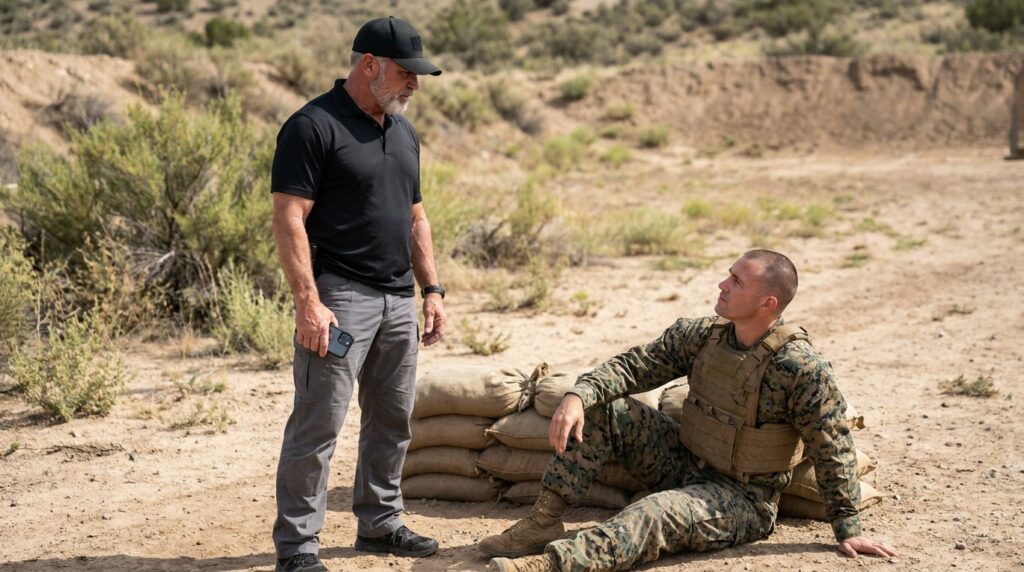
Stafford looked past Miller’s shoulder, his eyes catching the sharp, blinding glare of the sun hitting the hood of the logistics truck parked near the briefing shed. The heat was an active weight, pressing down on the small area of exposed skin between his black cap and his collar. He noticed the layout of the range with a clinical, unblinking focus: the sandbags were stacked five high, wrapped in weathered burlap that was starting to fray and spill fine, yellow sand onto the crushed rock. The corners were sharp, geometric, and unforgiving.
“The ledger covers the men, Marcus,” Stafford said softly. “If they flag each other during a dry-fire run, they won’t live long enough to clear the invoice.”
“They’re clearing twenty-four-second intervals because that’s what the transit contract demands,” Miller said. He was closer now, close enough for Stafford to smell the sour blend of energy drinks and gun oil on his uniform. Miller’s jaw was working, a small muscle twitching beneath his close-cropped sideburn. “We aren’t running peacetime drills for the National Guard. These boys are going into private security details for the logistics corridors. My corridors.”
Stafford didn’t shift his weight. He kept his feet spaced exactly twelve inches apart, his center of gravity low and immovable. His mind wasn’t on the safety violation anymore. It was on the small, heavy object resting at the bottom of his canvas gear bag three yards away—the tarnished brass key tag stamped with 10th-LOG-DIS.
He had found it three days ago in the central office file while reviewing the facility’s ammunition requisitions. It was an old ordnance token from his final deployment in the Arghandab—a deployment where seven men from his command had been left behind on a ridge because a private supply convoy had turned its trucks around twenty miles short of the extraction zone. The company that ran that convoy had changed its name twice since then, but the procurement serial numbers on Miller’s current supply crates matched the old manifest digit for digit.
Miller was looking down at him now, using his three-inch height advantage to crowd Stafford against the edge of the lane barrier. “You’ve been walking my perimeter for forty-eight hours, Stafford. Checking the seals on the crates. Looking at the fuel reserves. You think because you had a star on your shoulder ten years ago, you can come down here and play inspector general?”
“I’m here to ensure compliance,” Stafford said. He didn’t blink. His expression remained a gray mask, entirely devoid of the anger Miller was trying to provoke. “The facility is running hot on its numbers. You’re over-scheduled and under-manned.”
“We’re running at the pace required to survive,” Miller said, his teeth catching the light as he leaned in. His hands remained near his vest, but his shoulders were tight, his weight shifting forward onto the balls of his feet. “You want to talk about compliance? Let’s talk about why a retired spec-ops desk rider is so interested in our ordnance logs from 2018. Let’s talk about what you’re really looking for in the dark after the range clears.”
The accusation hung in the hot air between them. Stafford felt his pulse remain steady—forty-eight beats a minute, exactly where it had been when he crossed the border into Iraq thirty years ago. He didn’t answer with his mouth. He used the silence, letting it stretch until Miller’s chest hitched slightly with the unreturned pressure.
A low, metallic scrape came from the direction of the trainees. Vance had shifted his foot, his boot heel grinding a loose piece of brass against the stone.
The sound broke the spell. Miller tore his gaze away from Stafford, turning back to the squad with his jaw clamped tight. “Get these weapons cleared and stacked on the ready-bench,” he shouted, his anger finally spilling into the open lanes. “We’re moving to the sandbag enclosure for block two. Move!”
As the trainees scrambled to eject their magazines, Stafford looked down at his canvas bag. The cleaning rag had shifted under the vibration of the gunfire earlier, exposing the edge of the brass key tag. It gleamed under the harsh Texas sun, a small, jagged reminder that the past wasn’t dead—it was just waiting for the spacing to close.








