
CHAPTER 3: THE CORNER OF THE ANCHOR
The interior of the sandbag enclosure was four degrees hotter than the open lanes. Built from heavy, triple-layered polymer sacking filled with wet-packed river silt, the walls stood six feet high, forming a tight, geometric horseshoe that absorbed everything except the vertical glare of the midday sun.
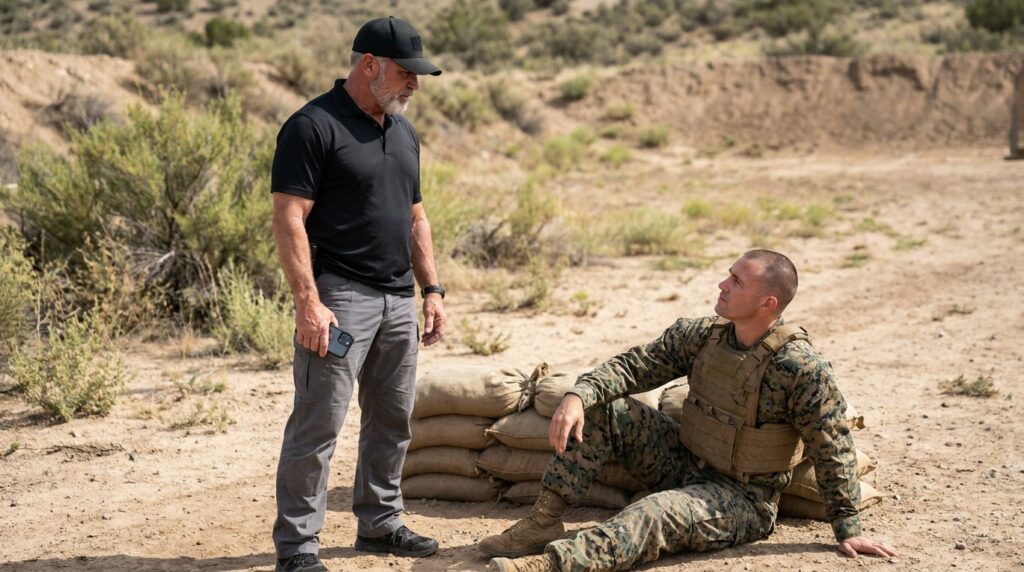
Stafford carried his own canvas kit bag, the heavy strap resting flat against his left clavicle. He took a position three feet inside the entrance threshold, his back aligned with the corner pillar where the timber supports met the earth. Every line in the space was sharp, clean, and rigid. Across from him, the six trainees sat on low pine benches, their knees nearly touching their chest rigs as they unbuckled their protective eyewear. They were silent, but their eyes tracked Miller as he unlatched a large, heavy plastic transit case resting on a folding table at the center of the pit.
“Block two is close-quarter containment,” Miller said, his boots scraping heavily against the hard-packed floor as he pivoted. He ignored Stafford completely, directing his voice over the heads of the class. He pulled a black, skeletonized short-barrel rifle from the foam insert of the case. The receiver was dry, stripped of cosmetic branding, but the industrial anodizing had a specific blue-gray sheen under the sun. “In this sector, you don’t have twenty yards of clearance. You don’t have time to build a platform. Your platform is whatever wall is behind your kidneys.”
He slammed the weapon’s bolt back, the sound a sharp, mechanical crack that vibrated against the dense sandbag walls. Stafford’s left hand remained hanging by his pocket, his index finger resting lightly on the knurled rim of his steel stopwatch. His gaze wasn’t on the rifle Miller was handling. It was on the side of the plastic transit case.
Stenciled beneath the factory latch was a white alphanumeric string: NX-4402-LOG.
The numbers were faded, partially scoured away by steel wool, but Stafford recognized the structure of the registry. It wasn’t a standard domestic logistics label. It was a tactical redistribution prefix from the automated depot at Bagram, 2018. The exact same depot that had signed off on the fuel and ammunition reductions for the 10th Logistics District forty-eight hours before his team’s perimeter had collapsed.
Miller noticed where Stafford was looking. His jaw tightened, the skin over his cheekbones turning pale as he stepped around the folding table, the rifle held diagonally across his chest in a low-ready posture. “Vance,” he called out without breaking eye contact with Stafford. “Get up here.”
The young trainee scrambled off the bench, his nylon vest rustling loudly as he adjusted his belt. His face was still damp from the heat, his breathing shallow. “Sir.”
“Take the blue gun from the tray,” Miller ordered, gesturing with his chin toward a solid plastic training replica lying on the timber table. “You’re entering an unsecured blind corner. I’m the primary obstruction. Show the evaluator what we do when the spacing collapses to zero.”
Vance gripped the blue polymer weapon, his arms stiffening into an aggressive forward press. He took two steps toward Miller, his boots slipping slightly on the loose silt.
“Stop,” Miller barked. He didn’t look at Vance. His eyes remained locked on Stafford, wide and bright with a confrontational intensity. “Look at the posture on the consultant, Vance. Look at how he stands near the gate. Hands out of the line, weight shifted back. He thinks this is an administrative review. He thinks when the door kicks open in a hot zone, you have time to wait for a signature.”
The trainees on the bench shifted, the wood groaning beneath their weight. The air inside the horseshoe felt thick, smelling of hot plastic and dry earth. Miller was deliberately narrowing the circle, using the presence of the class to sharpen the edge of the blade he was driving into Stafford’s territory.
“A real professional doesn’t wait for the space to clear,” Miller continued, his voice dropping into a rhythmic, transactional drone designed to provoke. He took a long step toward the threshold, his shoulder armor brushing the edge of the sandbag wall right next to Stafford. “He dominates the line before the old man can remember where he left his spectacles. Isn’t that right, Colonel?”
Stafford didn’t pull his shoulders back. He stayed locked into his vertical anchor against the timber support, his expression a smooth, unreadable gray mask. “The drill requires a two-man clearing sequence, Marcus. You’re isolating the lead element.”
“I’m showing them how to handle an dead weight,” Miller said. He stepped directly into Stafford’s personal space, his chest plate pressing within four inches of Stafford’s polo shirt. The blue-gray metal of the skeletonized rifle was a cold bar between them. “Some people spend thirty years living off a title they earned when M16s had carry handles, Stafford. They come down to a live deck and they think they’re ghosts. But out here, if you don’t have the muscle to hold the box, you’re just a liability with an expense account.”
The disrespect was no longer subtextual. It was a direct, public challenge to Stafford’s kinetic presence, delivered in front of the very men he had been sent to evaluate. Miller’s breath was hot against Stafford’s face, his body coiled tight like a spring that had been overwound by pride and a hidden, frantic fear of exposure.
Stafford felt the cold steel of his stopwatch under his thumb. He didn’t move his feet. He looked through Miller, his gaze cutting straight to the faded white numbers on the transit case behind him. He didn’t need to check the ledger anymore; the physical evidence of the old district betrayal was sitting right there on the table, wrapped in the uniform of a private training firm.
“You’re crowded, son,” Stafford said, his voice entirely clear of friction, a low baseline that made the surrounding silence feel absolute. “Reset the lane.”
Miller didn’t move back. He let his teeth show, a thin, hard smile that didn’t reach his eyes. “Make me.”








