
CHAPTER 5: THE PRICE OF CALCULATION
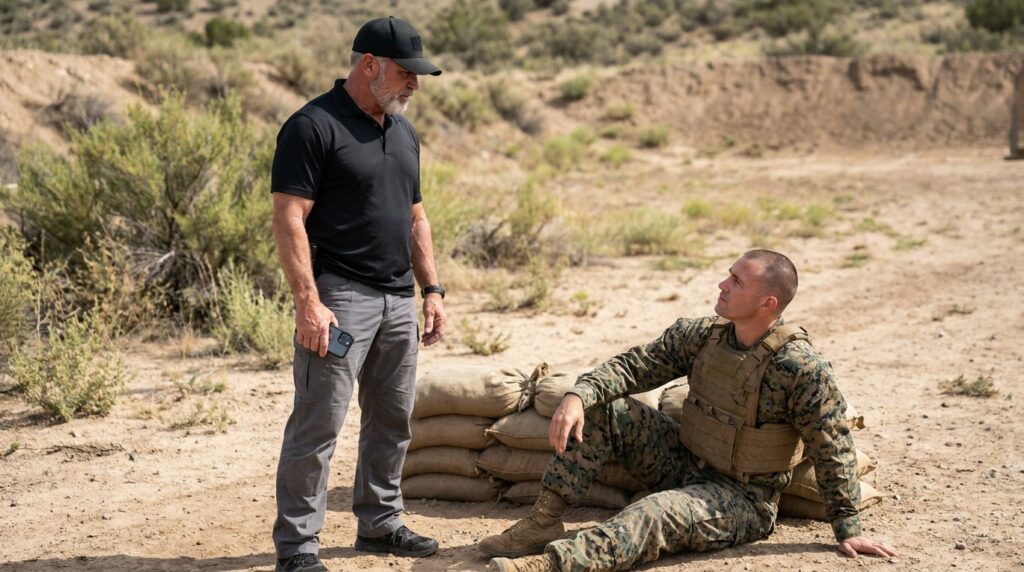
The contractor didn’t move for three complete seconds. He lay in the dust, a dark smear of Texas caliche coating the left shoulder of his camouflage jacket, his chest rising and falling in rapid, violent jerks beneath the heavy ceramic plating of his vest.
“Stay down,” Stafford said again. His voice was no louder than the wind dragging across the corrugated tin roof of the adjacent armory shed. It carried a flat, institutional resonance that bypassed the ringing ears of the six men on the benches.
Miller’s fingers twitched against the gravel. A bright crimson graze was beginning to bloom beneath the dust on his left forearm where the skin had scraped against the sharp limestone shards. He didn’t rise to his feet; he rolled to his side first, using his right hand to brace his weight against the ground while his boots kicked blindly into the dirt, trying to establish a baseline of support. His eyes were wide, bloodshot, and fixed entirely on the unmoving black tip of Stafford’s boot.
“You…” Miller managed, the word catching in his throat as his diaphragm spasmed from the residual shock of the impact. “You broke the lane parameter.”
“The parameter was compromised when you placed your hands on an evaluator, Marcus,” Stafford replied. He didn’t offer a hand to assist. He didn’t alter his stance by an inch. He remained balanced, his boots planted firmly twelve inches apart, his thumbs loosely hooked into his pockets, maintaining an exact radius of defensive isolation.
Behind them, Vance let the blue plastic training weapon slip from his fingers. It hit the pine planks with a dull clatter that seemed to break the collective paralysis of the row. One by one, the other five trainees lowered their gazes, their eyes tracking the gray dust clouds kicked up by Miller’s heavy boots. They knew what they were witnessing wasn’t a standard safety intervention anymore. It was an execution of authority—the clinical dismantling of a reputation built on performative force.
Stafford turned his face slightly toward the center table, ignoring the contractor’s struggles to sit upright. His attention was locked onto the open tray of the plastic transit case. Under the harsh, vertical glare of the sun, the scoured white markings of the old Bagram registry looked like a scar across the black polymer.
He stepped toward the table, his movement deliberate, unhurried, and precise. He reached down and flipped the interior lid of the case, exposing a secondary compartment hidden beneath the foam padding. Tucked into the narrow slot was a thick, leather-bound manifest log with an unbranded steel binding. It was stamped with a duplicate series of logistics indicators matching the numbers on the brass tag at the bottom of his own canvas kit bag.
He flipped the first page. The entries weren’t standard inventory numbers for a private civilian range. They were active supply coordinates—grid segments in the western sector that didn’t correspond to any legitimate military deployment or state authority.
“Leave that alone,” Miller rasped from the floor. He was on his knees now, his hand clutching the front of his tactical vest as he dragged his body up against the support beam of the sandbag wall. The arrogance had drained from his face, replaced by a pale, frantic desperation that made the skin around his jaw look tight and translucent. “That’s company property, Stafford. You don’t have clearance for those logs.”
“The procurement bureau signed off on these serial numbers four years ago, Marcus,” Stafford said, his finger running down the line of faded black ink. “The same bureau that cut the fuel reserves for the Arghandab perimeter. You didn’t buy these crates from a surplus dealer. They were assigned to you before your team ever left the sector.”
Miller’s mouth opened, but no sound came out. The small muscle beneath his cheekbone was twitching with a frantic, animal cadence. He wasn’t looking at Stafford as a corporate auditor anymore; he was looking at a man who had pulled a thread that connected directly to the foundation of the entire facility.
A low, metallic rumble vibrated through the caliche outside the enclosure. The heavy, dual-axle suspension of an unmarked command vehicle was rolling up the main gravel lane from the highway gates. The sound grew louder, the deep hum of a diesel engine cutting through the range’s remaining silence until the tires ground to a halt right beside the sandbag barrier.
Stafford closed the logbook with a single, sharp snap of his wrist. He didn’t look back at the class. He felt the cold edge of the steel stopwatch against his hip, a familiar weight that reminded him that every action had a calculation, and every calculation carried a price. The trap hadn’t been set by Miller; the contractor was just the trigger mechanism for a much larger machine that was finally beginning to turn in the high heat of the desert.








