
CHAPTER 7: THE RECOVERY VALUE
“The transport leaves in three minutes, Stafford.”
Director Vance didn’t lift his fingers from the leather document case resting on the table. His posture was perfectly straight, his starched khaki shirt presenting a flat, unyielding plane against the dusty, shadowless heat of the enclosure.
Stafford didn’t look down at the covered logbook. He let his arms drop fully to his sides, his fingers relaxing completely. “Three minutes is a clean margin, Director,” he said, his voice dropping into that quiet, rhythmic baseline that carried no trace of the sand or the sweat that stained his gray tactical pants.
He bent down with an unhurried, mechanical economy of motion, his muscular frame silhouetted against the blinding glare of the entrance. His right hand reached into the loose, fine limestone gravel beside his boots, his fingers closing around the worn nylon strap of his canvas kit bag. As he lifted the heavy bag, his thumb brushed the edge of the tarnished brass tag hidden beneath the cleaning rag—the metal tag stamped with 10th-LOG-DIS. It was a small, cold wedge of fact, entirely secure within the canvas walls.
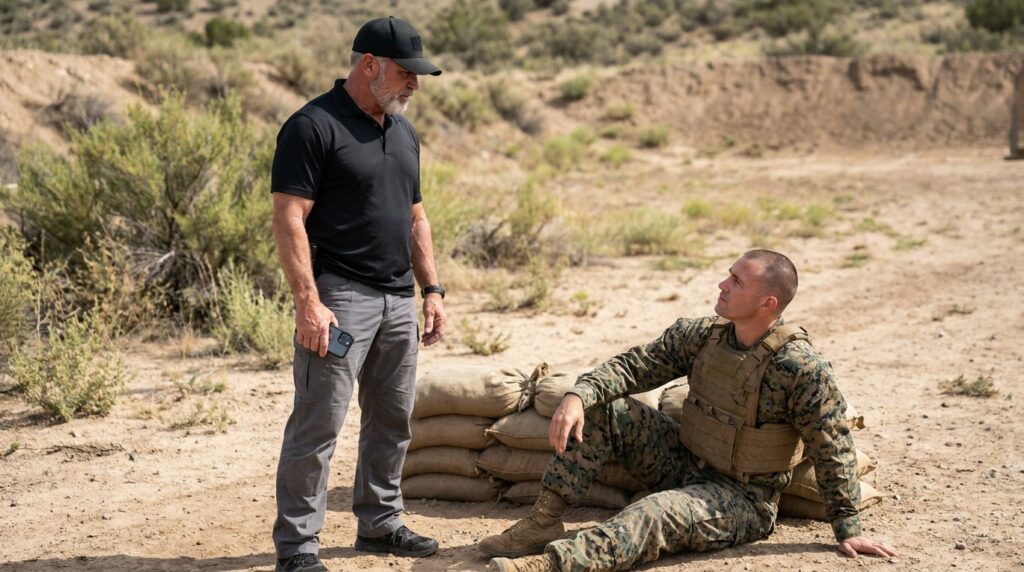
Beside the timber pillar, Miller remained on his knees, his hands braced flat against the earth as if the limestone itself were the only thing preventing him from sliding out of the lane completely. His camouflage jacket was white with caliche dust, his face pale and empty under his close-cropped hair. He didn’t look up when Stafford adjusted the strap across his left clavicle. His ego had been scoured away, leaving nothing but an active-duty operator who had been shown that his physical capability meant nothing inside a system governed by paper liquidations and gold federal seals.
Stafford took his first step toward the horseshoe exit. His boot sole caught a loose piece of spent brass, pressing it firmly into the silt with a sharp, dry crunch that broke the finality of Vance’s silence. He didn’t look back at the six trainees on the benches. They sat like statues, their blue plastic training weapons resting across their laps, their eyes fixed forward on the table where the black transit case sat like an unmarked headstone under the desert sun.
“Colonel,” Vance called out just as Stafford cleared the corner pillar. The voice was thin, sharp, and perfectly insulated from the glare outside. “Make sure you hand in your gate badge at the checkpoint. You don’t have secondary access to this sector.”
Stafford paused for a fraction of a second, his shadow stretching long and narrow across the threshold rock. He didn’t turn around. “The checkpoint doesn’t keep a log for ghosts, Director. You should check your ledger.”
He walked out into the open range. The sun hit his face with a sudden, violent heat, the white limestone floor reflecting the light until the entire horizon looked like an overexposed strip of film. Two hundred yards away, the rhythmic thud of the long-range rifle lanes continued, a flat, mechanical beat that measured the distance between the training ground and the larger institutional war that had just locked its teeth into his life.
He reached his hip, his fingers closing over the smooth, unbranded steel stopwatch hanging from his belt loop. He clicked the crown once. The ticking stopped. The hands froze exactly on the twenty-four-second mark—the baseline standard for a break in the perimeter line. He unhooked the cold metal circle from his pants and dropped it into the front pocket of his canvas bag, letting it sink beside the brass token from Bagram.
The private training facility was disappearing behind him, its heavy sandbag walls and corrugated tin sheds shrinking against the vast, gray line of the Texas scrubland. Stafford didn’t speed up his stride. He kept his feet spaced exactly twelve inches apart, his body moving with the silent, calculating momentum of a machine that had been designed to survive the winter of 2018 and was now tracking the signal all the way back to the source.








