
CHAPTER 8: THE BASELINE SHIFT
The high-pressure hydraulic lines on Gary’s dump truck shrieked as the steel lift cylinders extended, forcing the massive bed upward into the gray mist. Six tons of washed three-quarter limestone gravel hit the tail gate with a deafening, metallic crash that rattled the windowpanes of the identical colonial houses down the block. The rock slid in a single, heavy torrent, pouring straight into the driveway apron with a sound like a small mountain collapsing onto the blacktop.
Miller didn’t raise his hand to stop it. The code enforcement officer stood by his cruiser’s fender, his pen scratching three firm, carbon-copied strokes across a bright orange citation pad before tearing the top sheet away with a sharp slap of the paper.
“Ma’am,” Miller said, his voice easily cutting through the hiss of the rain as he stepped toward the side porch. He didn’t look at the luxury SUV that still sat blocking the curb. He jammed the orange ticket straight under the driver’s side wiper blade of Brenda’s vehicle, right over the glass. “This is a formal municipal order for immediate easement clearance. You have sixty minutes to remove this vehicle and initiate the remediation protocol for an unrecorded alteration of a county drainage culvert. If that intake isn’t cleared of the masonry wash by noon tomorrow, the county water district takes over the site at your expense.”
Brenda didn’t reach for the paper. Her hands remained frozen at her sides, her fingers hooked rigidly into the strap of her leather shoulder bag. Her clipboard lay on the wet sidewalk behind her heel, its aluminum clip reflecting the steady, rhythmic blue strobes from the cruiser’s roof bars. Through the wet, streaked lenses of her sunglasses, she stared at the blueprint map still pinned beneath Miller’s thumb—the ancient county plat that had completely erased her authority from the dirt.
“This is an association sector, Miller,” she whispered. Her voice was thin now, stripped of its bureaucratic cadence, barely holding against the cold wind coming off the ridge. “We’ve maintained the grading for twenty years. The town can’t just declare an unrecorded bypass without a formal board hearing.”
“The county doesn’t hold hearings for an active storm main, ma’am,” Miller said, turning his back to her and nodding once toward Mark. “The lines are where the state drove the iron. Everything else is just landscaping.”
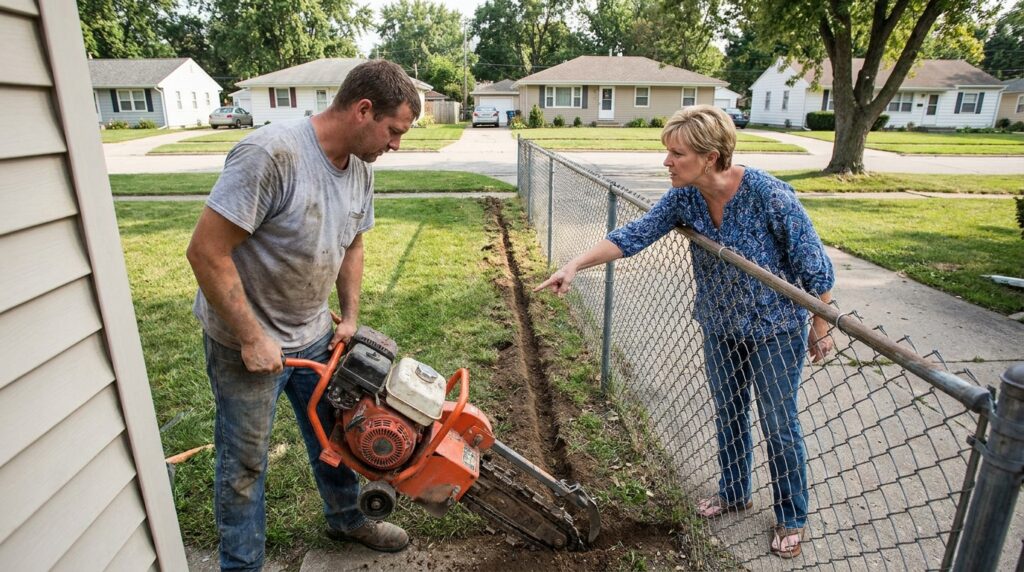
Mark didn’t wait for the rest of the conversation. He hit the primary drive lever on the ditch witch, the two-hundred-cc engine screaming back to maximum operational revs as the cutting boom sank five inches deeper into the wet clay. The vibration hit his calloused palms like a solid blow, traveling straight up his arms to find the dull, cold throb in his broken left wrist. He leaned his thighs back into the frame, his grease-stained boots sliding an inch in the muck before he stabilized his stance, tracking the exact line of the string toward the tie-in point.
The machine chewed through the remaining yards of shale with a relentless, mechanical rhythm, spitting out a uniform hill of gray dirt that rose parallel to the zinc fence. Behind him, Leo had finally found his pace. The kid was moving with the rhythmic focus of a real operator now, his shovel swinging in short, precise arcs as he scooped the fresh limestone backfill into the throat of the cut, bedding the four-inch perforated pipe before the rising water could float the line.
Across the fence, through the narrow gaps in the Leyland cypress line, the neighbors were starting to lower their porch awnings. The screen doors were clicking shut one by one down the cul-de-sac. The spectacle was over. The performative power of the clipboard had dissolved into the clay, leaving only the hard, structural reality of the grade and the water that was already beginning to drop, inch by inch, through the newly cleared channel Mark had driven through the yard.
By the time the final run cleared the road entry, the sky to the west had turned a deep, solid charcoal, the first heavy sheeting sheets of the storm system sweeping across the roofs of the subdivision. Mark cut the throttle, letting the machine drop into a wet, low idle before shutting the ignition off completely. The silence that followed was heavy, clean, broken only by the steady, rushing gurgle of four hundred gallons of storm runoff draining out of the client’s lot and dropping through the open sleeve of the municipal main.
He stood in the center of the yard, his gray t-shirt completely soaked, his work boots caked with six pounds of packed gray clay. He reached down and picked up his steel wire brush from the grass, tucking it back into his belt loop before looking over at the fence line one last time.
Brenda was gone. Her luxury SUV had been moved back into her garage, the heavy insulated door shut tight against the weather, leaving only the fresh, dark tire marks where the vehicle had skidded across the muddy margin of the sidewalk. The orange ticket was gone from the glass, but the small, rusted iron survey pin remained exposed at the base of the post, its stamped county seal clean and silver under the gray light of the rain.
Mark wiped the wet grit from his face with the back of his sleeve, his eyes tracking the steady flow of the water as it ran true through the limestone bed.








