
CHAPTER 3: THE WARNING SHOT
The drive belt didn’t snap; it went soft under the load, smoking against the drive pulley with a sharp, synthetic stench that cut through the raw odor of the dirt. Mark caught the slip instantly, his boots shifting in the loose clay as he cut the primary drive and let the trenching machine sink to a dead stop. A heavy quiet collapsed over the lot again, save for the faint, steady rattle of a dry bearing somewhere deep inside the housing.
“Leo, the three-quarter box wrench,” Mark said. He didn’t look up from the access panel. He dropped to one knee on the packed earth, his bare fingers sweeping away a crusty layer of soil from the tensioner bolt. The metal was hot enough to leave a white smudge of dry skin on his thumb. “And bring the rag from the tailgate.”
No answer came from the truck. Mark leaned his weight against the frame of the ditch witch, his left wrist pulsing with that dull, rhythmic ache as he turned his head toward the street. Leo wasn’t at the toolboxes. The kid was standing near the front bumper of the F-250, his face shadowed by his cap, staring at a thick piece of white cardstock that had been slammed under the passenger-side wiper blade.
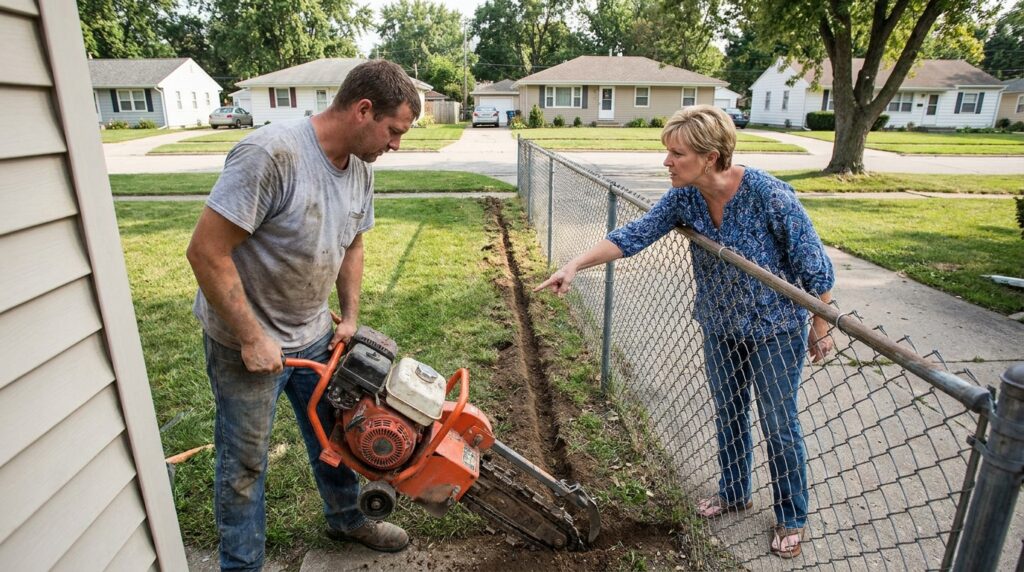
Brenda was already thirty yards down the sidewalk, her blue patterned blouse a bright, artificial speck against the uniform brick facades of the cul-de-sac. She didn’t look back. She walked with a stiff, calculated posture, the clipboard clamped tightly beneath her elbow like an official ledger.
Mark stood up slowly, the dry clay popping on his jeans as he crossed the yard. The turf felt spongy under his boots, a clear sign that the water table beneath the sod was already rising ahead of the storm system. He reached the truck, taking the cardstock from Leo’s hesitant fingers without a word.
The paper was thick, textured, and bore the embossed gold seal of the Oakridge Heights Homeowners Association. The ink was fresh, the bold typewriter font giving it the look of a municipal summons. It was a formal Cease-and-Desist order, citing three separate violations of the neighborhood civil code: unauthorized commercial equipment deployment, environmental disturbance of a common easement, and failure to present a physical hardcopy of the sub-divisional variance registry. At the bottom, a neat, blue-ink signature marked Brenda’s full name alongside a stamped assessment fee of twelve hundred dollars, payable within forty-eight hours to clear the property title.
“She said they’re bringing the county tow truck for the trailer,” Leo muttered, his voice dropping into that quiet, panicked rhythm of a kid who had never seen an asset seizure. He wiped his palms on his work vest, his eyes tracking the dark clouds rolling over the ridge to the west. “She said if we’re still on the sod when the code enforcement car gets here, they’re labeling the truck as an abandoned hazard.”
Mark rolled the heavy cardstock between his thumb and forefinger, feeling the cheap varnish on the gold seal flake off under his callouses. He looked at the white plastic caps on the client’s chain-link fence posts right next to the truck. On the top curve of the nearest cap, a clean, square patch of white adhesive residue remained—the kind left behind when a county surveyor’s tape is peeled away too quickly. It was completely free of dust, which meant whatever had been stuck there had been removed within the last twenty-four hours.
“The truck stays where it is,” Mark said. He tossed the notice onto the dashboard through the open window, his voice completely flat. “Get the box wrench. The tensioner’s slipping because the shale is packing into the guard.”
“Mark, the paper has a notary stamp,” Leo insisted, his hand staying on the edge of the truck bed. “My uncle had his rig impounded down in the valley for an unpermitted grading job. Took three weeks and four grand to get the registration cleared. We can’t afford to lose the lift on this truck if the court locks it.”
Mark turned his back to the street, his eyes scanning the client’s property line down toward the low corner where the chain-link met the road entry. The grass there wasn’t just dead; it had that brittle, chemically burned texture that happened when stale water sat stagnant under a hot sun for too long. He walked back to the machine, his boots sinking an inch into the soft clay by the boom.
The contractor logic in his head was already mapping the elevations. The street drain was clear—he’d checked the grate himself before unloading the trailer. Yet the side yard was acting like a bowl, holding liquid that should have dropped six feet through the natural slope of the hill. He looked across the wire fence into Brenda’s yard. Her lawn was immaculate, a deep, emerald green that looked entirely detached from the gray clay beneath it, bordered by a dense, five-foot wall of dark green Leyland cypress trees that ran parallel to his trench.
The cypress needles near the base of the fence were dry, dusted with a fine, white powder that smelled faintly of cured lime and dry cement mix. Mark knelt back down by the open casing of the ditch witch, his fingers finding the tensioner bolt. He didn’t use the wrench when Leo finally brought it over; he used the weight of his palm to force the bracket back into place, feeling the iron grind against the grit inside the slot until the belt went taut again.
“She’s not calling the county tow, Leo,” Mark said quietly, his voice cutting through the distant, low rumble of thunder from the ridge. He tightened the nut with three short, precise strokes of the wrench. “The county doesn’t pull a licensed commercial rig off a private driveway without a sheriff’s signature on a civil injunction. She knows that.”
“Then why’s she standing by her driveway with her phone out?” Leo asked, nodding toward the house next door.
Through the gaps in the cypress line, Brenda was visible on her side porch, her phone pressed to her ear, her sunglasses pushed up onto her short blonde hair. Her eyes were locked directly onto Mark’s position, her lips moving in a rapid, transactional rhythm. She wasn’t looking at the truck or the trailer; she was watching the exact spot where the steel boom of the trenching machine sat suspended over the gray clay, waiting for the iron to rotate again.
Mark wiped his grease-stained hands on his jeans, his gaze drifting back to the white adhesive mark on the fence cap. The line was exactly straight. He could feel the first cold drop of rain hit the back of his neck—a single, heavy drop that smelled of ozone and wet stone. The deadline wasn’t forty-eight hours anymore. It was two.








