CHAPTER 7: THE UNEARTHING
The flat of Mark’s spade struck something unyielding three inches below the mulch line, giving off a sharp, metallic ring that vibrated straight through his wet work gloves. He didn’t drop the shovel. Shifting his weight forward, he used the edge of his boot heel to shave away a final layer of slimy, decaying leaf mold. A dark, hexagonal head of rusted iron emerged from the gray clay, its surface scored with a deep cross-hatched pattern—the unmistakable profile of a county-certified survey pin driven into the bedrock thirty winters ago.
“Miller, right here,” Mark said. His voice was rough, choked with the damp chill of the rising wind. He didn’t clear his throat. He remained on one knee in the muck, his fingers wiping the slick grit from the face of the metal cap until a small, stamped seal—the county engineer’s crest—became visible through the oxidation.
The code officer stepped into the open trench, the heavy rubber soles of his boots suctioning into the clay with a loud, wet pop. He dragged his line flashlight across the pit, the white beam bouncing off the zinc links of the fence and tracking straight down into the hole. Miller didn’t look at the clipboard Brenda was still holding against her chest like a heavy shield. He reached down into his leather binder, pulling out a large, three-fold blueprint map that was already soft and dark at the margins from the driving rain.
“Hold the light, Leo,” Miller muttered over his shoulder.
The kid dropped his shovel and scrambled down, his hands shaking slightly as he grabbed the plastic casing of the maglight. The yellow strobe from the cruiser’s roof bars washed over the wet vellum paper, turning the blue ink lines into a cross-hatch of sharp shadows that shifted with every pulse of the lamp.
“The ninety-four layout shows the original right-of-way line running exactly four feet west of the modern curb,” Miller said, his index finger tracing a series of double-line perforations that scored the center of the sheet. He stopped at a small, ink-drawn circle labeled Bypass Cap 12. He leaned his head lower into the rain, his eyes squinting through the mist at the iron head Mark had just exposed. “It’s a main water artery buffer. Mark’s right. The boundary isn’t where your fence sits, ma’am.”
Brenda didn’t move from her position on the concrete sidewalk. Her floral blouse was soaked through now, clinging to her arms in dark, irregular patches, and the water rolling off her short blonde hair was leaving gray streaks down her high-end sunglasses. She clutched the aluminum form sheet tighter, her knuckles turning the color of chalk.
“That map is thirty years old, Miller,” she said, her voice dropping into that rapid, transactional register that lacked any room for debate. “The county turned over full civil maintenance of this gesamte section to the developer when the second phase was accepted into the municipal registry. We’ve been paying the landscape assessment on this strip since ninety-eight. If you let this man run that chain across that line, you’re exposing the township to a major liability claim for private property damage.”
“The county didn’t turn over an active water artery buffer, Brenda,” Miller said quietly, his voice carrying the flat finality of an official ledger. He reached down and took the steel wire brush from Mark’s belt, running it once across the side of the survey post until the clean, unweathered silver of galvanized iron appeared beneath the crust. “Look at the stamp. Water Basin District. This isn’t neighborhood common ground. It never was. The association has been assessing fees on a public utility lane for twenty-eight years.”
A sudden hush settled over the lot, heavier than the rain. Down at the corner of the curb, two homeowners who had been watching from behind their screen doors stepped out onto their porches, their phones lowered slightly as they stared at the white cruiser’s flashing lights. The delivery truck driver, Gary, leaned farther out of his cab, his huge tattooed arm resting on the door sill as he watched Miller look up from the pit.
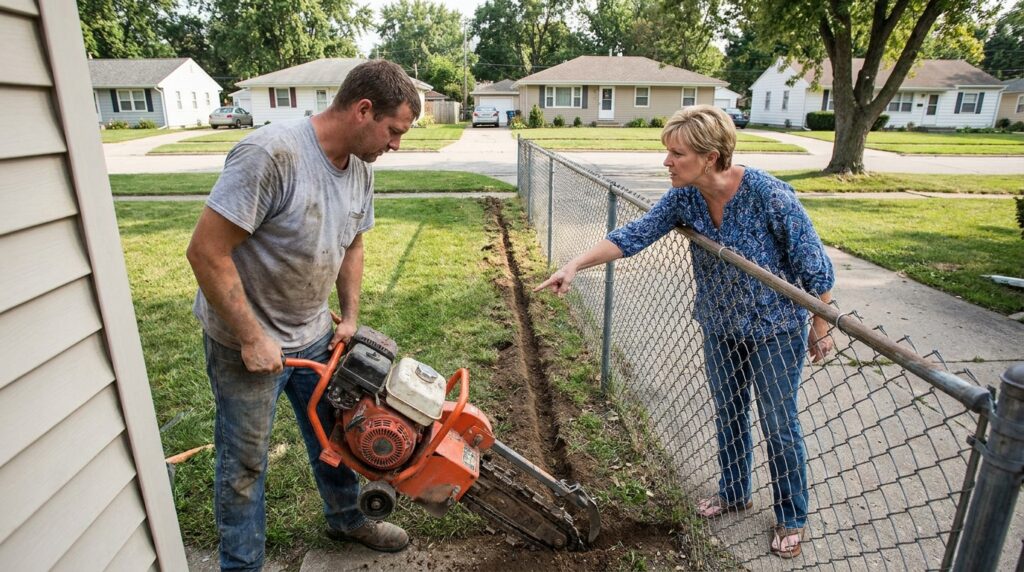
Mark stood up slowly, the gray clay popping on his jeans as he straightened his spine. His left wrist had gone entirely numb now, the cold rain washing the shale dust from his fingers in long, dark streaks that dripped onto the handles of the ditch witch. He looked at Brenda across the wire mesh. She wasn’t looking at him anymore; her eyes were fixed on the master plat sheet in Miller’s hand, her mouth a thin, rigid line behind the wet frames of her glasses.
“The lines don’t change just because you don’t like where they land, ma’am,” Mark said, his voice level and dry as he stepped back toward the controls of his machine.
Brenda’s fingers twitched against the clipboard, the metal corner scraping against her watch with a sharp, high-pitched click. She looked down the block toward the houses—the row of perfect beige boxes with their identical lawns—then shifted her gaze back to the exposed iron pin in the dirt between Mark’s boots. The decoy was dead in the clay, but as Miller reached for his official citation book, the rain began to fall faster, filling the narrow trench with three inches of dark, swirling water that began to lap against the foundation of her own garage.