
CHAPTER 6: THE BLUE LIGHTS
“Nobody dumps, nobody moves the equipment. Keep your hands off the rig until I see the staging log.”
The township code enforcement officer didn’t use a loudspeaker, but his voice carried the hard, flat weight of county ordinances. His white cruiser came to a skidding stop against the curb line, its amber and blue roof bars casting long, rhythmic slashes of neon across the wet vinyl siding of the houses. The passenger door swung open with a dry metallic click, and a middle-aged deputy in a dark state slicker stepped into the drizzle, his boots crunching heavily into the wet river gravel at the edge of the driveway.
Brenda moved instantly, her white tennis shoes splashing through the muddy overflow as she crossed the gap between her SUV’s rear bumper and the cruiser’s fender. Her clipboard was leveled like a shield, her fingers tracking a line of red ink on her form sheet.
“Officer, thank God you’re here,” Brenda said, her voice dropping into that rhythmic, urgent cadence she used for administrative review. “I called the desk forty minutes ago. This operator has been running a commercial ditcher inside a Class II drainage buffer since dawn. He’s already compromised the root systems of the protective boundary foliage, and now he’s attempting an unauthorized discharge of unclassified backfill onto a public thoroughfare.”
The code officer, a thick-set man named Miller with an official township badge pinned to his nylon vest, didn’t look at her paperwork. He walked past her toward the front bumper of the dump truck, his eyes scanning the narrow throat of the driveway where the six tons of limestone gravel remained suspended in the bed. His clipboard remained under his arm, his hands tucked securely into his vest pockets against the cold mist.
“Mark,” Miller said, nodding once toward the trenching machine sitting idle in the side yard. “You got a township cut permit for this run? The desk said they had a report of an active gas-line disturbance.”
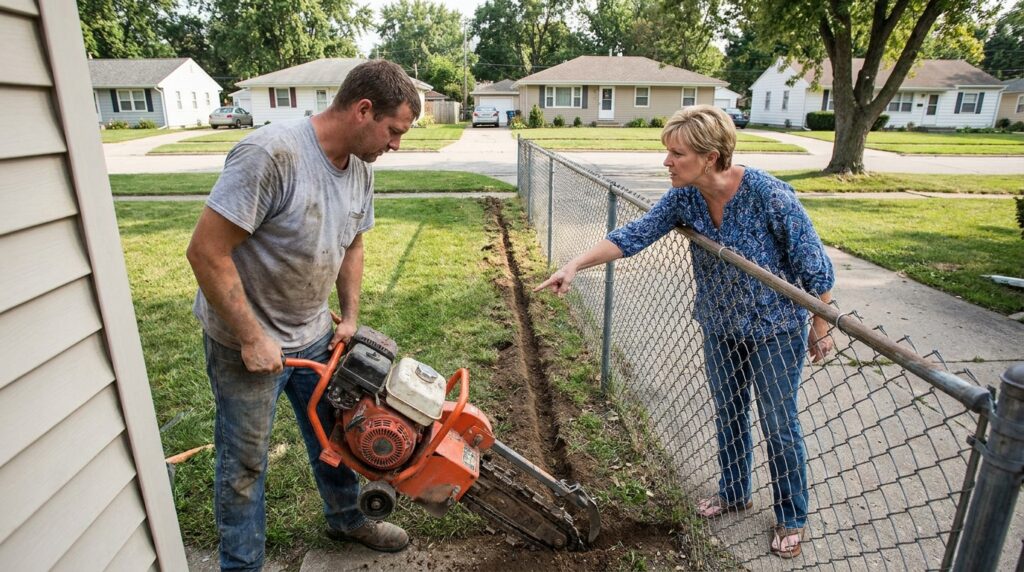
Mark didn’t step back from the curb. He stood his ground by the idling dump truck tire, his bare hands slick with gray clay dust, the rain dripping steadily from the stiff brim of his work hat. “Morning, Miller. No gas here. We’re working a standard residential subsurface French drain to clear a six-inch reverse grade ponding issue. The permit’s taped to the inside glass of the F-250 cabin. Stamped by county engineering last Tuesday.”
“It’s a fraudulent variance,” Brenda cut in, her voice tightening as she stepped between them, her sunglasses catching the flashing blue strobe from the cruiser. “The Oakridge Heights master covenant explicitly states that any infrastructure alteration within ten feet of the physical boundary fence line is subject to an architectural review board clearance. This contractor has zero association authorization. I have the signed stop-work injunction right here.”
Mark slowly turned his head, his gaze settling on the white post caps of the client’s fence. Leo was standing near the truck bed, completely frozen, his fingers clamped around the handle of a shovel as if he expected the deputy to reach for his belt. Mark reached into his back pocket, pulling out a small, steel wire brush he used for clearing threads, and walked five paces back up the slope toward the exposed brass transition valve at the bottom of the cut.
“Miller,” Mark called out, his voice perfectly level over the low diesel clank of the idling dump truck. “Bring your line flashlight down here for a second.”
The code officer hesitated, his boots shifting in the slick grass, before he walked across the property line, ignoring Brenda’s extended clipboard. He stood over the narrow trench, the beam of his heavy maglight cutting through the gray mist to illuminate the green-crusted brass transition valve between Mark’s boots.
Mark knelt down in the wet clay, the moisture soaking instantly through the knees of his jeans. He didn’t look up at Brenda, who had frozen on the sidewalk side of the wire fence, her fingers clamping tightly into the galvanized grid. He used the wire brush with three short, precise strokes across the neck of the valve casing, clearing away thirty years of lime buildup and oxidized copper scale until a clean, stamped series of characters emerged from the metal.
It wasn’t a standard irrigation code. It was a three-letter municipal designation: W.B.D., followed by a four-digit state utility marker.
“That’s a Water Basin District designation, Miller,” Mark said quietly, his finger tracing the stamped letters. “Look at the bedding gravel under the flange. It doesn’t run flat toward the street line. It drops twelve inches through an old four-inch overflow sleeve that leads straight into the main culvert throat underneath the sidewalk.”
Miller knelt down beside him, his nylon slicker rustling loudly as he adjusted the focus of the beam. He stared at the stamp, then shifted the light three inches to the left, where the edge of the limestone block inside the drain throat showed that clean, light-gray wall of cured masonry wash. His mouth thinned into a hard, professional line that Mark had seen on city inspectors a hundred times before.
“This isn’t an irrigation header,” Miller muttered, his voice dropping into that dry register reserved for structural code violations. He stood up slowly, the light from his maglight tracking the line of Brenda’s Leyland cypress trees where they ran parallel to the trench. “The county hasn’t run a basin line through here since the old farm tract was split in ninety-four.”
“It’s an abandoned easement, officer,” Brenda said quickly, her posture shifting as she took a half-step back toward the open door of her SUV, her phone finally lowering from its recording angle. “The association took over the main maintenance of this buffer zone when the third phase of the development was recorded. The contractor is trying to complicate a simple landscape code violation to avoid his fines.”
Mark stood up, wiping his muddy hands onto a dry rag from his belt. He looked past her shoulder toward the lower corner of the lot where the water was already rising over the top of her white tennis shoes. The decoy secret was crumbling right into the mud, but beneath the gray clay and the concrete wash inside the pipe, the actual grade lines of the plat were beginning to tell a completely different story.
“The association didn’t record the phase three buffer over a pre-existing county main, ma’am,” Mark said, his voice carrying the finality of an old survey stake. “Because the county doesn’t cede structural drainage to a private board. Miller, check the master plat folder in your trunk. Look at the ninety-four water main bypass route before you sign that red tag.”
The deputy by the cruiser shifted his weight, his eyes tracking the amber lights as they flashed against the dark sky, while Miller turned back toward his vehicle with a slow, deliberate stride that meant the paperwork was about to get very heavy for someone on the block.








