
CHAPTER 2: THE CLAIMS ON THE MARGIN
“Shut it down. Shut it down right now or I’m calling code enforcement to impound the rig.”
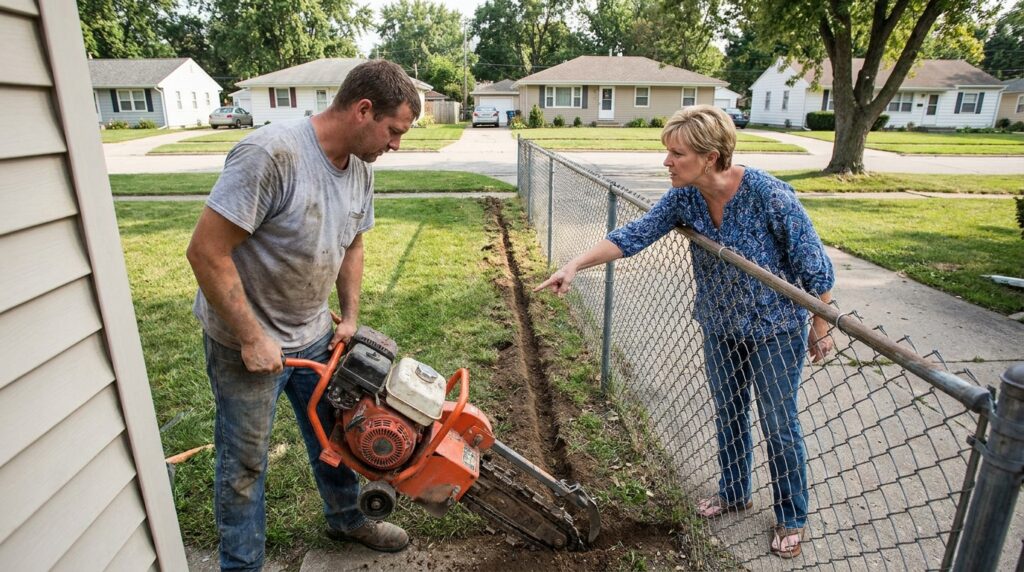
Brenda’s voice didn’t carry the erratic pitch of someone losing her temper; it had the cold, rhythmic precision of a state inspector checking a manifest. She stood exactly three inches back from the rusty chain-link mesh, her polished white tennis shoes perfectly clean against the cracked concrete of the sidewalk. Her oversized silver watch gleamed under the graying sky as she hoisted the heavy plastic clipboard against her ribs like armor.
Mark didn’t lift his hands from the rubber grips. The trenching machine gave a low, iron rattle as the teeth ground against another pocket of packed gray clay, sending a spray of fine, metallic dust over the toes of his work boots. He adjusted his stance, using his thigh to anchor the frame against the torque. Through the exhaust-warmed air, the smell of unburned diesel and pulverized shale was thick enough to taste.
“I’m talking to you, sir,” she said, her voice dropping an octave to cut beneath the high-frequency whine of the small engine. “This is a non-permitted disturbance of a Class II common easement. I have the master plat right here. You’re already looking at a twenty-five hundred dollar variance fine for the homeowner, and your operator’s license goes into the county registry by noon.”
Leo, the kid, had stopped completely now. He was leaning against the wheelbarrow forty feet back near the curb, his face pale under his dusty ball cap, staring at the clipboard in Brenda’s hands as if it were a warrant. That was the problem with the younger ones—they still believed the paperwork had teeth just because it was printed on heavy cardstock. They didn’t understand that on a property line, the only thing that held weight was the iron in the ground and the permit in the truck.
Mark slowly eased the throttle lever back, notch by notch, until the screaming engine dropped into a heavy, wet idle. The sudden drop in volume made the entire cul-de-sac feel artificially quiet, the silence punctuated only by the distant, rhythmic thrumming in his broken left wrist.
“Morning, ma’am,” Mark said. His voice was dry, raspy from the dirt. He didn’t clear his throat. He kept his boots planted in the trench, looking at her through the square gaps in the wire fence. From this low angle, her silhouette was framed against the neat, identical gables of the houses across the street—a row of perfect, vinyl-sided boxes that all shared the same five shades of beige.
“It’s not morning for your client anymore,” Brenda said, her finger tapping the top edge of her aluminum form sheet. “I warned him three weeks ago when he put the deposit down for this work. The HOA board has an exclusive landscape restriction on this entire northern boundary strip. You’re cutting straight through a protected root zone for the legacy hedges.”
Mark looked down at the trench between his boots. The chain had just exposed the top curve of that old brass plumbing transition he’d spotted a minute ago. It wasn’t standard residential stuff. The nut was oxidized to a deep, dark green, the crusty corrosion showing the distinct, squared ridges of a commercial high-pressure valve that had been abandoned long before these houses were framed in the nineties. It was dry, but the soil around it was packed with coarse river gravel—the kind utility companies used to bed in large-diameter mains.
“The hedges are six feet back on your side of the wire, ma’am,” Mark said, his tone perfectly flat, empty of any defensive edge. He reached into his back pocket, his calloused fingers tracing the stiff, folded corner of the city-stamped drainage permit. He didn’t pull it out yet. In a boundary fight, you didn’t show your hole card while the other side was still trying to bluff with a clipboard. “We’re running eight inches inside the client’s deeded line. The chain hasn’t touched a root over two inches.”
“The deeded line doesn’t matter when an overlapping covenant is active, Mr… Mark, is it?” She didn’t wait for him to confirm. She adjusted her sunglasses, her gaze scanning the length of the machine’s steel boom, tracking the fresh pile of clay like an auditor counting a deficit. “The covenant states that any modification to the grade within ten feet of the fence requires a two-thirds majority signature from the architectural review committee. You don’t have it. I checked the portal before the sun came up.”
She stepped closer, her floral blouse brushing against the wire fence with a faint, synthetic rustle. Her eyes were hidden behind the dark, polarized lenses, but Mark could see the tight, white line of her jaw. She was calculating the cost of the equipment sitting in the yard—the trailer, the truck, the fuel cells. She knew the margins for an independent contractor were thin enough that a three-day delay could break the quarterly insurance premium.
“Leo,” Mark called out without turning his head. “Get the laser level out of the cab. Check the drop on the secondary culvert by the road entry.”
The kid didn’t move for a second, his eyes still darting between Mark and Brenda’s clipboard.
“Now, Leo,” Mark repeated, his voice dropping into that low, heavy register he used when a cable was about to snap under load.
The apprentice jumped, dropping the wheelbarrow handles with a sharp clang that echoed down the blacktop, and scrambled toward the tool boxes on the side of the F-250.
Brenda watched the kid run, her mouth curling into the briefest hint of a professional smile. She turned her attention back down to Mark, her posture squaring as she took a half-step to the right, blocking his direct line of sight to the lower street drain. “You’re wasting his time, and you’re wasting your fuel. I’ve already sent the digital notice to the township inspector’s office. If that chain rotates one more time before the official car pulls up, I’m filing a formal visual nuisance report with the sheriff’s dispatcher.”
Mark looked at the brass valve between his feet again. The gravel bedding underneath it didn’t run toward the street; it angled back, deep under the fence line, straight toward the foundation of Brenda’s garage. He knelt down slowly, the dry clay popping beneath his knees, and ran his gloved hand over the crusty metal. There was a faint, cold draft coming through the gravel pack—the distinct smell of stagnant water and old lime mortar.
“The township won’t red-tag a safety excavation, ma’am,” Mark said quietly, his hand staying on the valve. “Not with three inches of rain coming down from the ridge by dawn.”
“It’s an unpermitted ditch, Mark. The city doesn’t override a private covenant for a puddle.” Brenda tilted her clipboard up, her pen poised above the line. “Now, do you turn it off, or do I call the county code desk while I’m standing right here in front of your truck?”
Mark stood up, wiping the gray dust from his gloves onto his jeans. He looked past her shoulder, down toward the corner of the lot where the concrete curb met the drainage intake. Something about the way the grass was dying along that specific curb line didn’t fit the slope of the hill. It was dry, yellowed, and completely dead—not from a lack of water, but from something else entirely.








