CHAPTER 5: THE COLD HARD FORCES
The air brakes on the dump truck didn’t just hiss; they popped with a sharp, pneumatic crack that sent the birds out of the Leyland cypress line. Down at the mouth of the driveway, the backfill delivery driver—a massive, bearded guy in a stained high-visibility vest—slammed his gears into reverse, his dual wheels biting hard into the asphalt curb. The six tons of washed limestone gravel in the bed shifted with a low, metallic roar like a minor landslide, the weight causing the truck’s leaf springs to groan against the chassis.
Then came the second sound: the high-velocity whine of a precision-tuned engine, followed by the dry, synthetic scrape of an iron bumper grinding over concrete.
Brenda’s luxury German SUV had cut across the cul-de-sac at forty miles an hour, its front wheels mounting the low curb strip directly in front of the dump truck’s massive steel bumper. She didn’t park; she jammed the vehicle into park right across the narrow throat of the driveway entrance, her low, wide chassis pinning the supply rig against the telephone pole on the margin. The vehicle sat there idling with a low, high-end purr, completely blocking the only access route to the side yard.
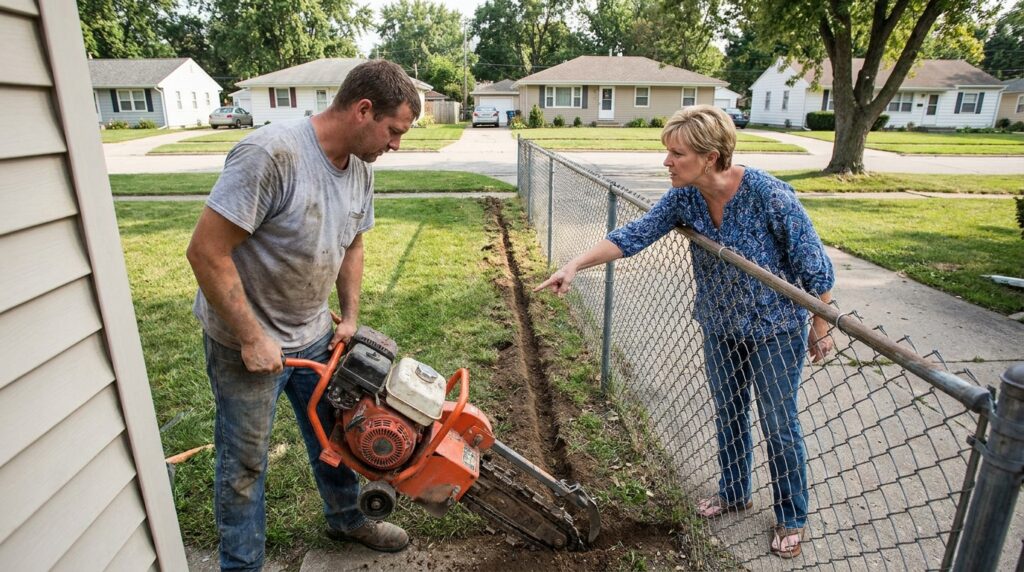
Mark slowly stood up from the handles of the trenching machine, his boots slick with the gray clay. The rain was coming down in a steady, cold drizzle now, the mist collecting on the hot exhaust shield of the ditch witch and popping off in tiny, gray bubbles. The cold water ran down his neck, soaking through the collar of his t-shirt, but his left wrist had stopped throbbing. It had gone cold, numb—the precise warning sign that he had pushed his structural frame past its daily tolerance.
“Hey! You can’t dump that here!” Brenda’s car door flew open, the interior chime giving off a polite, digital pulse that sounded absurdly out of place against the low rumble of the diesel engine. She stepped straight into the rain, her white tennis shoes instantly slurring into the muddy overflow along the sidewalk edge. She didn’t have her clipboard this time; she had her phone held out like a meter, the screen glowing through the wet air. “This road is rated for under five tons. You’re cracking the structural concrete of the sub-divisional apron. I’ve already flagged the license plate with the municipal office!”
The dump truck driver didn’t get out of his cab. He rolled down the heavy glass window, his elbow—thick as an oak log and covered in faded grease-gun tattoos—settling over the wet iron door sill. He looked down at the luxury SUV wedged six inches beneath his tire line, then shifted his gaze up the yard toward Mark.
“Mark!” the driver yelled over the diesel clatter. “You want me to drop this in the street? Because this lady’s fixing to get her roof peeled off if I clear my tailgate.”
“Keep it in the bed, Gary,” Mark called back. His voice was completely empty of irritation, carrying only the hard, factual calculation of a man who knew exactly how many minutes of labor remained before the storm overtopped the culvert. He didn’t look at Brenda. He walked down the grade toward the driveway, his boots leaving deep, ribbed impressions in the clay.
Leo was already backing away toward the rear of the F-250, his face entirely blank with the realization that the job had stalled out six yards short of the tie-in point. “Mark, the township code car just turned onto the main boulevard. I saw the amber light through the trees. They’re going to lock us out before we can lay the pipe.”
Mark reached the bottom of the yard, his eyes scanning the narrow gravel apron where Brenda’s SUV sat idling. Right under her rear tire line, where the concrete curb met the drainage intake grate, the water was already three inches deep. It wasn’t moving. It was bubbling up, thick with that same white, chalky slurry he’d noticed earlier under the cypress branches.
He didn’t speak to Brenda. He knelt down on the wet blacktop right next to her front wheel well, his bare hand dropping into the cold water to trace the iron rim of the street drain. The metal was clean, but six inches down into the throat of the pipe, the natural dark curve of the stone block was gone. It had been replaced by a smooth, light-gray wall—the distinctive, hard-packed surface of a concrete patch mix that had been poured directly down the throat of the intake and left to cure under the silt.
The decoy was clear. Brenda wasn’t trying to enforce an HOA landscape rule; she was trying to hide the fact that during her own garage renovation two months ago, her contractors had dumped three bags of residual masonry wash straight down the storm easement to avoid a commercial disposal fee. The plug had turned the client’s side yard into a structural retention pond, and the first full bucket from Mark’s trenching machine was about to expose the blockage to the city inspector.
“You’re looking at the wrong line, Mark,” Brenda said, her voice dropping into that tight, performative hiss as she stepped closer, her phone still recording his hands in the water. She was standing so close he could smell the expensive leather cleaner from her car seats through the wet diesel smoke. “The county code is very clear about unpermitted excavation on common infrastructure. When that officer gets out of his car, he’s not looking at my curb. He’s looking at your lack of an engineering registry stamp.”
Mark didn’t pull his hand out of the drain. He looked up at her from his knee, his face gray with clay dust, his eyes completely steady beneath the dripping brim of his hat. He could see the small, rhythmic twitch in the corner of her left eye behind her glasses—the same muscle failure that hit a foreman when they knew the structural load test was coming back red.
“The county doesn’t stamp a private drainage line, ma’am,” Mark said quietly, his voice cutting clean beneath her phone’s microphone range. He stood up slowly, the wet gravel grinding under his boots as he faced her down across the low hood of her car. “But they do check the outflow on a municipal culvert. And right now, your rear axle is sitting on six cubic yards of unrecorded flow diversion.”
Down the block, the low, mechanical whine of an approaching township vehicle drifted through the wet air, its amber roof lights casting long, rhythmic strobes of yellow across the perfect, identical facades of the boxes across the street.