
CHAPTER 6: THE WATCH STOOD
The silhouette in the rotted frame of the sliding door didn’t bring a rifle up. It moved with a slow, deliberate limp that Arthur had tracked through the county for twenty winters—the heavy, uneven drag of an off-duty deputy whose right hip had been pinned together with surgical steel after a high-speed chase on the state line.
Jesse Miller didn’t turn on his flashlight. He let his wide brim drain a steady line of river water onto the walnut shell floorboards as he stepped past the flatbed trailer. The dull, green electrical tape on Vance’s counterfeit folder caught the yellow wash from the distant scale-shack, but the deputy’s eyes remained on the canvas bag Arthur had dragged from the turbine pit.
“The county road’s rising, Arthur,” Jesse said, his voice flat, carrying the dry, dead-pan rasp of an old man who spent his life writing down the weights of gravel trucks. “The logs from the ridge are already turning back at the fork. If you’re going to burn that bag, you’d better do it before the river covers the bypass gate.”
Raymond Vance Jr. didn’t lift the revolver. His thick hand remained frozen against the grain of his work trousers, his knuckles caked with white lime slurry that had dried into a stiff, chalky crust. He looked from the deputy’s tarnished badge to the old logbook resting on the creosoted timber between Arthur’s boots.
“You knew,” the boy muttered. His jaw worked against the cold, his teeth giving a single, hard click. “You’ve been checking the scale logs since my uncle passed. You knew what Gage did.”
“Gage didn’t leave his name in the county courthouse, Raymond,” Jesse said, stepping close enough that the smell of his wet wool uniform mixed with the sulfurous stink of the old kiln. He didn’t look at the gun. He reached down with two fingers, flipping open the brittle, oil-soaked cover of the maritime ledger. The first page was white paper that had turned the color of dry tobacco, the official ink cracked along the margins like dried river silt. “He left it on the bank boards in Seattle. Your dad knew it when he signed the voucher in San Diego. He took the three hundred dollars because your mother was already coughing up blood in the trailer behind the foundry.”
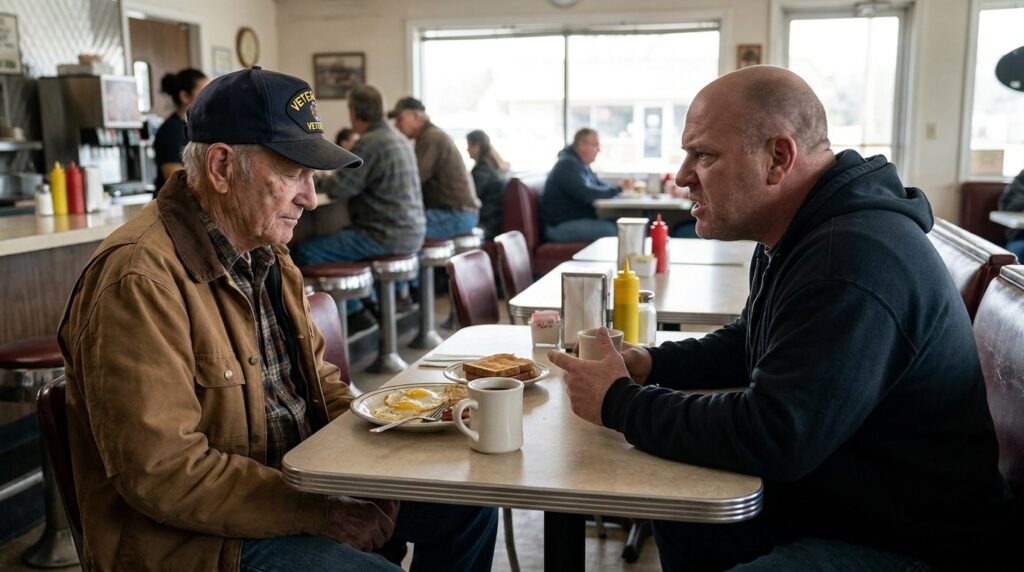
Arthur didn’t shift his heels from the iron ring of the hatch. His hand remained hooked into the greased butcher paper, his thumb feeling the small, cold edge of the brass-plated corners that reinforced the ledger’s binding. The deep, paradigm-shifting truth didn’t change the weight of his brown jacket or the crisp gold embroidery on his navy cap. It was just a number on a different page—a system where the currency wasn’t gravel or diesel, but the unrecorded lives of forty-two men who had been left to clear the lower decks while the officers counted the drums on the pier.
The silence that followed was different from the clamp-down in the diner. It was wide, wet, and empty, filled only by the mechanical groan of the river water hitting the iron bypass gates three hundred yards down the slough. Time dilated within the cold iron rafters of the shed; Arthur observed the micro-texture of the moment—the tiny flakes of rust dropping from the corrugated roof panels as each heavy raindrop hit the metal, the steady, rhythmic wheeze of Raymond Vance’s lungs, and the gray, ancient weariness etched into the lines of Jesse’s face. The entire history of the county—the broken roads, the silent veterans, the generational anger that had accumulated like silt in the river bottom—was laid bare under the jaundiced light leaking through the tin walls.
“The watch is over, boy,” Arthur said softly. He didn’t look down at the pages anymore. He looked directly into the young contractor’s eyes, his gaze steady, devoid of the quick, defensive anger of the uninitiated. “Your father didn’t run. And he didn’t fail the line. He held the pressure valve open until the bilge pumps could clear the lower trunk. If he hadn’t stayed by the ladder, the San Bernardino would have been sitting on the bottom of the channel before the tugs could clear the harbor mouth.”
Vance’s fingers opened. The heavy service revolver didn’t hit the timbers with a crash; it slipped out of his pocket and dropped into the deep, wet sawdust by his boot, its barrel disappearing instantly into the soft, rotten mulch of ground walnut shells. The stocky man dropped his head into his palms, his heavy shoulders shaking once under the wet dark fabric of his hoodie as the unearned rage of twenty years collapsed into the quiet reality of an unwritten truth.
Jesse reached down, his leather glove registering a sharp, cracking sound as he closed the ledger and slid it back into the oil-blackened canvas bag. He didn’t look at Arthur as he hoisted the weight against his pinned hip.
“The township doesn’t need the logs, Arthur,” the deputy said, his boots hunting for traction on the grease-slicked hemlock planks as he turned toward the sliding door. “They’ve got enough trouble with the silt on the grade. I’ll keep this in the lockbox down at the cellars. If anyone from the state office comes down to ask about the Vance voucher, I’ll tell them the water got into the kiln back in ninety-three.”
Arthur stood alone on the creosote floor as the deputy’s uneven stride faded into the steady drum of the rain outside. He reached out, his hand catching the stocky man’s shoulder—not with the tension of a restraint, but with the heavy, unyielding leverage of a man who had stood the watch on the lower decks when the bulkheads were turning red.
“Come on, Raymond,” Arthur said, his gravelly voice dropping into the quiet rhythm of the closing shift. “The grader’s past the bridge by now. Let’s go finish those eggs before the kitchen turns off the grill.”
The boy didn’t answer, but he didn’t pull away. He followed the older man out through the broken iron paneling of the shed, his boots leaves a single set of deep, heavy tracks in the white limestone mud that the rain was already washing away into the dark slough below.








