
CHAPTER 2: THE SCALE OF FRICTION
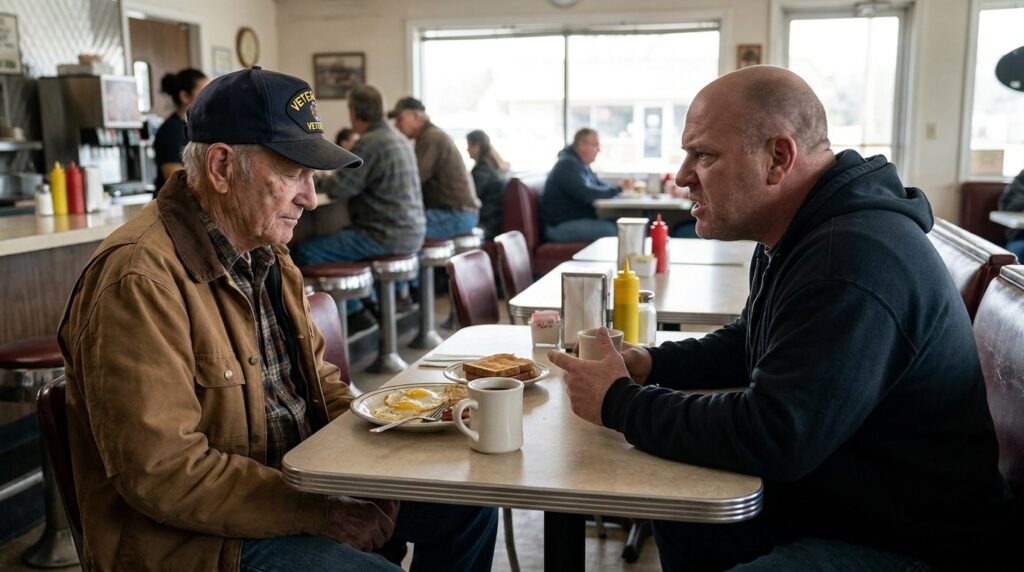
The silence in the diner didn’t just settle; it clamped down like an ungreased vise.
Arthur’s boots found the rusted iron ring near the base of the stool, his heels digging into the familiar notched metal until his spine cleared the edge of the booth. He didn’t rise with the sudden, theatrical jerk of a younger man looking for a fight. He rose with the slow, heavy leverage of an old crane, his joints clicking behind the low hum of the refrigeration unit that had just kicked back to life.
The stocky man didn’t move his feet, but his shoulders gave up three inches of their width. His palms remained flat against the pitted Formica, the yellowed skin over his knuckles turning a bloodless gray. Up close, the dark hoodie was stiff with dried mortar dust and the faint, bitter stink of transmission fluid. This wasn’t a soldier; it was a man who worked the gravel pits near the river, his muscles built from short, repetitive lifts that left the lower back vulnerable to a quick rotation.
“You’ve got grease on your collar,” Arthur said, his voice flat as a timber line. He didn’t look at the bully’s eyes anymore. He looked at the hollow just below the man’s ear where the pulse was jumping against the dirty fabric of the hood. “And your left knee is leaning inside the booth frame. If I touch the table, you’re going over the benchmark.”
The bully’s fingers bunched, but they didn’t lift. A small, blue-inked tattoo—clumsily executed, three fading letters over a blurred silhouette—was visible on the side of his thick neck, mostly hidden by the salt-and-pepper scruff of his beard. J.V.R. The letters were old, the ink bleeding into the grain of his skin like oil into dry pine.
“You’re Miller,” the stocky man muttered. The tone had changed. The mocking edge had rusted through, replaced by something old and wet, like a basement floor after a freeze. “Arthur Miller. They said you came back here to rot. They said you kept the logbooks.”
Arthur’s thumb pressed harder into the brass rivet of his cap. The cold metal bit into the calloused pad of his skin. The name didn’t belong in this diner. In this county, he was just the old man who lived behind the grain elevator and took his meals at the counter when the morning log trucks cleared out. The logbooks were three thousand miles away, rotting in a gray canvas bag inside a cedar chest that smelled of damp wool and dead silverfish.
“The eggs are five dollars,” Arthur said, pointing a single, steady finger toward the plate between them. “And the coffee has been sitting since six. If you’re staying, buy a cup. If you’re working the haul road, the grader’s already three miles past the bridge.”
The fry cook, Toby, moved his hand beneath the counter. The dry scrape of a heavy plastic telephone receiver against its cradle sounded loud in the corner booth. The off-duty deputy in the corner didn’t lift his eyes from his local paper, but his thumb had unlooped the leather retention strap over his sidearm, the small snap clearing with a distinct, metallic click that everyone in the room ignored with perfect discipline.
The stocky man looked down at the table. A grease-smeared work order from the county sand-and-gravel yard was sticking out of his front pocket, the corner torn where a signature should have been. His mouth opened, his jaw shifting as if trying to clear the taste of lime dust from his teeth.
“My old man didn’t get a cap,” the bully said. The words were small, transactional, dropped onto the congealing grease of the plate like dropped washers. “He didn’t get the flag either. Just an insurance voucher from a warehouse in San Diego that didn’t cover the cost of the limestone.”
Arthur didn’t shift his gaze. His mind didn’t drift to the gray water or the smell of burning diesel in the berthing compartments of 1972, but the skin around his jaw tightened until the old scar beneath his chin—the one he’d caught on a broken hatch lever during the standard sea watch—turned a sharp, chalky white. He recognized the shape of the nose now. It was the same flat, crooked bridge he’d seen through a red emergency lens while the air pumps were failing.
“The yard closes at noon on Thursdays,” Arthur said, his hand moving to his pocket to draw out three crumpled single bills. He laid them beside the cold hash browns, his movements rhythmic, unhurried, matching the slow rotation of the ceiling fan above the counter. “The rain’s going to turn the silt into grease by the river. If you’re driving that triple-axle, you’ll want your chains on before you hit the grade.”
The stocky man took a slow step backward. His boots made a dry, scraping sound against the salt-pitted linoleum. He didn’t reach for the money, and he didn’t look back at the booths where four sets of eyes were tracking the oil stains on his hoodie. His right hand remained inside his pocket, his fingers locked around something heavy and square—a small leather wallet or an old service medal with the ribbon rotted off—that didn’t belong in a gravel yard.
“He said you were the one who signed the detail,” the man said from the threshold of the booth. His voice was low, almost lost behind the rattle of a diesel truck shifting gears on the grade outside. “He said you were standing right by the ladder when the hatch dropped.”
Arthur reached down, took his water glass, and drained the last half-inch of tepid, iron-tasting water. He let the heavy glass bottom drop back onto the laminate with a clean, dull thud that signaled the end of the shift.
“The ladder was clear,” Arthur said.
The bully didn’t answer. He turned, the screen door rattling against its wood frame as he stepped out into the yellow fog of the gravel lot. The rain was starting now, heavy drops hitting the tin roof of the diner with the sound of scattered gravel. On the table, right where the man’s left palm had been resting, a small, triangular piece of red plastic—a broken reflector from an old navy-issue flashlight—remained embedded in the gray grease of the laminate.
Arthur reached out, his thick fingers picking up the plastic fragment, his skin registering the sharp, broken edge before he slid it into his pocket beside his keys.








