
CHAPTER 3: THE BROKEN LINE
The screen door didn’t settle until Arthur was already three feet into the gray downpour. The cold rain hit the stiff, faded canvas of his brown jacket with the sound of dry beans dropping into an empty bucket. Beneath his boots, the gravel yard had already begun to dissolve, the white limestone slurry mixed with the iridescent sheen of old crankcase leaks to form an unyielding, milk-colored grease that coated the sides of his soles.
He didn’t check the road. He knew the sound of the triple-axle Kenworth shifting its air brakes down by the culvert without needing to watch the tail lamps. The engine was missing on the third cylinder, a heavy, wet mechanical wheeze that echoed off the corrugated metal walls of the grain elevator across the county line.
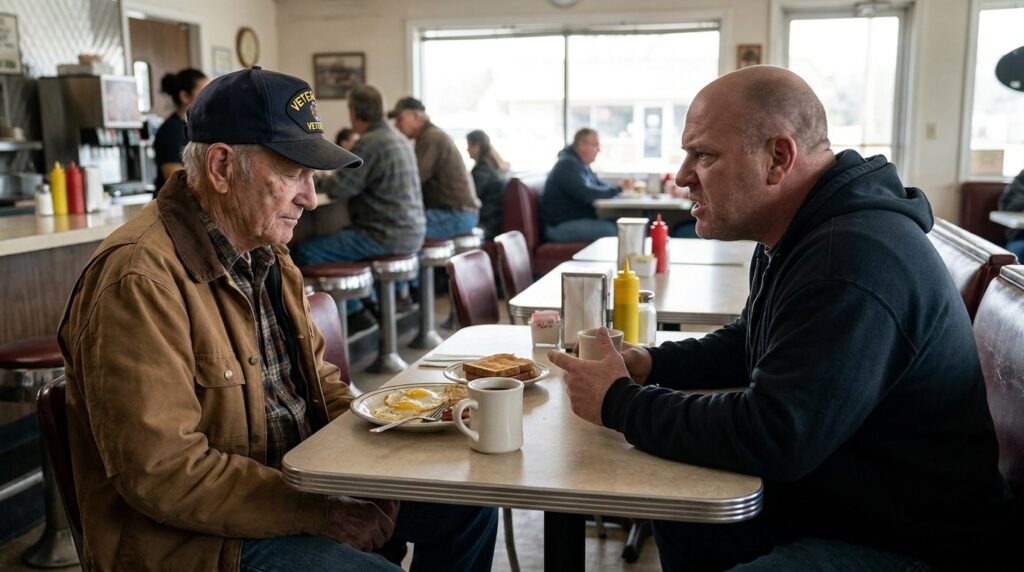
Arthur reached his truck—a twenty-year-old Ford with a rusted-through tool box bolted behind the cab—and slid his hand into his pocket. His calloused fingers bypassed his brass keys, brushing against the sharp, jagged corners of the red plastic reflector fragment he had cleared from the diner table. Beside it lay a strip of damp paper the bully had dropped when his hand cleared his hoodie pocket. It was a pink carbon duplicate of a county weight receipt, stained with hydraulic oil at the margin.
Arthur didn’t open it until he was behind the wheel, the cold vinyl seat groaning under his frame as the windshield began to opaque with the damp fog of his breath. The air inside the cab smelled of dry horsehair and stale tobacco. He held the pink slip up to the weak, gray light leaking through the water-streaked glass.
The signature at the bottom wasn’t the stocky man’s name. It belonged to the hauling contractor: Vance Hauling & Logistics. But beneath the corporate stamp, written in the frantic, ballpoint scrawl of a yard clerk who hadn’t cleared the ink margin, was a driver’s name and an old military payroll identification prefix.
Driver: Raymond Vance (Jr.) — Ref: V-1972-DIS.
Arthur’s thumb drifted automatically to the brass rivet on his cap, pressing until his nail went white. The prefix wasn’t county code. It was the specific administrative shorthand used by the Bureau of Naval Personnel during the final pull-out from the western Pacific. The DIS didn’t stand for discharge. It stood for Disciplinary Segregation—the legal quarantine used for men whose final service records were stripped of their honors before the hull paint could dry in San Diego.
He smoothed the wet paper against the cracked dashboard, his palm registering the deep indentation of the pen. The boy outside hadn’t just been angry about a free jacket or a voucher at the clinic. He had been carrying the specific, inherited rot of a man who believed his family name had been stolen by the person holding the logbooks.
Outside, the rain intensified, drumming against the truck’s cab with the rhythm of distant anti-aircraft fire on a night watch. Arthur pumped the throttle once, the starter motor turning over with a dry, metallic screech before the straight-six caught, its rusted leaf springs vibrating against the frame as the exhaust pipe rattled against the bumper.
He didn’t turn back toward his cottage behind the elevator. Instead, he dropped the transmission into low gear, the gear teeth grinding through a layer of old, burnt fluid before locking into place. The truck slithered through the white lime mud of the diner lot, its tires hunting for traction along the edge of the ditch where the gravel ended and the river silt began.
Through the rear-view mirror, he saw the off-duty deputy step out onto the porch of the diner, his Stetson tilted forward against the rain. The deputy wasn’t looking at the highway; he was looking down at the white slurry where the Kenworth’s triple tires had dug deep into the county roadbed, leaving two parallel trenches that filled instantly with muddy water.
Arthur knew where the sand-and-gravel yard kept its old records. It wasn’t in the new metal office by the scales. It was in the pre-war lime kiln at the base of the bluff, where the Vance family had kept their equipment since the day they stopped hauling stone with mules. If the boy had his father’s old Navy-issue flashlight in his pocket, he had the rest of the locker down in the valley where the river didn’t clear till August.
The truck’s wipers left two greasy arcs across the glass, the rubber split at the center, leaving a thin line of water that split Arthur’s vision in two as he turned the vehicle down toward the bottomland. His left hand remained on the wheel, but his right hand reached down, his fingers tracking the cold, metallic shape of an old grease gun beneath the seat—not for defense, but for the weight of something solid and heavy when the air turned sour.
He knew what the logbooks said about Raymond Vance. He had written the entry himself under a red light while the bulkhead was still hot to the touch. But the boy didn’t know about the second log—the one that never made it to the canvas bag because the executive officer had burned the carbon sheets in the galley oven before the tugs met them at the mouth of the bay.
Arthur slowed the truck as the road changed from asphalt to crushed shale. The smell of wet river willow and sulfur from the old lime pits came through the floorboards, thick and flat. He killed the headlights fifty yards before the gate, letting the vehicle’s momentum carry it through the weeds until the bumper brushed the rusted chain-link fence of the yard.
The Kenworth was parked near the hopper, its diesel block ticking as it cooled in the wet dark. A single yellow light was burning inside the lower office windows, casting a long, jaundiced reflection across the standing water of the scale pit.








