
CHAPTER 4: THE FILE DRAWER
The door to the lime kiln office didn’t have a latch left; it was held shut by a length of rusted rebar wedged against the rotted cedar frame. Arthur applied his shoulder to the rough timber, his boots churning through a thick carpet of wet, dead willow leaves and sulfurous mud until the wood groaned and gave way three inches. The smell hit him instantly—not the clean, sharp damp of the river, but the dead, alkaline stench of wet lime, old carbon sheets, and forty years of mice nesting in wet fiberglass.
He didn’t use a flashlight. The jaundiced square of light from the gravel scale-shack fifty yards away cut across the floorboards, illuminating the long, parallel streaks of grease left by Raymond Vance’s work boots. The boy had been here within the hour. A green metal filing cabinet, salvaged from some post-war county surplus sale, sat in the corner beneath a sagging rafter, its bottom two drawers pulled out so far the tracks had dropped their ball bearings into the silt.
Arthur knelt. The movement was a slow calculation against the stiffness in his left meniscus, his trousers soaking through with the gray lime-water that pooled between the floorboards. His rough fingers tracked the tabs of the hanging folders. They weren’t sorted by customer name or gravel tonnage; they were sorted by year, the old manila paper soft as felt from the valley humidity.
The drawer labeled 1972 was gone entirely. In its place, wedged back into the rusted frame where the drawer glides met the casing, was a military-issue ammunition box. The stenciled yellow lettering on the side had been scrubbed with steel wool, but Arthur’s thumb didn’t need the paint. His skin found the deep, pitted indentation where a hull designation had been stamped into the steel with a cold chisel: LST-1185.
The San Bernardino. The ship that had spent three weeks sitting four miles off the coast of Da Nang while the shore batteries cleared out, her ballast tanks full of fuel she wasn’t supposed to be carrying and forty-two men in the hold who weren’t on the division roster.
“You’re late, Miller,” a voice said from the shadow behind the door.
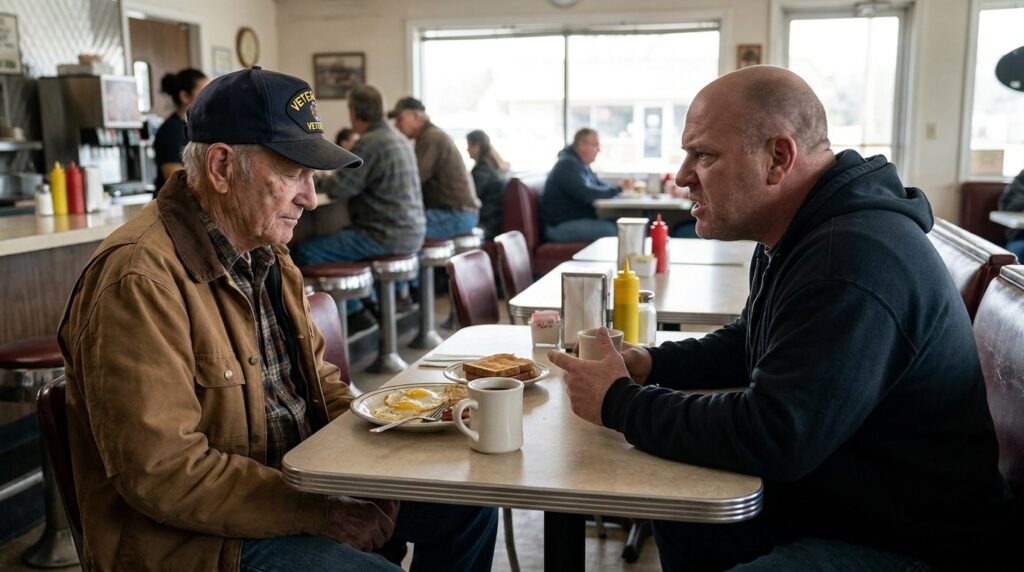
The rebar shifted. Raymond Vance Jr. stepped into the jaundiced light, his stocky frame silhouetted against the wet screen of the window. He wasn’t holding a wrench. His right hand was tucked deep into the pouch of his damp hoodie, the heavy, square weight Arthur had noticed at the diner now pulling the fabric tight against his ribs. The skin around the boy’s jaw was slick with rain, his teeth showing white behind his short beard.
Arthur didn’t pull his hand out of the filing cabinet. He kept his fingers anchored on the cold handle of the ammunition box, his mind measuring the distance between his knees and the threshold. “Your father didn’t keep his tools in here, Raymond. He kept them in the truck.”
“He didn’t have a truck when he came back,” Vance said, his voice dropping into the flat, toneless registry of an engine running out of prime. “He had a gray canvas gym bag and two broken fingers on his left hand. He spent three years sitting on the porch waiting for the mail to bring the voucher from San Diego. The one with your signature on the bottom line.”
“The signature was for the gear allowance,” Arthur said, his voice dropping below the rattle of the rain on the tin roof. “The division didn’t have the authority to clear the payroll after the third line-item was scratched.”
“You scratched it,” the boy said, taking a step forward. The floorboards bowed beneath his boots, a clear line of yellow water bubbling up between the seams. “I found the carbon sheets in his locker behind the compressor. The log says he was on the detail at the fuel pier. It says he was the one who uncoupled the line before the explosion.”
Arthur let his hand drop from the box. He rose, his joints popping with the distinct, dry sound of an ungreased hinge. The space between them was less than four feet now—close enough that he could see the orange clay caked into the seams of Vance’s hoodie. The boy’s left hand came out of his pocket, holding a faded, plastic-wrapped folder that had been sealed with green electrical tape.
“Look at the name on the line, old man,” Vance muttered, thrusting the folder forward into the light. “That’s his handwriting. That’s the operational report from the night the pump room went down. He didn’t abandon the watch. He was locked out from the deck above.”
Arthur didn’t reach for the folder. He looked past it, his eyes fixing on the corner of the ammunition box still wedged in the bottom of the cabinet. The green tape on the folder wasn’t Navy issue; it was the heavy, industrial vinyl they used at the county substation back in the seventies. The handwriting wasn’t Raymond Vance’s either. It belonged to Lieutenant Commander Gage—the man who had spent the entire deployment inside the air-conditioned sea-cabin, drinking gin out of a paper cup while the lower decks were clearing out the bilge by hand.
The decoy was perfect. Gage had left just enough paper behind in the local offices to ensure that if any of the boys from the county started asking why their lungs were clear but their pockets were empty, they’d find a name like Vance or Miller on the logs instead of his own.
“The paper’s dry, Raymond,” Arthur said softly, his eyes returning to the boy’s face. “But the ink’s from a clerk’s desk in the courthouse, not the ship’s office. Your father didn’t write that report because he couldn’t hold a pen by the time we hit the pier in Subic.”
Vance’s shoulder twitched, his right hand tightening inside the hoodie pouch until the steel silhouette beneath the fabric became unmistakable—the short, heavy barrel of an old service revolver, its cylinder unlatched or the spring rusted through from forty years in a machine shed.
“You’re lying,” the boy said, but the intensity in his voice had dropped an octave, the certainty or the rage beginning to leak out of him like air from a punctured tire. “The logbook’s at your house. Everyone in the township knows you kept the iron trunk.”
“The trunk is empty,” Arthur said, taking a half-step forward until his boot touched the edge of the pink weight receipt Vance had dropped earlier. “The books you’re looking for aren’t behind the elevator. They’re down in the machine shed by the old loading dock, where your uncle left the crane logs when the company went under.”
A sudden, sharp beam of white light cut through the wet window from the road above. The high, unhurried wail of a county siren rose over the sound of the river grade—not an emergency run, but the standard tracking sweep the evening patrol took when the gravel scales were left open past the shift.
Vance froze, his head jerking toward the light as his fingers slipped against the weight in his pocket. The distraction was only three seconds long, but it was the gap Arthur had been calculating since his boots first cleared the rebar at the door.








