
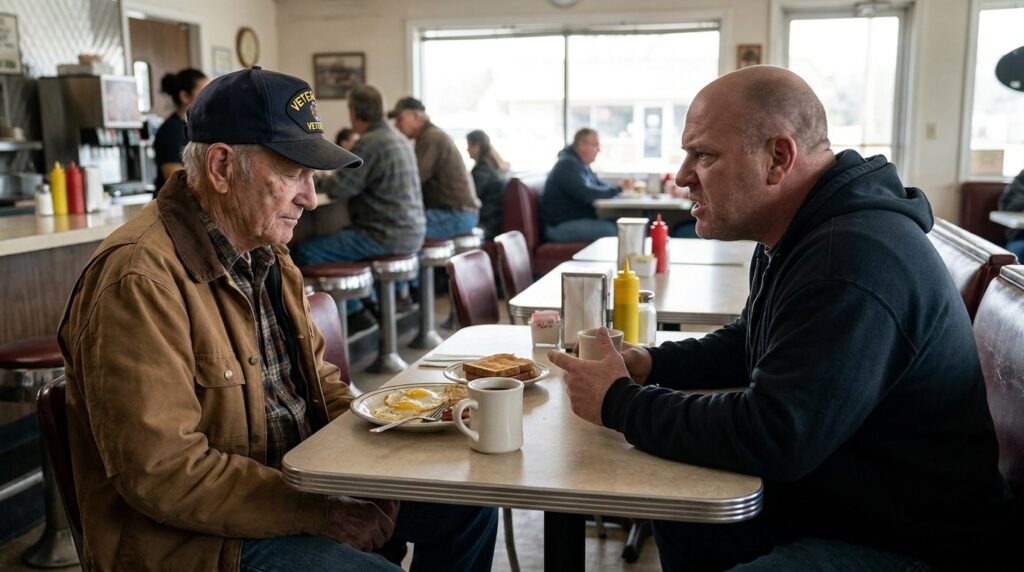
CHAPTER 1: THE COLD GREASE
“You think that cap means something, old man?”
The voice didn’t belong to the room. It was too thick, smelling of sour damp cotton and the sharp, industrial tang of diesel exhaust from the highway outside.
Arthur didn’t look up from his hash browns. The yellow of the egg had already cooled into a thin, waxy film against the rim of the thick ceramic plate. He kept his left thumb firmly anchored on the loose brass rivet at the back adjustment strap of his cap, his skin identifying the rough, pitted edge of the metal by memory alone. The diner was small, three miles off the interstate, where the air smelled permanently of old lard and the floor tiles had been scuffed down to the gray backing by sixty years of work boots.
The stocky man in the dark hoodie leaned down farther. His palms flattened against the edge of the laminate table, forcing the Formica to groan under his weight. Arthur observed the fingernails—split, caked with dry orange clay, the knuckles scarred from a loose wrench or an uncalculated swing.
“I’m talking to you, blue-cap,” the man muttered. His breath was warm, smelling of cheap tobacco and stale mints. “My taxes pay for your monthly voucher down at the clinic. My back’s broken from hauling rebar while you sit here in a free jacket looking like a museum piece. You think you’re better than the rest of this town because you took a boat ride fifty years ago?”
Across the narrow aisle, Mrs. Gable’s fork stayed suspended two inches above her rye toast. The low hum of the double-door refrigerator behind the counter clicked off, leaving a sudden, ringing void in the air. The fry cook, a boy named Toby whose grandfather had died in a dry dock, stopped his scraping tool against the flat-top grill. The metal-on-metal screech died instantly.
Arthur didn’t blink. He watched a drop of condensation slide down the side of his water glass, cutting a clean path through the film of dust and grease on the outside. His hands remained flat, fingers spaced precisely two inches from his silverware. His pulse was a steady, rhythmic thud in his ears—forty-eight beats a minute, exactly where it had been when the alarms used to sound on the lower decks. Panic was an expensive luxury. It required oxygen he didn’t care to waste on a man who wore his anger like a rented suit.
“You’ve got a tear in your sleeve,” Arthur said. His voice was gravelly, dry from the morning air, lacking the high pitch of an old man’s defense.
The stocky man’s jaw twitched. His left hand drifted slightly backward toward the heavy pocket of his hoodie, his shoulder dipping an inch. “What did you say?”
“Your sleeve,” Arthur repeated, his eyes finally shifting from the congealing egg to the man’s face. He noted the slight yellowing in the whites of the bully’s eyes—a liver that didn’t like liquor, or a life spent sleeping in trucks. “You’re catching it on the booth screws. It’s going to split open if you keep leaning.”
The bully’s chest expanded, his face darkening to the color of wet brick as his fingers bunched into fists against the Formica. He didn’t look at the small, square tattoo peeking out from the cuff of Arthur’s brown jacket—a faded blue anchor that had lost its flukes to forty years of sun. Instead, his eyes fixed on the silver eagle pin pinned just above the cap’s visor, its wings bent slightly from an old drop on a concrete pier.
Arthur moved his weight forward, his heels coming into contact with the grease-slicked rungs of the stool beneath him.








