Chapter 9: A Different Kind of Legacy
One year after the collision, the cemetery looked peaceful again.
The damaged lawn had recovered.
The broken golf cart was long gone.
Margaret Wilson’s headstone stood straight and secure on its restored foundation.
The inscription was clean and clearly visible beneath the afternoon sunlight.
Karen visited every Sunday.
Sometimes she brought white roses.
Sometimes she carried a small watering can to care for the nearby flowers.
And sometimes she simply sat on the stone bench beneath the oak tree, listening to the wind move through the branches.
She had learned that grief did not always arrive when someone died.
Sometimes it came years later, when a person finally understood what they had lost.
Karen had mourned her mother at the funeral.
But she had not truly considered the depth of Margaret’s life until the day she nearly destroyed her grave.
That realization remained painful.
Yet it had also given her a reason to change.
Her relationship with the neighborhood was still complicated.
Some residents remained distant.
A few never forgave her.
Karen accepted that.
She had no right to demand reconciliation.
But others gradually began greeting her again.
Evelyn Parker occasionally invited her for coffee.
Thomas trusted her with routine cemetery maintenance.
Linda Foster sometimes asked her to help organize volunteer projects.
Karen had also begun writing letters to homeowners she had treated unfairly.
She did not send a mass apology.
Instead, she addressed individual situations.
She acknowledged specific mistakes.
She offered no excuses.
Some people replied warmly.
Others did not respond.
She respected both choices.
That autumn, the cemetery trustees announced the creation of a volunteer program honoring Margaret Wilson’s years of service.
The program would organize seasonal cleanups, help maintain neglected graves, and connect elderly visitors with volunteers who could assist them safely.
Karen contributed money toward gardening supplies and accessibility improvements.
But she declined the suggestion that the program should also bear her name.
Margaret had earned that recognition.
Karen wanted it to remain hers.
At the dedication ceremony, about forty people gathered near the chapel.
Thomas spoke about Margaret’s kindness.
Evelyn shared memories of the meals Margaret had delivered during difficult times.
Several longtime residents recalled her cheerful determination to preserve the cemetery.
Karen stood near the back, listening.
She learned stories she had never heard before.
Her mother had quietly paid for a struggling family’s funeral expenses.
She had helped restore the grave of a World War II veteran whose surviving relatives lived across the country.
She had spent countless afternoons sitting with lonely widows who needed someone to listen.
Karen had once believed her mother lived a small life.
Now she understood how wrong she had been.
When the ceremony ended, Thomas approached her.
He handed her a small envelope.
Inside was a photograph of Margaret taken shortly before her final illness.
She stood beside the restored cemetery bench, smiling beneath the oak tree.
On the back, in Margaret’s handwriting, were four words.
Take care of people.
Karen held the photograph against her chest.
For a long moment, she could not speak.
Then she walked toward her mother’s grave.
The afternoon sun cast long shadows across the grass.
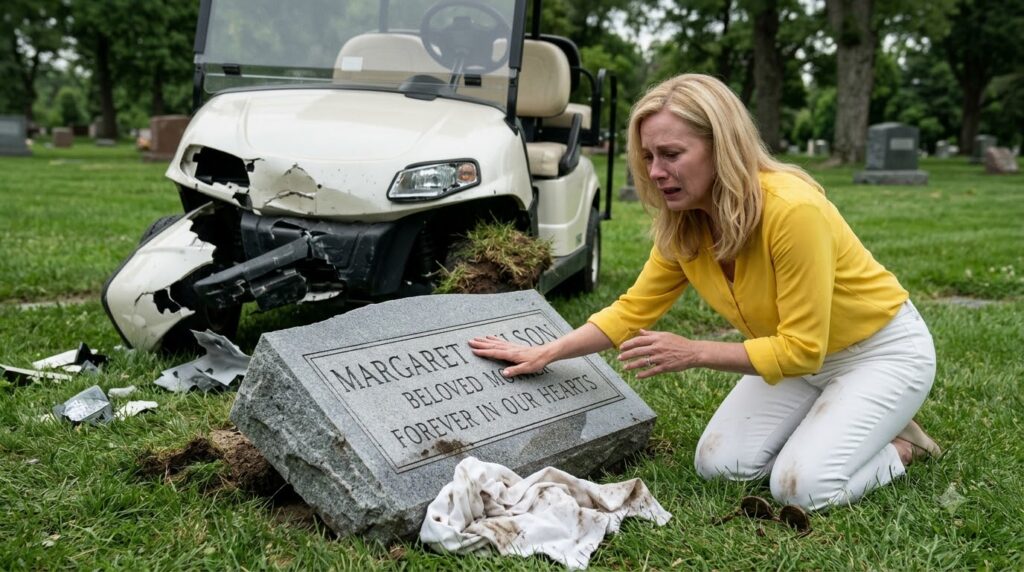
Karen knelt beside the headstone, just as she had done on the terrible morning of the collision.
But this time, there was no broken plastic.
No damaged monument.
No angry demand.
Only flowers, quiet birdsong, and the gentle movement of leaves overhead.
She placed the photograph beside the roses.
“I’m trying, Mom,” she whispered.
And she meant it.
As Karen rose to leave, Evelyn called from the pathway.
A group of volunteers needed help carrying folding chairs back to the chapel.
Karen turned toward them.
For a brief moment, she looked back at her mother’s grave.
Then she walked toward the waiting volunteers.
She picked up two chairs and carried them across the lawn.
Nobody applauded.
Nobody called her president.
Nobody asked for a speech.
And for the first time in many years, Karen felt no need to be important.
She was simply useful.
The cemetery remained a place of peace, protected from the development that had once threatened it. The HOA had recovered much of its disputed money, adopted stronger safeguards, and begun rebuilding trust among its residents. Margaret’s grave had been restored, and the families buried around her could continue resting undisturbed.
Karen could not undo the crash.
She could not recover the years she had wasted fighting neighbors or dismissing her mother’s wisdom.
But she could decide what kind of person she would be for the years she had left.
Once, she had believed that leaving a legacy meant putting her name on something grand.
A gate.
A fountain.
A beautiful entrance that everyone would notice.
Her mother had left something different.
A cemetery cared for.
Neighbors comforted.
Families remembered.
And a daughter who, after making the worst mistake of her life, finally understood the difference between having authority and deserving respect.
As the sun lowered behind the oak trees, Karen carried the last chair into the chapel.
She returned to lock the storage shed, checked that the pathways were clear, and quietly closed the cemetery gate.
Behind her, Margaret Wilson’s headstone stood beneath the trees.
The stone bore no record of Karen’s terrible mistake.
Only a name, a life, and three simple words:
BELOVED MOTHER.
Karen no longer needed the world to know she was in charge.
She had finally learned something far more important.