Chapter 6: When the Neighborhood Fought Back
The independent financial review began the following Monday.
Within days, the HOA board suspended further payments connected to the cemetery development project.
Richard Hale objected.
He claimed the investigation was unnecessary, expensive, and damaging to the association’s reputation.
But Linda Foster had gathered enough documentation to persuade the remaining board members that a full accounting was essential.
Residents began demanding access to meeting minutes and financial summaries.
Several homeowners who had previously remained silent now spoke openly about their experiences with Karen’s administration.
A retired firefighter described receiving repeated violation notices while recovering from surgery.
A widowed homeowner explained how landscaping fines had accumulated while she was caring for her dying husband.
A young family reported being threatened with legal action over a wheelchair ramp installed for their disabled father.
Karen had not personally issued every notice.
But she had approved the enforcement policies that made such treatment possible.
The stories were painful to hear.
She had believed strict rules created a beautiful neighborhood.
Instead, she had helped create a place where some residents feared opening their mail.
At the next board meeting, Karen stood before a crowded room.
Her bright yellow blouse had been replaced by a simple navy sweater.
She carried no stack of violation notices.
She had no prepared argument defending her authority.
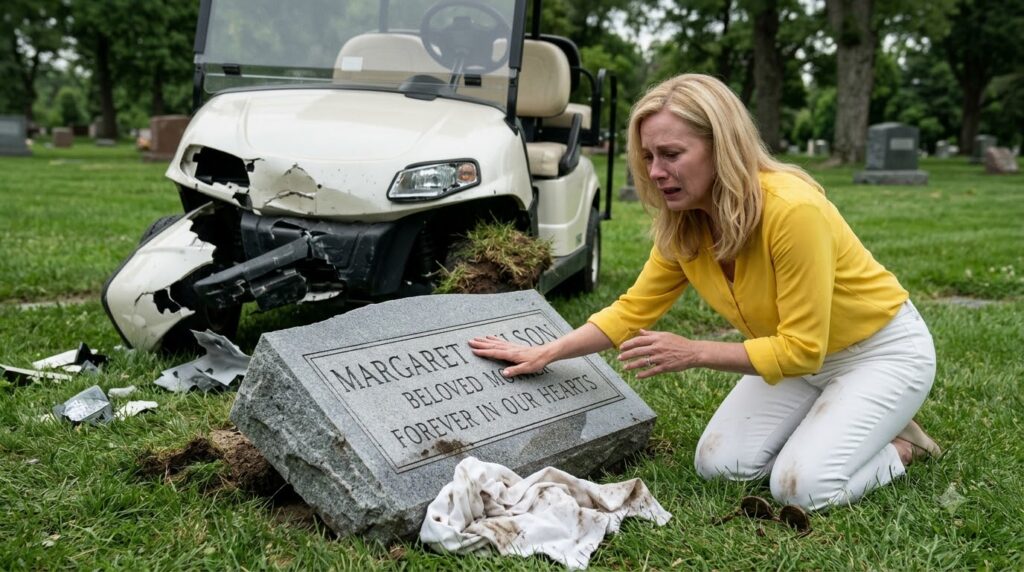
Instead, she read a brief statement accepting responsibility for the cemetery damage and acknowledging failures in her leadership.
She announced that she would take a leave of absence from her duties while the investigation continued.
She also supported an immediate review of enforcement practices and the suspension of disputed cemetery-related assessments until the board could determine how the funds had been used.
Some residents appreciated the statement.
Others remained skeptical.
They had heard Karen make promises before.
One man asked whether she expected forgiveness simply because she had damaged her own mother’s grave.
Karen answered quietly.
“No. I expect to be held responsible.”
The room remained silent.
It was not applause.
It was not reconciliation.
But it was the first time many residents had heard Karen accept criticism without retaliation.
Meanwhile, the financial investigation uncovered troubling details.
Heritage Development Consulting had received payments for services that appeared incomplete or inadequately documented.
Emails showed Richard had urged the company to begin preliminary design work even after receiving written notice that the cemetery preservation restrictions made the proposed route unacceptable.
The independent reviewer referred the findings to the HOA’s attorney and recommended a forensic accounting.
Richard denied wrongdoing.
He argued that preliminary work was legitimate and that the board had approved the overall project.
His nephew maintained that the consulting company had performed valuable services.
The dispute would require further examination.
But the revelations changed the neighborhood’s understanding of the project.
What Karen had promoted as a community improvement had also created an opportunity for poorly supervised spending.
The board voted to terminate the cemetery development proposal.
It also scheduled a special membership meeting to address leadership changes and financial accountability.
Karen did not oppose the decision.
Instead, she began reviewing the association’s enforcement records with Linda.
They identified fines that appeared inconsistent with the HOA’s written policies.
Some notices had been issued without proper warning.
Others involved accommodations that should have received more careful consideration.
Karen recommended that the board establish an independent appeals process and review potentially improper penalties for refunds.
She knew the changes would cost money.
She also knew that fairness was not always inexpensive.
One afternoon, Evelyn Parker visited Karen’s home.
Karen was surprised to see her.
Evelyn had brought a photograph.
It showed Margaret Wilson standing beside Evelyn’s late husband during a cemetery cleanup event.
Both were laughing.
Evelyn explained that Margaret had helped her family during her husband’s final illness.
She had delivered meals, driven Evelyn to appointments, and sat with her when the house became too quiet.
Karen studied the photograph.
She had never known.
Evelyn touched the edge of the frame.
“Your mother never made people feel small for needing help.”
Karen looked down.
For years, she had believed that authority earned respect.
Now she was beginning to understand that respect could not be demanded.
It had to be given first.