Chapter 8: The Work Nobody Applauded
Karen began her community service at the cemetery on a cold Monday morning.
She arrived at seven-thirty wearing old jeans, work boots, and a plain green jacket.
Thomas Bennett was waiting beside the maintenance shed.
He handed her a pair of gardening gloves and a rake.
There was no ceremony.
No photographer.
No special treatment.
Her first assignment was clearing fallen branches and leaves from the pathways.
The work was harder than she expected.
By noon, her back ached and her hands were sore.
She had spent years hiring people to maintain her property.
Now she was discovering the effort required to care for a place properly.
Thomas worked nearby, occasionally explaining how to protect older headstones from damage.
He taught her not to lean tools against monuments.
He showed her how to identify fragile stone surfaces.
He explained why certain cleaning chemicals could permanently damage historic inscriptions.
Karen listened.
At first, Thomas remained cautious.
He had watched her treat cemetery workers dismissively for months.
He did not confuse one apology with lasting change.
But Karen returned the next morning.
And the next.
She swept pathways, removed weeds, cleaned benches, and helped prepare flower beds for winter.
When her assigned community service hours were complete, she asked whether she could continue volunteering.
Thomas considered the request.
Then he handed her another pair of gloves.
Over the following months, Karen learned the stories behind many of the graves.
She met an elderly man who visited his wife’s resting place every Wednesday, bringing two cups of coffee because they had shared breakfast together for fifty-three years.
She met a retired nurse who maintained the graves of former colleagues.
She watched grandchildren carefully place handmade cards beside their grandparents’ headstones.
These were ordinary acts of remembrance.
They required no committee approval.
No enforcement notice.
No threat of fines.
Karen began to understand why the cemetery mattered so deeply to the community.
One afternoon, Evelyn Parker arrived carrying a folding chair and a small bouquet of yellow roses.
Karen offered to help her along the uneven pathway.
Evelyn accepted.
They walked slowly toward her husband’s grave.
For several minutes, neither spoke.
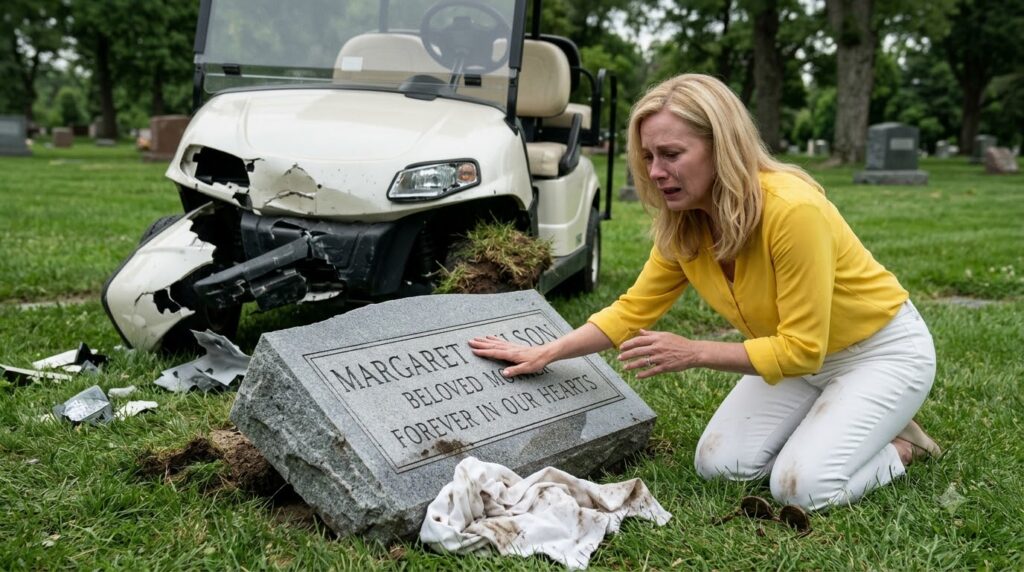
Then Evelyn asked about the restoration of Margaret’s headstone.
Karen explained that the monument specialist had completed the foundation repairs and was preparing to reinstall the stone.
She had paid the full restoration cost.
Evelyn nodded.
“Your mother would have appreciated you making it right.”
Karen looked toward the rows of graves.
“I hope so.”
Evelyn paused.
“She would have appreciated what you’re doing here even more.”
Karen felt tears gathering.
She had expected punishment to be the hardest part of accountability.
Instead, she discovered that the harder task was continuing to do the right thing when nobody was watching.
Back in Willow Creek, the HOA had begun changing.
Linda Foster helped establish a transparent budgeting process.
Residents received clearer financial reports.
A new appeals committee reviewed disputed violations.
Several improperly assessed fines were refunded or canceled.
The board adopted rules requiring disclosure of financial relationships involving contractors.
Most importantly, the association began treating homeowners as neighbors rather than potential violators.
The changes were not perfect.
Disagreements continued.
Some residents still argued about landscaping, fences, and parking.
But the atmosphere slowly improved.
People attended meetings without expecting humiliation.
Older homeowners felt more comfortable asking for assistance.
Families began volunteering for community projects.
Karen watched these changes from a distance.
She no longer sat at the head of the boardroom table.
She no longer controlled the agenda.
Surprisingly, she did not miss it as much as she had expected.
One Saturday, Thomas asked her to help prepare a small memorial gathering for families whose loved ones had been buried in the cemetery’s oldest section.
Karen arranged chairs, cleaned the pathways, and placed flowers near the chapel.
When the families arrived, she remained quietly in the background.
A woman thanked her for helping.
Karen smiled.
It was a simple moment.
But it meant more than any title she had ever held.