Chapter 3: A Mother’s Last Warning
Karen read the letter twice before she could speak.
Her mother’s words were gentle, but they carried the weight of disappointment.
Margaret had written about the meaning of home, the importance of remembering those who came before, and the responsibility that came with owning property in a community.
She described the cemetery as a place where families remained connected across generations.
Then she addressed Karen directly.
You have always been determined, sweetheart. Even as a little girl, you wanted everything done properly. I admired that strength. But somewhere along the way, you began confusing being right with being in charge.
Karen lowered the paper.
She remembered arguing with her mother about neighborhood regulations.
Margaret had disliked the HOA’s increasingly aggressive enforcement policies. She believed rules should protect residents, not frighten them.
Karen had accused her of being old-fashioned.
Margaret had replied that courtesy never went out of style.
At the time, Karen had rolled her eyes.
Now those words felt painfully different.
The letter continued.
One day, you may have the power to make decisions affecting people who cannot easily defend themselves. When that day comes, please remember that dignity matters more than appearances.
Karen swallowed.
Her mother had written those words before Karen became HOA president.
Before the fines.
Before the threats.
Before the cemetery proposal.
It felt as though Margaret had seen the woman her daughter might become.
But the letter contained another revelation.
Margaret explained that she and several neighbors had helped establish a preservation fund for the cemetery’s oldest section.
The fund was intended to protect neglected graves, maintain the historic grounds, and ensure that no future development displaced the people buried there.
Thomas showed Karen copies of the original agreements.
The cemetery was privately operated by a nonprofit trust, but its land was subject to recorded restrictions and county oversight.
The western burial section, including Margaret’s grave, was protected by a conservation agreement.
Any construction proposal affecting that area required approvals Karen had never obtained.
Karen stared at the documents.
For months, she had told HOA residents that the cemetery trustees were being unreasonable.
She had claimed that the land was underused and that the project would improve property values.
She had even circulated a map showing the proposed walking trail passing directly through the protected burial section.
Now she understood that the plan had never been as simple as she had presented it.
Her mother had helped protect the very land Karen wanted to transform.
Thomas watched her carefully.
“Margaret was proud of Willow Creek,” he said. “She just believed a community should make room for its history.”
Karen folded the letter.
For the first time, she wondered whether her mother had been trying to tell her something during their final conversation.
That conversation had taken place in a hospital room eight years earlier.
Margaret was weak from heart disease, but her mind remained sharp.
She had asked Karen to promise that she would look after the cemetery.
Karen had been distracted by a business call.
She remembered giving a hurried answer.
“Of course, Mom.”
She had barely looked up from her phone.
Three days later, Margaret was gone.
Karen pressed the letter against her chest.
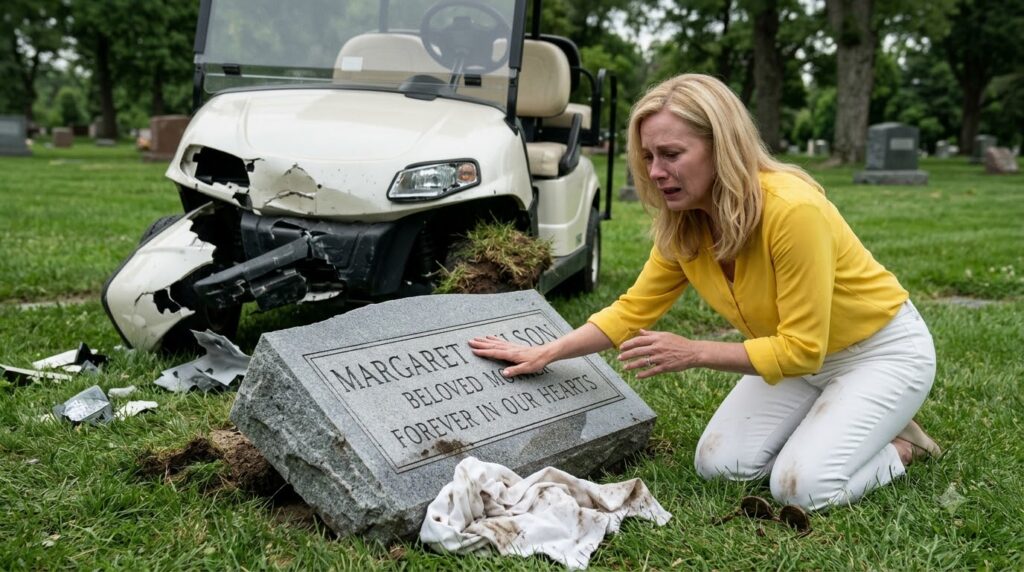
The memory hurt more than the bruises from the collision.
But Thomas had not finished.
He opened another folder.
This one contained correspondence from the Willow Creek HOA.
Karen recognized the association’s letterhead.
Several documents were dated only six months earlier.
One was a formal warning from the cemetery trustees, addressed to the HOA board, explaining that the proposed development conflicted with the recorded preservation agreement.
Karen had never seen it.
Another was a legal opinion commissioned by the association.
It reached the same conclusion.
Karen frowned.
“Where did you get these?”
“The trustees received copies during the planning discussions.”
Karen scanned the pages.
At the bottom of the legal opinion was a handwritten note.
Hold until after community vote.
The initials beside it belonged to the HOA’s vice president, Richard Hale.
Karen felt a new kind of anger.
Richard had repeatedly encouraged her to pursue the cemetery project.
He had assured her that the legal obstacles were minor.
He had insisted the development would secure her legacy as HOA president.
Now she wondered why.
Thomas said nothing as Karen examined the documents.
The answer was not yet clear.
But one thing had become obvious.
Karen had damaged her mother’s grave while pursuing a project that someone else had been quietly pushing forward.
And the person encouraging her might have had reasons of his own.