Chapter 5: The Secret Beneath the Development Plan
Linda Foster arrived at Karen’s house carrying three folders and a laptop.
At sixty-four, Linda was a retired accountant who had served as HOA treasurer for nearly a decade.
She was meticulous, practical, and rarely emotional.
That morning, however, her expression was grim.
Karen invited her into the dining room.
The house was immaculate.
White furniture, polished floors, expensive artwork, and carefully arranged flowers created the impression of a life under complete control.
Linda placed the folders on the table.
“I think we have a serious problem.”
She opened a spreadsheet showing the cemetery development budget.
The HOA had collected $186,000 in special assessments from homeowners during the previous year.
Residents had been told the money would fund engineering studies, landscaping designs, permit applications, and preliminary construction work.
But Linda had discovered that nearly $72,000 had gone to a company called Heritage Development Consulting.
The payments were supported by vague invoices describing feasibility reviews and land-use coordination.
Linda could find no completed reports corresponding to several of the charges.
Karen recognized the company name.
Richard had mentioned it repeatedly.
He claimed Heritage Development Consulting specialized in complicated property acquisitions.
Linda had investigated the company’s public business filings.
Its registered manager was Richard’s nephew, Daniel Hale.
Karen stared at the paperwork.
Richard had never disclosed the relationship to the board.
Worse, the HOA had paid for work connected to a development proposal that the cemetery trustees had already rejected.
Karen remembered signing several payment authorizations.
Richard had presented them as routine expenses.
She had approved them without reading the supporting documents carefully.
Her signature appeared on the forms.
That realization frightened her more than Richard’s possible misconduct.
She had spent years demanding strict compliance from homeowners while neglecting her own responsibility to oversee association spending.
Linda explained that the board needed an independent review.
If the payments were improper, the association might need to seek repayment.
Karen agreed.
But she also understood that she could not simply blame Richard.
She had been president.
She had approved expenditures.
And she had encouraged a culture in which questioning leadership was treated as disloyalty.
That afternoon, Karen met privately with her attorney, Rebecca Shaw.
Rebecca was a fifty-eight-year-old lawyer known for her straightforward advice.
She reviewed the documents and explained the situation carefully.
The cemetery collision and the HOA financial concerns were separate matters.
Karen’s remorse would not erase responsibility for damaging the headstone.
Nor would Richard’s possible misconduct excuse her failure to exercise proper oversight.
Karen listened.
For once, she did not search for a way around the consequences.
Rebecca recommended that she preserve all relevant records, cooperate with investigators, and step aside from decisions involving the cemetery project while the board arranged an independent review.
Karen agreed.
Then she asked a question that surprised even her.
“What would it take to repair the grave properly?”
Rebecca explained that the cemetery trustees would need to approve the restoration and select a qualified monument specialist.
Because the stone had shifted, the foundation also required inspection.
The work could be expensive.
Karen said she would pay.
Not from HOA funds.
From her own savings.
Rebecca nodded, but warned that restitution was only one part of accountability.
Karen understood.
That evening, she returned to the cemetery.
Thomas was watering flowers near the chapel.
He looked surprised to see her walking through the gate.
Karen carried a small bouquet of white roses.
She approached her mother’s grave slowly.
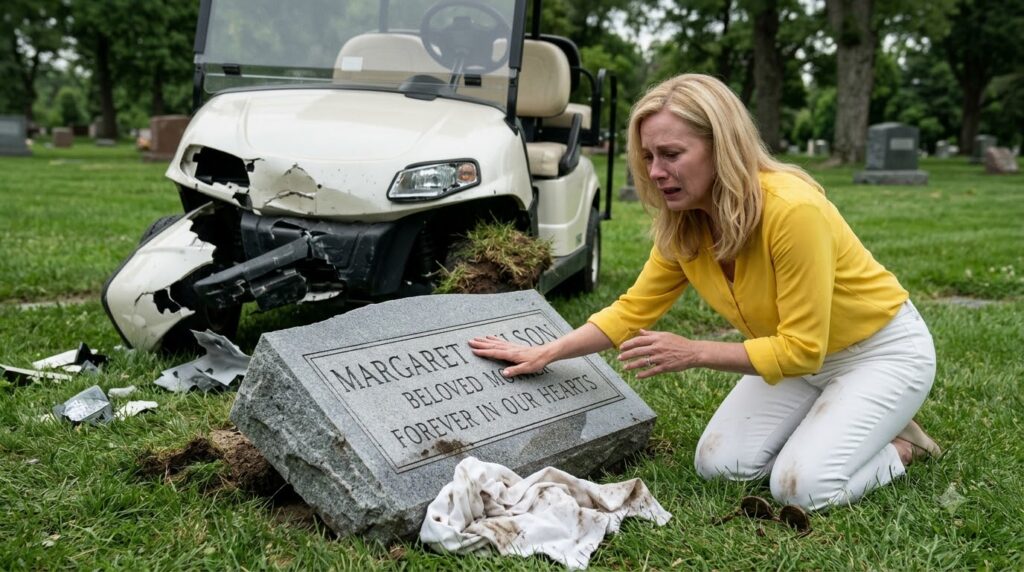
The damaged headstone remained supported by temporary braces.
Yellow safety tape marked the surrounding area.
Karen placed the roses outside the barrier.
For several minutes, she stood without speaking.
Then she noticed a small bronze plaque attached to a nearby stone bench.
It bore an inscription honoring cemetery volunteers.
Among the names was Margaret Wilson.
Karen sat down.
She remembered her mother bringing homemade meals to sick neighbors, visiting elderly friends, and quietly helping families who had fallen on difficult times.
Karen had always considered those acts admirable but impractical.
She had believed success meant influence, authority, and financial security.
Her mother had measured it differently.
As evening settled over the cemetery, Karen began to understand that the most important things Margaret had built were not visible from the road.
They existed in the memories of people who had been treated with kindness.
And Karen had spent years overlooking them.