Chapter 2: The Woman Behind the Stone
The sheriff’s deputy arrived twenty minutes later.
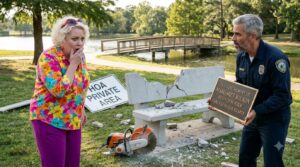
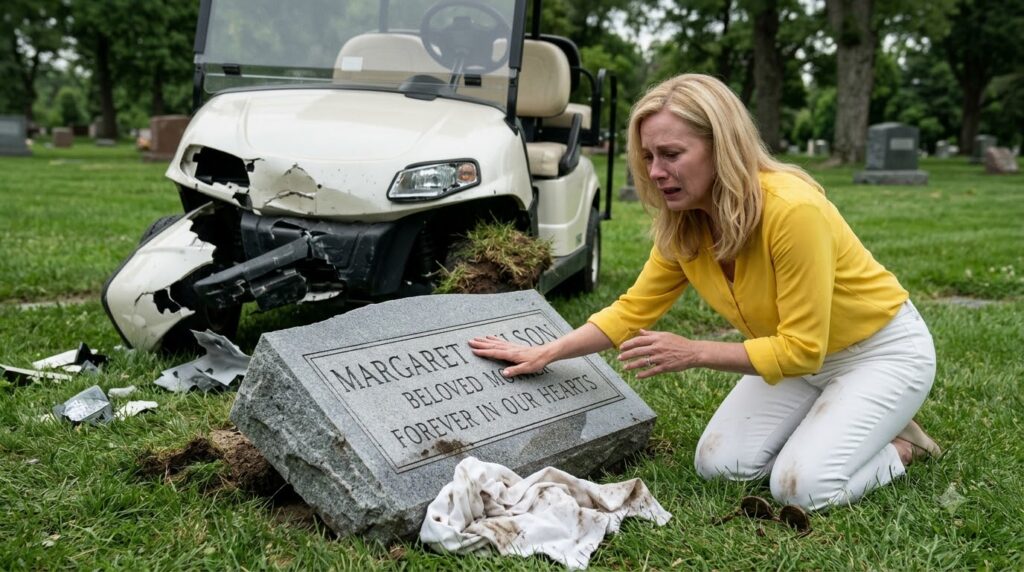
By then, Karen’s damaged golf cart had been pushed away from the leaning monument, and Thomas had placed temporary barriers around the grave.
Deputy Sarah Collins, a forty-three-year-old officer with a calm manner and little patience for evasive explanations, surveyed the scene.
The broken bumper lay in several pieces.
Fresh tire tracks crossed the cemetery lawn.
The granite headstone had shifted nearly six inches from its original position.
Karen stood beside the cart, clutching her handbag.
She had stopped crying, but her face remained pale.
Deputy Collins asked what had happened.
Karen initially described the collision as an accident. She claimed the accelerator had stuck and insisted that the golf cart had suddenly become uncontrollable.
Thomas listened without interrupting.
Then he told the deputy what he had witnessed.
He explained that Karen had accelerated directly toward the monument despite his warning.
Karen protested.
But the evidence did not support her explanation.
The golf cart’s electronic controller recorded recent operating data, including accelerator input. The deputy arranged for the vehicle to be inspected rather than accepting either account immediately.
She photographed the damage, collected witness information, and informed Karen that the incident would be referred for further investigation.
Karen’s position as HOA president offered no protection.
For the first time in years, she found herself facing an authority she could neither intimidate nor overrule.
After the deputy left, Thomas invited Karen into the cemetery’s small maintenance office.
It was a modest brick building behind the chapel, with a coffee maker, a wooden desk, and shelves filled with old burial records.
Karen followed reluctantly.
Her mother’s name continued echoing through her mind.
Thomas opened a filing cabinet and removed a thick folder labeled Margaret Wilson.
Inside were maintenance receipts, correspondence, photographs, and handwritten notes.
Karen stared at the folder.
“Why do you have all this?”
Thomas settled into his chair.
“Because your mother helped keep this place alive.”
He explained that Margaret had volunteered at the cemetery for nearly twenty years.
After Karen’s father died in 1999, Margaret began visiting every Sunday. At first, she came only to place flowers on his grave.
Eventually, she noticed how many neighboring graves had been forgotten.
Some belonged to veterans whose families had moved away.
Others belonged to factory workers, teachers, nurses, and ordinary people who had helped build Willow Creek long before the surrounding subdivisions existed.
Margaret began cleaning neglected headstones.
She organized volunteers.
She persuaded local businesses to donate gardening supplies.
When cemetery funding fell short, she quietly paid for repairs from her own savings.
Karen remembered her mother mentioning the cemetery.
She remembered dismissing those conversations as sentimental distractions.
What she had never understood was how much Margaret had accomplished.
Thomas showed her a photograph taken in 2015.
Margaret stood beneath an oak tree beside a group of volunteers. She wore gardening gloves and a faded blue cardigan, smiling proudly beside a newly restored headstone.
Karen recognized the cardigan.
She had donated it to charity after her mother’s death.
A strange ache settled in her chest.
Thomas turned another page.
There was a photograph of Margaret kneeling beside the grave of a young soldier who had died in Vietnam.
Another showed her helping an elderly widow plant roses.
In a third, Margaret stood beside Thomas and several teenagers holding paintbrushes near the cemetery fence.
Karen realized she had never seen any of these pictures.
Her mother’s life had been larger than the small, inconvenient role Karen had assigned to it.
Thomas reached the final section of the folder.
There, beneath a plastic sleeve, lay a handwritten letter.
The envelope was addressed to Karen.
The date was September 14, 2017.
Nearly a year before Margaret died.
Karen recognized her mother’s careful handwriting immediately.
Thomas hesitated.
“She asked me to keep this in case you ever became involved with the cemetery.”
Karen frowned.
“Why would she think that?”
Thomas looked toward the window.
“Because she knew about the development plans long before you became HOA president.”
Karen’s hands tightened around the envelope.
She had believed her cemetery proposal was an original idea.
But apparently, someone had considered it years earlier.
And her mother had known.
Karen slowly opened the letter.
The first line made her stomach drop.
My dear Karen, if you are reading this, I fear you have forgotten something important about the place we call home.