Chapter 7: The Day Karen Faced the Judge
Six weeks after the collision, Karen appeared in county court.
The prosecutor had filed misdemeanor charges related to intentional property damage and unlawful interference with cemetery property, based on the available evidence and applicable local law.
Karen’s attorney had negotiated a proposed resolution, subject to the judge’s approval.
The agreement required Karen to accept responsibility for the damage, pay restitution, complete community service, and comply with probationary conditions.
The cemetery trustees had provided an estimate from a professional monument restoration company.
The total included resetting the granite headstone, repairing its foundation, restoring damaged landscaping, and inspecting the surrounding burial area.
The amount was $14,860.
Karen agreed to pay it personally.
But the money was not the hardest part.
The hardest part was standing before the judge and acknowledging what she had done.
She wore a plain gray suit.
Her hands trembled as she addressed the court.
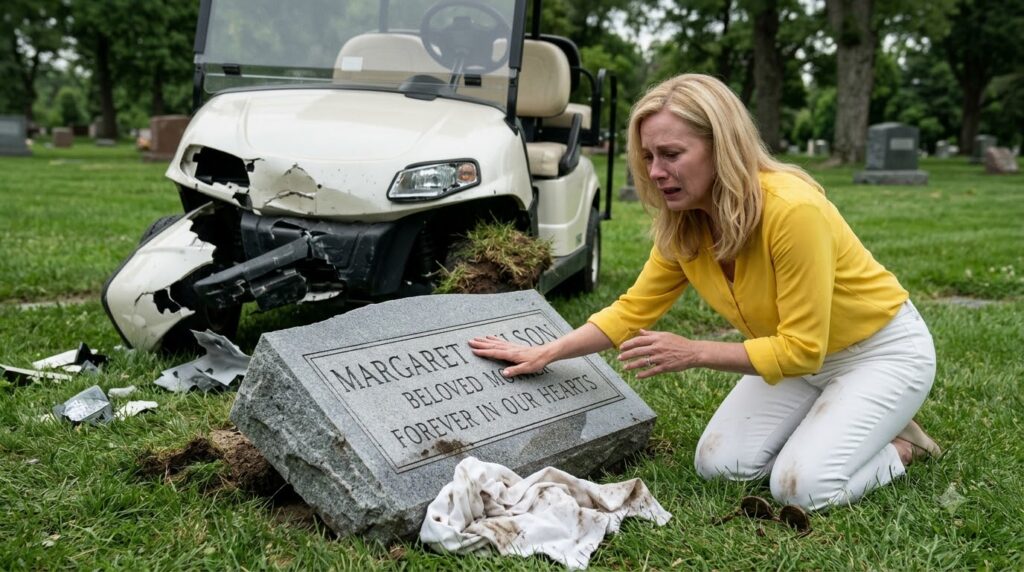
She admitted that she had deliberately driven toward the monument in an effort to damage it and support her argument that the old cemetery needed clearing.
She acknowledged that she had ignored warnings and endangered herself and anyone nearby.
Then she explained that the damaged grave belonged to her mother.
The courtroom was quiet.
Karen did not use that fact as an excuse.
She understood that the identity of the person buried there did not determine whether the act was wrong.
Every grave represented someone loved.
Every family deserved peace.
The judge reviewed the agreement and the restoration arrangements.
He emphasized that remorse mattered only when accompanied by meaningful action.
He also noted that the court’s concern extended beyond Karen’s personal grief to the protection of cemetery property and the public interest.
The court approved the resolution.
Karen received twelve months of probation, restitution obligations, and 120 hours of community service, along with other conditions.
She was also prohibited from operating motorized recreational vehicles on cemetery property.
Karen accepted the judgment.
Outside the courthouse, several reporters waited.
She declined to discuss the case in detail.
She offered a short statement accepting responsibility and expressing regret to the cemetery trustees and the families affected.
Then she walked away.
There was no dramatic declaration of innocence.
No accusation against the judge.
No attempt to turn herself into a victim.
For Karen, that silence marked a significant change.
Meanwhile, the HOA financial investigation continued.
The forensic accountant identified unsupported consulting charges and failures to disclose potential conflicts of interest.
After reviewing the findings, the board authorized legal action to recover disputed payments.
Richard resigned as vice president.
His nephew’s company contested the allegations.
Months later, the parties reached a civil settlement requiring repayment of $58,000 to the HOA without an admission of fraud.
The remaining disputed expenses were addressed through the association’s insurance and internal accounting review, subject to the applicable coverage and board decisions.
The settlement did not erase the damage caused by poor oversight.
But it helped the association recover a substantial portion of the money.
Karen also resigned permanently as HOA president.
She did so in a letter distributed to residents.
In it, she acknowledged that her leadership had become more concerned with control than service.
She supported the adoption of new conflict-of-interest rules, independent financial oversight, and a more reasonable enforcement process.
The board accepted her resignation.
Some residents celebrated.
Others simply felt relieved.
Karen understood both reactions.
She had spent years making herself feared.
She could not expect people to trust her overnight.
That evening, she returned home and placed her mother’s letter on the dining room table.
She read it again.
One sentence stood out more clearly than ever.
The true measure of a person is not how much power they hold, but how gently they treat those who have less.
Karen closed her eyes.
She wished she had understood those words while Margaret was alive.
But wishing could not change the past.
Only her actions could change what came next.