
Chapter 9: The Spring That Belonged to Everyone
The following spring arrived slowly in Portland.
Rain lingered through March.
Cold mornings delayed the first blossoms.
For weeks, Emily watched the cherry tree from her kitchen window, wondering whether it would bloom again.
Its canopy remained uneven.
The missing branches left open spaces where pink flowers once gathered thickly.
But the trunk was strong.
New buds appeared along the surviving limbs.
Then, one morning in April, Emily stepped outside and saw the first blossoms opening.
They were small and pale pink.
Only a handful at first.
But by the end of the week, clusters of flowers covered the healthy branches.
The tree had survived.
Emily stood beneath it for a long time.
She touched the rough bark near one of the healed pruning wounds.
The scar remained visible.
It probably always would.
But the tree was growing around it.
Sophie came outside carrying two mugs of coffee.
She stopped when she saw the blossoms.
For a moment, she looked like the little girl who used to hang paper butterflies from the branches.
Then she smiled.
They sat together on the garden bench.
Neither felt the need to say much.
Across the neighborhood, Willow Creek Estates had changed in ways both large and small.
The new HOA board published meeting summaries and made financial reports available to homeowners.
Landscaping complaints were handled through a documented review process.
Residents had opportunities to respond before enforcement decisions were made.
The board also established a clear policy prohibiting unauthorized entry onto private property.
These changes did not eliminate every disagreement.
Neighbors still argued occasionally about parking, fences, and noise.
But disagreements were no longer treated as opportunities for intimidation.
People asked questions.
They attended meetings.
They expected explanations.
And they understood that serving on the HOA board was a responsibility, not a personal privilege.
Patricia Whitmore remained in the neighborhood for several months after her removal.
She rarely attended community events.
Her bright clothing and lavender hair were still unmistakable when she appeared outside, but her influence had faded.
Eventually, she sold her house and moved to another part of the Portland area.
Emily learned about the sale from the neighborhood newsletter.
She felt no triumph.
Only relief.
She had never wanted Patricia’s life destroyed.
She had wanted her to stop destroying pieces of other people’s lives.
The settlement had addressed Emily’s documented losses.
The HOA reforms had addressed the failures that allowed Patricia’s conduct to continue.
And the neighborhood had finally learned that silence was not the same as peace.
That April, Linda proposed a community garden afternoon.
The event would bring neighbors together to exchange seedlings, share gardening advice, and help residents who could no longer manage heavy yard work.
The new board approved the use of the community center’s outdoor space.
Emily volunteered to bring young plants.
George contributed tomato seedlings.
Martha brought herbs.
Samuel donated bags of compost.
Linda prepared refreshments.
Brian supplied a small number of native shrubs and helped residents understand basic planting techniques.
There were no mandatory landscaping standards attached to the event.
No warnings.
No fines.
Just neighbors helping neighbors.
On the morning of the gathering, Emily carried a wooden tray of seedlings from her garden.
The tray was new.
The pots were new.
But the arrangement reminded her of the one Patricia’s branch had crushed.
This time, Sophie helped her carry it.
Among the plants were several small roses propagated from Margaret’s original bush.
Not all the cuttings had rooted.
But three had survived.
Emily had decided to keep one, give one to Linda, and donate the third to the community garden.
As she arranged the pots on a table, George approached.
He thanked her for standing up to Patricia.
Emily shook her head.
She reminded him that the neighborhood had changed because many people finally chose to speak.
George smiled.
He said that might be true, but someone had needed to go first.
Later that afternoon, Linda invited everyone to walk past Emily’s garden.
The cherry tree was in bloom.
Its damaged side remained thinner than the rest, but the surviving branches glowed pink in the sunlight.
Several neighbors stopped to admire it.
Some remembered the security footage.
Others had only heard the story.
But everyone understood that the tree represented something more than landscaping.
It represented the right to enjoy one’s home without intimidation.
It represented the importance of fairness.
And it represented the strength that ordinary people could find when they refused to let fear divide them.
When the gathering ended, Emily returned home with Sophie.
They carried the empty seedling tray through the side garden.
The late-afternoon sun stretched across the lawn.
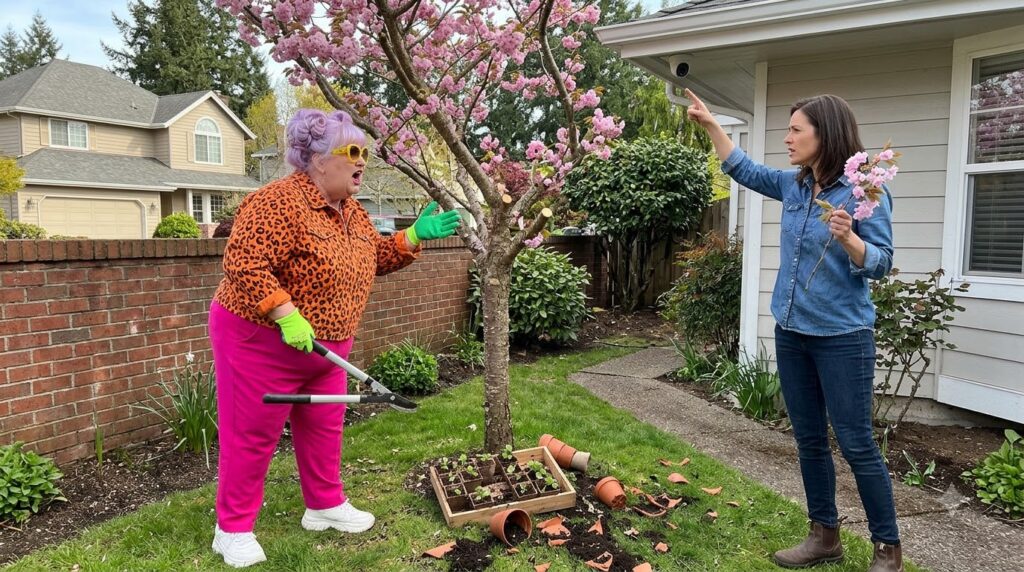
For years, Patricia had complained that the cherry tree stole sunlight from her patio.
Emily looked at the golden light passing between the branches.
She thought about how strange it was that someone could become so consumed by a little shade that she failed to appreciate the beauty creating it.
Sophie placed the tray beside the garden bench.
Then she noticed a small envelope tucked beneath one of the flowerpots.
Inside was a handwritten note from Linda.
It thanked Emily for helping the neighborhood remember what community was supposed to mean.
At the bottom, Linda had written a sentence Emily would keep for years.
Good neighbors don’t demand that everyone else’s garden become smaller so theirs can feel bigger.
Emily folded the note carefully.
She placed it inside the old family photo album, beside the picture of Margaret planting the tree.
That evening, she sat alone beneath the blossoms.
A light breeze moved through the branches.
A few petals drifted onto her shoulders.
The neighborhood was quiet.
Not the frightened silence she had once mistaken for peace.
A different kind of quiet.
The kind that comes when people know their boundaries will be respected.
Emily looked up through the pink flowers.
The tree would never look exactly as it had before Patricia cut it.
Its shape had changed.
Its scars remained.
But it was alive.
And beneath it, the garden was growing again.
Emily smiled, remembering her mother’s words about planting things for a future she might never see.
She understood them better now.
Some things were worth protecting not because they would last forever, but because they made the years we had more meaningful.
Her mother had planted a tree.
Emily had protected it.
And together, in ways neither could have predicted, they had helped an entire neighborhood remember the value of home.
The End.








