Chapter 6: The Contractor Who Refused to Stay Silent
Brian Whitmore called Emily on a rainy Thursday afternoon.
He sounded nervous.
He explained that he owned Northwest Garden Renewal and had recently learned about the dispute involving her cherry tree.
Emily immediately asked whether he had authorized Patricia to enter her property.
Brian said no.
He had never visited Emily’s garden.
He had never assessed the cherry tree.
And he had never recommended removing its branches.
That surprised Emily.
Patricia had repeatedly suggested that professional landscaping advice supported her actions.
Brian explained that his aunt had been sending him potential customers for more than a year.
At first, he believed the referrals were legitimate.
He assumed homeowners had received proper HOA notices and wanted help bringing their landscaping into compliance.
But over time, he began noticing inconsistencies.
Some homeowners seemed confused about the alleged violations.
Others insisted that no relevant rule existed.
Brian had asked Patricia to stop describing his company as the HOA’s preferred contractor.
She ignored him.
He also said he had never been told that association funds might be used to pay for certain inspections connected to his business.
Rachel arranged to meet with Brian the next day.
At the meeting, he provided copies of emails and invoices.
Several messages showed Patricia encouraging him to contact homeowners who had received landscaping warnings.
In one exchange, Brian asked whether a particular tree-removal notice had been approved by the board.
Patricia replied that he should leave HOA matters to her.
Another message concerned Emily’s property.
Patricia had sent Brian a photograph of the cherry tree and asked for an estimate to remove it.
Brian responded that he would need to inspect the tree and obtain the homeowner’s permission before proposing any work.
Patricia never arranged that inspection.
Instead, she entered Emily’s garden herself.
The timing was significant.
The email had been sent nearly two weeks before the confrontation.
It supported Emily’s belief that Patricia had planned to remove the tree long before claiming an urgent landscaping problem.
Brian also disclosed that Patricia had suggested he might receive more neighborhood business if he cooperated with her Garden Harmony Initiative.
He had declined to make any exclusive arrangement.
Rachel carefully distinguished what the documents established from what remained uncertain.
They showed undisclosed family connections, questionable representations, and efforts to direct business toward Brian.
They did not, by themselves, prove that Brian had participated in a scheme.
Brian appeared genuinely distressed.
He had built his company from a single pickup truck and a borrowed mower.
Now his business name was being associated with threats and unauthorized property work.
He agreed to provide a written statement.
He also offered to help identify which invoices reflected services actually performed.
That cooperation became important when the HOA board commissioned an independent financial review.
The review found that several landscaping-related payments lacked the approvals or supporting records required by the association’s policies.
Some payments had been made for work that could be verified.
Others required further explanation.
The board referred the unresolved financial questions to its attorney and accountant.
Meanwhile, the petition for a special membership meeting gathered enough valid signatures under the bylaws.
The meeting was scheduled for the following Saturday at the Willow Creek Community Center.
Patricia responded with a neighborhood-wide email.
She accused a small group of disgruntled homeowners of undermining community standards.
She claimed that her actions had protected property values and preserved the neighborhood’s reputation.
She described the upcoming meeting as a distraction from necessary enforcement.
But the message had an unintended effect.
Residents who had previously ignored the dispute began asking questions.
Why had the association issued fines without proper review?
Why was Patricia’s nephew repeatedly recommended for landscaping work?
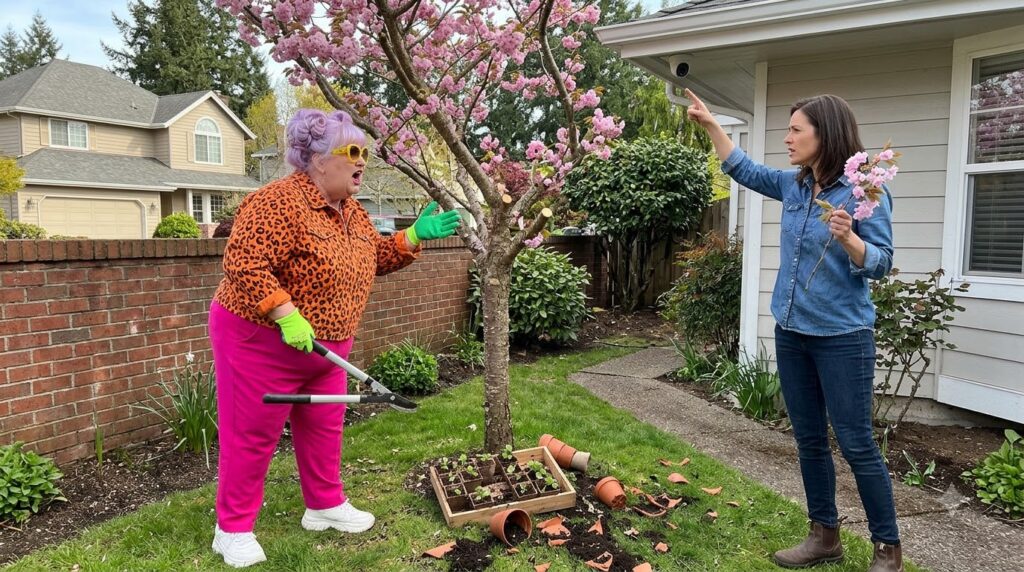
Why had the president entered a homeowner’s private garden with pruning tools?
And why had an authorization document appeared with a signature the treasurer denied making?
By Friday evening, nearly every household in Willow Creek Estates had heard about the controversy.
Emily spent the night before the meeting reviewing her notes.
She did not want revenge.
She did not want to humiliate Patricia.
She wanted the facts to be understood.
Rachel had advised her to speak calmly, avoid speculation, and allow the documents to carry the argument.
Sophie helped arrange the photographs into a simple presentation.
The first image showed the cherry tree in full bloom.
The second showed Patricia cutting the branch.
The third showed the shattered pots.
The final image showed the security camera above the garden.
Sophie paused over the photograph of Margaret planting the tree.
She asked whether Emily intended to include it.
Emily considered the question.
The photograph did not prove trespassing.
It did not establish damages.
It would not determine whether the HOA had violated its own rules.
But it explained why the tree mattered.
Emily placed it at the beginning.
Then she closed her laptop.
Outside, rain tapped softly against the kitchen window.
For the first time in weeks, Emily slept without checking the security camera before bed.
Whatever happened at the meeting, Patricia would no longer be able to pretend that no one had seen what she had done.