
Chapter 7: The Meeting That Changed Willow Creek
The Willow Creek Community Center was nearly full when Emily arrived Saturday morning.
Rows of folding chairs faced a long table where the HOA board normally conducted its meetings.
Residents stood in small groups, speaking quietly.
Some held copies of the bylaws.
Others carried folders containing notices, photographs, and correspondence.
Emily recognized people she had lived near for years but rarely spoken with.
The atmosphere was tense, but not hostile.
There was a sense that something long postponed was finally being addressed.
Patricia arrived fifteen minutes before the meeting began.
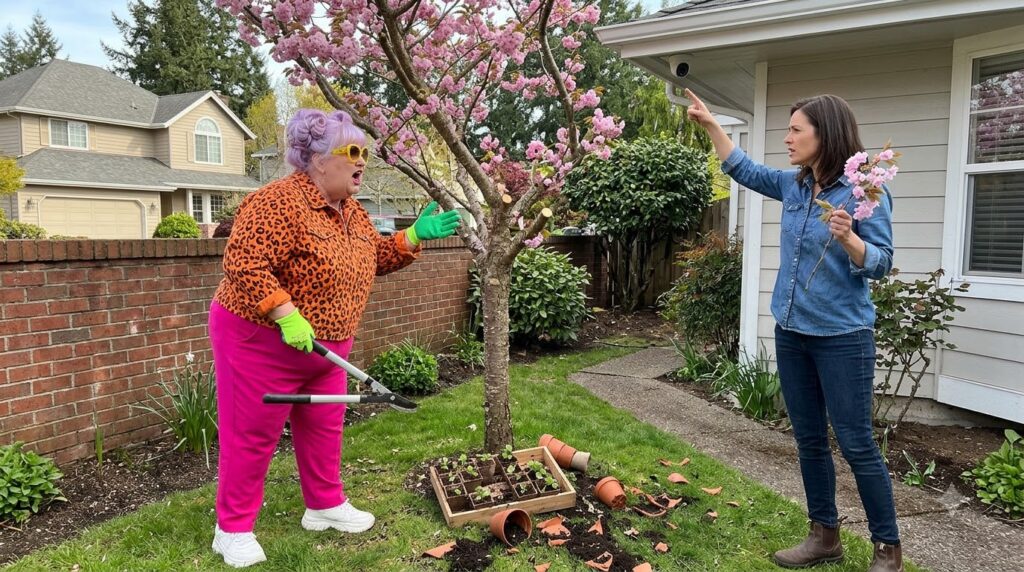
Her lavender-purple hair was arranged in its familiar curly buns.
She wore a bright orange jacket and carried a thick binder.
Her expression suggested that she expected to regain control of the room.
She took her seat at the board table.
But the meeting was not hers to control.
Under the procedures established for the special meeting, an independent meeting chair had been appointed to manage the agenda and voting process.
The association’s attorney attended to advise on the bylaws and procedural requirements.
Patricia objected to the arrangement.
The chair calmly explained that the meeting would proceed according to the governing documents.
The first presentation concerned the landscaping notices.
Daniel Ruiz summarized the management company’s records.
He confirmed that several disputed notices had been issued outside the standard review process.
He also confirmed that the Garden Harmony Initiative had not been formally adopted.
Residents listened closely.
For years, many had assumed that a letter bearing the HOA name represented an enforceable decision.
Now they learned that some notices had reflected Patricia’s personal interpretation rather than approved association policy.
Next, Harold Jenkins addressed the financial records.
He explained that the independent review had identified landscaping expenditures requiring further examination.
He avoided accusing anyone of theft or fraud.
Instead, he focused on missing approvals, incomplete documentation, and the need for stronger financial controls.
Then he addressed the Emergency Landscaping Authorization.
He stated clearly that he had not signed it.
The room grew quiet.
Patricia shifted in her chair.
She claimed that the document reflected an administrative misunderstanding.
Harold did not argue.
He simply repeated that he had never authorized the work.
The meeting chair directed that the disputed document and related records be preserved for further review.
Then Emily was invited to speak.
She walked to the front carrying a small folder.
Her hands trembled slightly.
She had never enjoyed public speaking.
But when she looked across the room, she saw Linda, George, Martha, Samuel, and Sophie.
They were watching her with quiet encouragement.
Emily began with the photograph of Margaret planting the cherry tree.
She explained that the tree had been a gift from her mother.
She described the years of blossoms, family photographs, and afternoons spent beneath its branches.
Then she showed the security footage.
The room watched Patricia step across the brick boundary.
They watched her position the loppers around the branch.
They heard the sharp crack.
They saw the branch fall onto the seedlings.
The terracotta pots shattered.
Emily appeared in the frame, rushing to protect what remained.
Then Patricia’s voice filled the room.
“Your tree violates HOA standards!”
A moment later, Emily’s response followed.
“You’re trespassing! It’s all recorded!”
The camera tilted upward.
Patricia saw the security camera.
And the room heard her furious protest.
“You can’t record me!”
Emily stopped the video.
For several seconds, nobody spoke.
The footage required little explanation.
Patricia had entered private property and damaged a tree without permission.
The fact that she was HOA president did not make the conduct acceptable.
Emily then displayed the arborist’s findings and the disputed enforcement notices.
She explained that she had asked for documentation supporting the claimed violation and had received no valid board authorization.
She finished by saying that she wanted the damage addressed and the rules applied fairly to everyone.
She did not demand that residents hate Patricia.
She asked them to remember that an association existed to serve homeowners, not frighten them.
When Emily returned to her seat, Linda squeezed her hand.
The meeting continued for nearly two hours.
Other residents described their experiences.
George explained the threats involving his vegetable garden.
Denise described the pressure to replace healthy shrubs.
Samuel discussed the warnings about his maple tree.
Their accounts were supported by copies of notices and correspondence.
Patricia was given an opportunity to respond.
She insisted that she had acted to protect community standards.
She claimed that residents had misunderstood her intentions.
She argued that strong leadership sometimes required unpopular decisions.
But she could not produce an adopted rule authorizing her actions at Emily’s property.
Nor could she explain why she had used a document bearing Harold’s disputed signature.
The association’s attorney reminded everyone that some questions would require further investigation.
The membership vote, however, concerned whether Patricia should continue serving on the board.
After the required procedures were completed, ballots were distributed and counted.
The result was decisive.
The members voted to remove Patricia from her board position.
A separate board action appointed interim leadership and suspended the disputed landscaping enforcement notices pending review.
Patricia sat motionless as the results were announced.
For years, she had treated disagreement as disobedience.
Now the homeowners had exercised the authority granted to them by the association’s own governing documents.
She gathered her binder and left without speaking to Emily.
There was no cheering.
No dramatic celebration.
Just a long, collective release of tension.
Residents began talking openly.
Some apologized to neighbors they had avoided.
Others volunteered to help review the bylaws.
Harold agreed to assist with improving financial oversight.
Linda offered to organize a committee focused on homeowner communication.
Emily stood near the back of the room, exhausted.
Sophie approached and hugged her.
For the first time since the incident, Emily felt that the neighborhood might become the place she had believed it was when she bought her home.
But removing Patricia from office did not repair the tree.
It did not compensate the homeowners who had paid questionable fines.
And it did not resolve the disputed authorization.
Those matters would require time, documentation, and patience.
Emily was prepared for that.
She had learned that justice was not always a single dramatic moment.
Sometimes it was a series of careful decisions that gradually restored what had been lost.








