
Chapter 5: The Signature That Changed the Case
Harold Jenkins arrived at Rachel Morgan’s office the next afternoon.
He carried a leather briefcase, a folder of HOA financial statements, and the weary expression of a man who had spent too many years assuming other people were acting in good faith.
Harold had served as Willow Creek Estates treasurer for nine years.
He had joined the board after retiring because he believed community service was a practical way to help his neighbors.
He was not interested in neighborhood politics.
He liked balanced budgets, clear records, and meetings that ended on time.
Patricia had made all three increasingly difficult.
Rachel placed the Emergency Landscaping Authorization on the conference table.
Harold examined it through his reading glasses.
He confirmed that he had not signed the document.
The signature resembled his, but the lettering was wrong.
More importantly, Harold explained that no emergency landscaping authorization had been discussed or approved by the board.
The association had procedures for addressing genuine hazards, such as fallen trees blocking common roads or dangerous limbs threatening shared property.
Emily’s flowering cherry tree had never been identified as an emergency.
Harold had not even known Patricia intended to enter her yard.
Rachel asked whether he would provide a written statement.
He agreed.
Then Harold opened his briefcase.
He had brought something else.
For months, he had been concerned about the association’s landscaping expenses.
Several invoices from Northwest Garden Renewal had appeared in the financial records under vague descriptions such as community beautification consultation and vegetation compliance review.
The amounts were not enormous individually.
But they added up.
Harold had questioned Patricia about the invoices.
She told him the services were necessary to maintain property values and avoid future disputes.
When he requested supporting documentation, she repeatedly delayed.
He had begun collecting copies because the explanations did not satisfy him.
Rachel examined the records.
The invoices appeared to involve work at common areas and preliminary inspections of private properties.
Some lacked detailed descriptions.
Others referenced addresses where residents had complained about receiving unauthorized landscaping warnings.
The records did not establish that money had been stolen.
But they raised serious questions about approval, disclosure, and whether association funds had been spent appropriately.
Rachel advised Harold that the board should seek an independent review of the invoices and related contracts.
She also recommended preserving the original records.
Harold nodded.
He seemed relieved that someone had finally taken his concerns seriously.
That evening, Emily attended a gathering at Linda’s house.
Six homeowners sat around the dining room table.
Among them were George and Martha Wilson, a retired couple in their seventies.
George had worked as a postal carrier for thirty-eight years.
Martha had spent much of her life caring for their family.
They had moved to Willow Creek Estates because they wanted a quiet retirement.
Instead, Patricia had repeatedly threatened them over a small vegetable garden behind their house.
The garden contained tomatoes, green beans, and herbs.
George had built the raised beds after recovering from heart surgery.
Gardening helped him stay active.
Patricia claimed the beds were inconsistent with neighborhood landscaping standards.
She recommended Northwest Garden Renewal for removal and replacement.
The estimate was nearly two thousand dollars.
George had refused.
Soon afterward, they received a fine.
The management company eventually withdrew it after discovering that the cited rule did not apply to their backyard.
But the experience had frightened Martha.
She had begun worrying every time an HOA letter arrived.
Another homeowner, Denise Walker, described being pressured to replace healthy shrubs.
A third, retired firefighter Samuel Brooks, had been warned about a mature maple tree that had stood on his property for decades.
Each story was different.
But the pattern was familiar.
An aggressive notice.
A questionable interpretation of the rules.
A recommendation to hire Patricia’s nephew.
Then pressure when the homeowner resisted.
Emily listened carefully.
She had originally imagined her dispute ending with compensation for the damaged tree.
Now she understood that a private settlement might leave the larger problem untouched.
The neighborhood needed an accountable board.
It needed transparent records.
And it needed residents who could disagree with an HOA officer without fearing retaliation.
Linda suggested requesting a special membership meeting.
Under the association’s bylaws, a sufficient number of homeowners could petition for one.
The purpose would be to address governance concerns and, if the required procedures were satisfied, consider removing Patricia from the board.
The room fell silent.
Everyone understood what that meant.
Patricia had controlled the association for years.
Challenging her openly would be uncomfortable.
Some residents worried about retaliation.
Others feared that the dispute would divide the neighborhood.
Emily did not dismiss those concerns.
She knew the costs of standing up better than anyone.
But she also knew what happened when everyone remained silent.
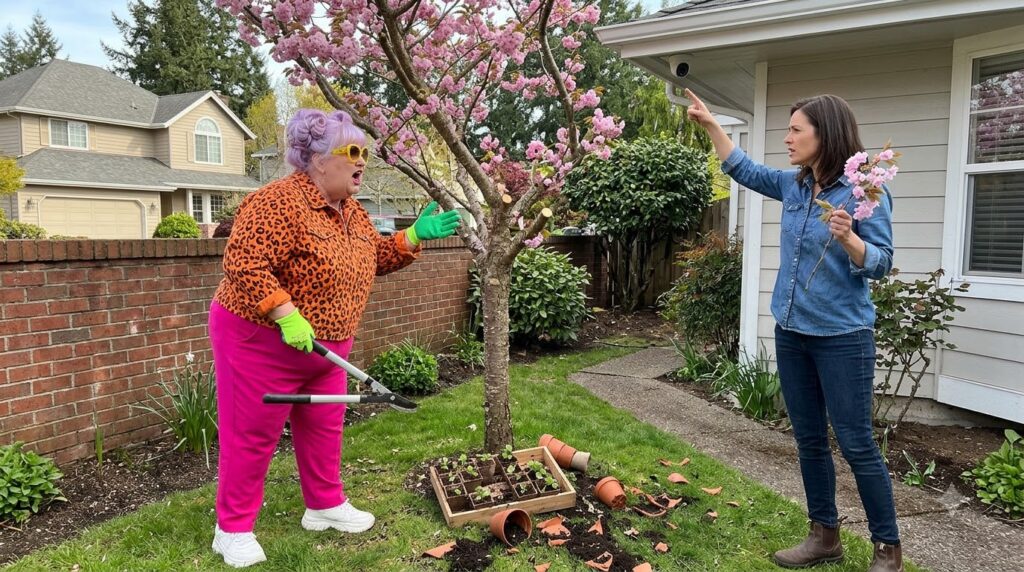
She placed the photograph of her mother’s cherry tree on the table.
Then she placed beside it the photograph taken after Patricia’s destruction.
The contrast was heartbreaking.
One image showed a beautiful canopy filled with pink blossoms.
The other showed broken branches, shattered pots, and exposed wounds.
Emily told the group that she wasn’t asking anyone to fight for her tree alone.
She was asking them to decide what kind of neighborhood they wanted to live in.
By the end of the evening, every homeowner at the table had agreed to support a petition.
Over the next four days, Linda and Harold helped collect signatures.
Emily continued organizing evidence.
Rachel prepared the necessary legal notices.
And Patricia, apparently unaware of how much support Emily had gained, sent another angry email accusing her of creating unnecessary division.
Emily saved the message.
She no longer felt compelled to answer every accusation.
For the first time since the branch fell, she could see a path toward resolution.
But the most important evidence had not yet surfaced.
It arrived from someone Emily had never met.
Brian Whitmore.
Patricia’s own nephew.








