
Chapter 8: What the Camera Could Not Capture
In the weeks following the special meeting, Willow Creek Estates began changing.
The interim board ordered a comprehensive review of landscaping enforcement records.
Disputed fines issued without proper authorization were suspended while each case was examined.
Homeowners were invited to submit documentation if they believed they had been treated unfairly.
The board also established a policy requiring written approval and proper records for landscaping-related expenditures.
Any potential conflict of interest involving board members or their relatives would require disclosure and appropriate review.
The independent financial examination continued.
Some questionable invoices were eventually supported by evidence of completed work.
Others were referred for additional legal and accounting review.
The board did not announce conclusions it could not substantiate.
It focused on correcting procedures and determining what remedies were appropriate.
Patricia’s removal from the board was final under the association’s process, but the consequences of her conduct were not over.
Rachel Morgan continued representing Emily in the property-damage dispute.
The security recordings, arborist’s report, photographs, and witness statements provided strong evidence that Patricia had entered Emily’s garden and caused the damage.
After negotiations through counsel, Patricia agreed to a civil settlement.
The agreement required her to compensate Emily for documented tree-care expenses, replacement plants, damaged garden materials, and related costs.
It also included a written commitment not to enter Emily’s property without permission.
The settlement did not erase what had happened.
But it provided a practical resolution to the property-damage claim.
The disputed authorization was handled separately.
After Harold’s statement and the supporting records were reviewed, the matter was referred to the appropriate authorities for evaluation.
Emily was informed that any determination about possible criminal wrongdoing would be made independently of her civil settlement.
She accepted that distinction.
She wanted accountability, but she did not want to invent certainty where the evidence had not yet established it.
The association also reviewed complaints from other homeowners.
George and Martha Wilson received written confirmation that their vegetable garden complied with the applicable rules.
Their disputed fine was canceled.
Denise’s landscaping notice was withdrawn.
Samuel’s maple tree was no longer the subject of enforcement threats.
Linda received a personal apology from the interim board for the way her arbor dispute had been handled years earlier.
The apology could not rebuild the wooden structure her husband had made.
But it acknowledged that she had been treated unfairly.
One Saturday, several neighbors gathered at Linda’s house to help build a new arbor.
George brought lumber.
Samuel supplied tools.
Brian Whitmore, hoping to make amends for the confusion surrounding his company, volunteered his labor without charge.
Linda initially resisted.
She did not want anyone to feel obligated.
But when the neighbors explained that they wanted to do something together, she agreed.
By late afternoon, a simple wooden arbor stood near her garden path.
It was not identical to the original.
The wood was newer.
The shape was slightly different.
But Linda smiled as she planted two climbing roses beside it.
For the first time in years, she looked forward to watching them grow.
At Emily’s house, Thomas Bennett returned to inspect the cherry tree.
The wounds had begun to respond to treatment.
There were no guarantees.
The tree would need monitoring, and some of the lost branches would never return in their original form.
But Thomas saw encouraging signs of healthy growth.
He advised Emily to avoid unnecessary intervention and allow the tree time to recover.
Emily followed his instructions carefully.
She also replanted the damaged seedlings.
The Japanese maple survived.
It was small and uneven, but new leaves appeared along its upper stem.
The rose cutting had not survived.
Emily found that loss unexpectedly difficult.
It had been taken from a plant Margaret once tended with extraordinary care.
For several evenings, Emily stood beside the empty pot, remembering her mother.
Then Sophie made a suggestion.
They could visit the old family home, where Margaret’s original rosebush still grew beside the back porch.
Emily had avoided the property since it was sold to a family friend.
The memories were painful.
But she called the new owner, who kindly invited them to visit.
On a clear Sunday morning, Emily and Sophie drove across Portland.
The old house looked smaller than Emily remembered.
The porch had been repainted.
The garden beds had changed.
But the rosebush remained.
Its deep pink flowers climbed along the same wooden railing Margaret had painted years earlier.
The owner allowed Emily to take several cuttings.
Sophie carefully wrapped them in damp paper towels for the drive home.
That afternoon, mother and daughter prepared fresh pots.
They worked slowly, following the propagation instructions Thomas had recommended.
As Emily pressed soil around the cuttings, she remembered the afternoon Margaret planted the cherry tree.
Her mother had been tired.
Her hands had trembled.
But she had insisted on finishing.
Emily finally understood something she had overlooked for years.
Margaret had never expected every plant to survive.
She had simply believed that caring for something living was worthwhile, even when the outcome was uncertain.
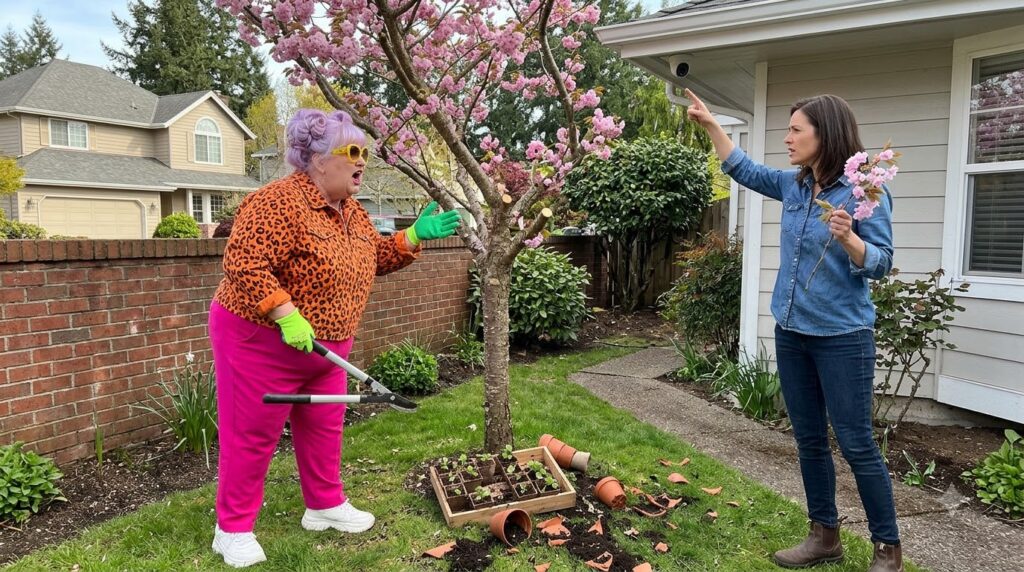
The camera had captured Patricia’s actions perfectly.
It had shown the trespassing, the broken branch, and the shattered pots.
But it could not capture everything that mattered.
It could not record eleven years of family memories.
It could not measure the comfort Emily found beneath the blossoms.
And it could not show the quiet determination that had grown from the damage.
Those things existed beyond the camera’s frame.
They were the reasons Emily had refused to surrender.








