
Chapter 4: The Price of Standing Up
The first fine arrived on Monday.
Five hundred dollars.
The notice claimed that Emily had failed to maintain landscaping consistent with neighborhood appearance standards.
It cited the damaged cherry tree as evidence.
Emily stared at the document in disbelief.
Patricia had damaged the tree herself.
Now she was attempting to punish Emily for the condition she had created.
A second notice arrived the following day.
It warned that continued noncompliance could result in additional penalties, subject to the HOA’s enforcement procedures.
Emily immediately disputed both notices in writing.
She attached photographs, the arborist’s preliminary findings, and the police incident number.
She also requested a formal hearing before the board.
Daniel confirmed receipt and stated that the disputed fines would be placed on hold pending review.
That should have been the end of the immediate problem.
Instead, Patricia began appearing around Emily’s property at unusual hours.
She walked slowly along the sidewalk, photographing the front lawn.
She stopped beside the brick boundary and inspected the damaged tree.
One evening, Sophie noticed Patricia standing across the street with her phone pointed toward their house.
Emily documented each incident without confronting her.
She had learned that Patricia seemed to thrive on arguments.
The camera footage and written records were far more useful than another shouting match.
Meanwhile, Thomas Bennett completed his arborist report.
The findings were troubling.
The cherry tree had sustained significant improper pruning damage. Although recovery remained possible, the tree would require professional monitoring and care.
Thomas estimated the cost of corrective treatment and follow-up inspections.
He also explained that determining any permanent loss in value would require further assessment.
Emily sent the report to her homeowner’s insurance company to ask about coverage and documentation.
The representative advised her to preserve all evidence and obtain repair estimates.
Emily then scheduled a consultation with an attorney.
Her name was Rachel Morgan.
At fifty-four, Rachel specialized in property disputes and HOA governance.
She had spent nearly twenty-five years representing homeowners, associations, and small businesses.
Rachel reviewed Emily’s documents carefully.
She was especially interested in the security footage.
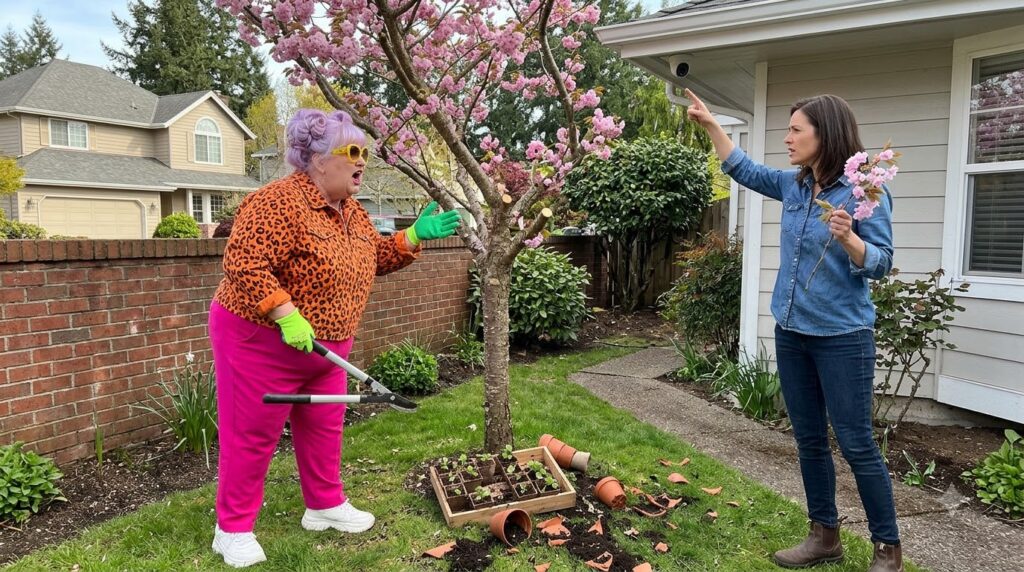
The recording clearly showed Patricia entering the garden, cutting the branch, and damaging the seedlings.
The earlier recordings showed repeated unauthorized entries.
Rachel explained that an HOA president did not automatically possess the right to enter private property simply because she believed a landscaping rule had been violated.
Any authority would depend on the governing documents, applicable law, and the circumstances.
Nothing Emily had provided appeared to authorize Patricia’s actions.
Rachel recommended three immediate steps.
Emily should preserve the original recordings, continue communicating in writing, and avoid any direct confrontation that might complicate the dispute.
Rachel would send a formal demand requesting that Patricia cease entering the property, preserve relevant records, and address the damage.
She would also notify the association’s board that Emily disputed the notices and intended to seek compensation for the harm.
Emily left the office feeling more prepared.
But the situation was taking a toll.
She had missed several hours of work attending appointments and gathering evidence.
Sophie had become anxious whenever she heard someone outside.
The garden, once a place of peace, now reminded both women of conflict.
One evening, Emily found Sophie sitting beneath the cherry tree.
The damaged canopy cast an uneven shadow across the grass.
Sophie was holding the old photograph of Margaret.
She admitted that she had begun worrying Patricia might return and cut down the entire tree.
Emily sat beside her.
She promised they would do everything reasonably possible to protect it.
But she also told Sophie something her mother had taught her years earlier.
A home was not merely a building or a piece of land.
It was the place where people were supposed to feel safe enough to live without fear.
That was what Emily intended to defend.
The following morning, Rachel called with an unexpected development.
Patricia had responded to the formal demand.
Rather than acknowledging the damage, she claimed that Emily had interfered with legitimate HOA enforcement.
She also alleged that Emily’s security camera violated her privacy.
Rachel was not particularly concerned about that allegation based on the camera’s documented view of Emily’s own garden.
What interested her was an attachment Patricia had included.
It was a document labeled Emergency Landscaping Authorization.
The document appeared to authorize immediate corrective work at Emily’s property.
It bore Patricia’s signature.
And beneath it was another signature.
That of HOA treasurer Harold Jenkins.
Emily knew Harold.
He was a seventy-one-year-old retired accountant who lived two streets away.
He had always been courteous and quiet.
Rachel asked whether Emily knew if Harold had actually approved the work.
Emily didn’t.
But she knew someone who might be willing to ask him.
She called Linda.
By sunset, Linda had spoken with Harold.
His response changed everything.
He had never seen the authorization before.
And the signature on the document was not his.








