
Chapter 3: The Neighbor Who Had Been Watching
Linda Parker arrived the next morning carrying a covered dish of homemade blueberry muffins and a thick manila envelope.
At sixty-seven, Linda had the composed manner of someone who had spent decades managing classrooms full of restless children.
She rarely raised her voice.
She also rarely spoke without knowing exactly what she intended to say.
Emily invited her into the kitchen.
Linda placed the muffins on the counter, then set the envelope on the table.
Inside were copies of HOA meeting agendas, landscaping committee notes, and a neighborhood improvement proposal.
Emily recognized Patricia’s name on nearly every page.
Three months earlier, Patricia had introduced something called the Willow Creek Garden Harmony Initiative.
The proposal encouraged homeowners to reduce landscaping features that supposedly interfered with neighboring properties.
Its language sounded harmless.
It emphasized cooperation, neighborhood appearance, and shared enjoyment of outdoor spaces.
But attached to the proposal was a list of properties identified for possible landscaping review.
Emily’s address appeared near the top.
So did six others.
Linda explained that she had attended the meeting where Patricia introduced the initiative.
At first, the proposal seemed like another attempt to standardize the neighborhood’s appearance.
Then Patricia began discussing tree removal.
She claimed mature trees reduced property values by creating uneven lawns, excessive shade, and maintenance concerns.
Several residents objected.
The association already had landscaping rules, and homeowners had purchased their properties with existing trees.
Patricia insisted that the neighborhood needed stronger enforcement.
The board postponed a vote pending legal review.
But Patricia apparently continued acting as though the initiative had been approved.
Linda opened another document.
It was a handwritten record of complaints collected by several homeowners.
One resident had received a warning about a backyard vegetable garden.
Another had been told to remove a wooden bench that had stood beside her front walkway for fifteen years.
A retired couple had received repeated notices about a decorative birdbath.
In each case, Patricia had claimed that the property violated HOA standards.
In several cases, the management company later withdrew the notices.
Emily looked up.
“Why hasn’t anyone stopped her?”
Linda’s expression tightened.
Because most people had been afraid of making things worse.
Patricia was relentless.
Residents who challenged her often received additional complaints, inspection requests, or threatening letters.
Some were elderly. Others worked long hours or had limited money for legal disputes.
They chose peace over confrontation.
Linda admitted that she had done the same.
Two years earlier, Patricia had demanded that Linda remove a wooden garden arbor built by her late husband.
The arbor stood entirely on Linda’s property.
It had never caused a complaint.
But Patricia claimed it violated an unwritten neighborhood design standard.
Linda eventually removed it.
She had been seventy dollars short of paying a medical bill that month and could not face the possibility of mounting fines.
Her voice grew quieter as she described watching a contractor dismantle the arbor.
Her husband had built it the summer before his first heart attack.
For years afterward, climbing roses had grown over the wooden frame.
Removing it had felt like losing another piece of him.
Emily reached across the table and touched Linda’s hand.
For the first time, Emily understood why the neighborhood seemed so quiet whenever Patricia passed.
The silence was not agreement.
It was exhaustion.
Linda then showed Emily the final document in the envelope.
It was a copy of a proposed amendment to the landscaping rules.
The amendment would have given the HOA broader authority to require removal of trees and shrubs that substantially interfered with neighboring outdoor spaces.
But the proposal had never been adopted.
The board had tabled it.
Patricia had nevertheless been citing its language in enforcement notices.
Emily recognized the wording immediately.
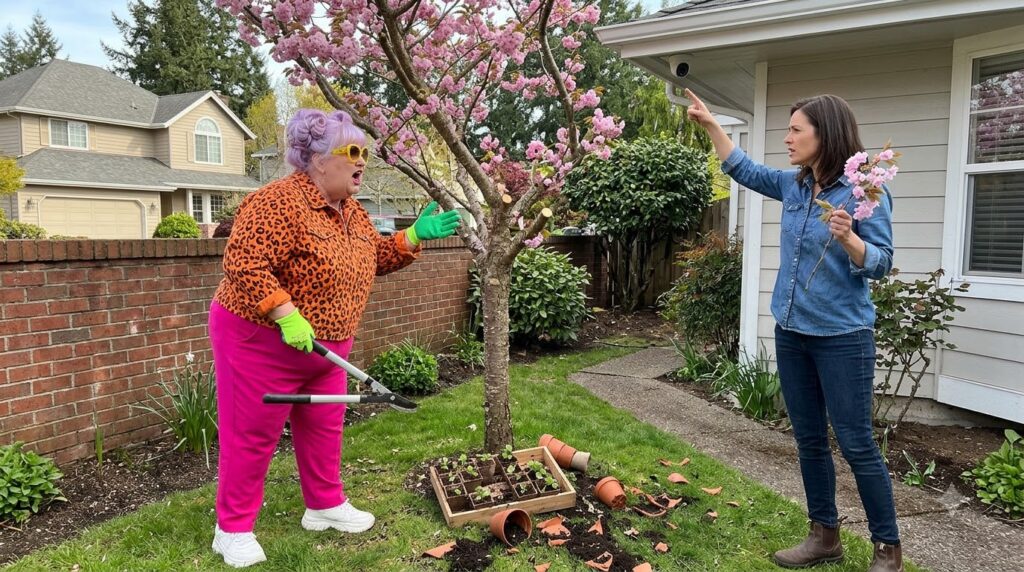
It was almost identical to the language in the notice demanding removal of her cherry tree.
Linda had another concern.
During the meeting, Patricia repeatedly referred to a private landscaping contractor called Northwest Garden Renewal.
She described the company as a preferred service provider capable of helping homeowners achieve compliance.
Linda had wondered why Patricia seemed so eager to recommend one particular contractor.
She had never received a satisfactory answer.
Emily searched the company online.
Its website advertised tree trimming, landscaping redesign, and complete yard renovation.
The owner was listed as Brian Whitmore.
Emily stared at the surname.
Linda confirmed what Emily suspected.
Brian was Patricia’s nephew.
The connection did not automatically prove wrongdoing, but it raised an obvious question.
Had Patricia been using HOA enforcement threats to generate business for a relative?
Emily reviewed the documents again.
Several homeowners had received recommendations to hire Northwest Garden Renewal after being threatened with landscaping fines.
Some had paid hundreds or thousands of dollars for work they later learned was unnecessary.
Emily’s anger changed shape.
Until now, she had been focused on the damage to her tree.
But the documents suggested something larger.
A pattern.
A system in which Patricia could frighten homeowners with official-looking notices, then direct them toward someone who would profit from fixing the supposed violations.
That afternoon, Emily called Daniel Ruiz again.
She asked for copies of the board minutes and any records showing whether Northwest Garden Renewal had been approved as an HOA vendor.
Daniel promised to review the request.
An hour later, he sent a short response.
The company was not listed among the association’s approved contractors.
And the Garden Harmony Initiative had never received final board approval.
Emily forwarded the information to Linda.
By evening, three more neighbors had contacted her.
They wanted to know whether she was planning to challenge Patricia.
Emily looked through the kitchen window at the damaged cherry tree.
She had never wanted to become the center of a neighborhood dispute.
She wanted to care for her home, raise her daughter, and enjoy the quiet life she had worked hard to build.
But Patricia had crossed a boundary that went beyond bricks and property lines.
She had counted on people being too tired, too frightened, or too isolated to resist.
Emily opened a new folder on her computer.
She named it Willow Creek HOA Evidence.
Then she began organizing everything.








