
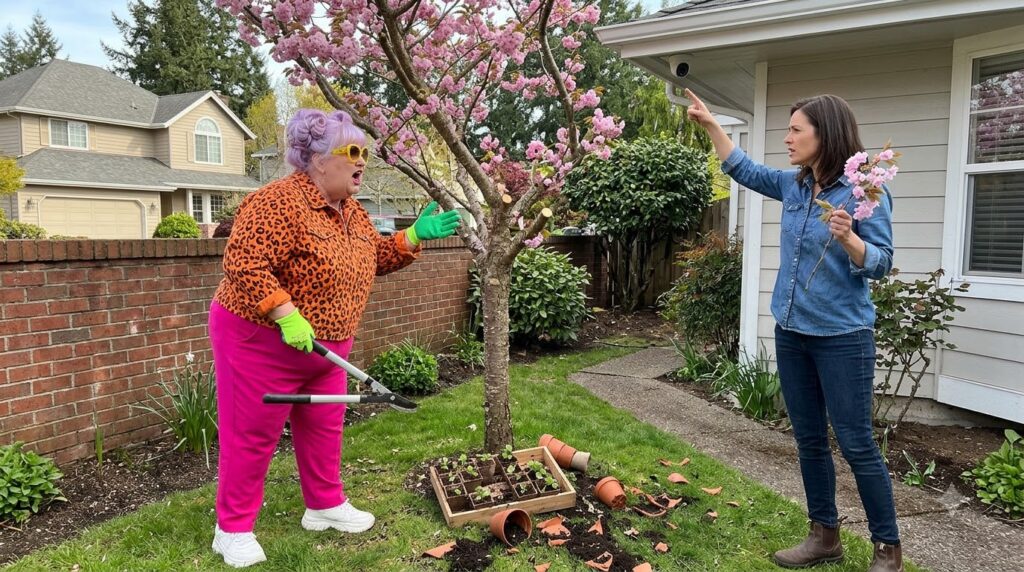
Chapter 2: The Violation That Never Existed
By eight the following morning, Emily had received an official email from the Willow Creek Estates HOA.
The subject line read:
FINAL LANDSCAPING COMPLIANCE NOTICE — IMMEDIATE ACTION REQUIRED
The message stated that Emily’s flowering cherry tree violated community landscaping standards by creating excessive shade and interfering with the neighboring property’s reasonable enjoyment.
It demanded that Emily remove the tree within fourteen days.
Failure to comply, the notice warned, could result in escalating fines and further enforcement action, subject to the association’s governing documents.
Emily read the message three times.
The notice was dated two days before Patricia entered her garden.
Attached was a photograph of the tree taken from Emily’s property.
It matched the angle Emily had seen in the security recording.
Emily opened the HOA handbook.
She had kept a printed copy since purchasing the house thirteen years earlier.
The landscaping section required residents to maintain healthy trees, prevent dangerous overgrowth, and keep vegetation from obstructing sidewalks or shared access areas.
It contained no prohibition against trees casting shadows on neighboring patios.
There was also no provision authorizing an HOA officer to enter private property and remove healthy branches without permission.
Emily photographed the relevant pages.
Then she contacted the HOA’s management company, Evergreen Community Services.
A representative named Daniel Ruiz answered.
Daniel was thirty-six, polite, and noticeably uncomfortable when Emily explained what had happened.
He confirmed that Patricia had submitted a landscaping complaint.
But the management company’s records showed no completed board hearing, no approved enforcement decision, and no authorization for anyone to enter Emily’s property.
Daniel asked Emily to forward the notice.
Twenty minutes later, he called back.
The email had been sent from Patricia’s personal HOA officer account.
It had not been processed through the management company’s standard compliance system.
Daniel explained that the association’s governing documents required written notice and an opportunity to respond before most landscaping fines could be imposed.
The president could not simply declare a violation and order immediate removal.
Emily felt the first small shift in her understanding.
Patricia hadn’t merely overstepped while pruning a tree.
She had used her position to manufacture the appearance of official authority.
That afternoon, Emily contacted a certified arborist named Thomas Bennett.
Thomas was sixty-three, with silver hair, weathered hands, and nearly forty years of experience caring for trees throughout the Pacific Northwest.
He arrived carrying a measuring tape, a camera, and a professional assessment kit.
He examined the cherry tree carefully.
The branch cuts were uneven. One large limb had been removed in a way that exposed vulnerable tissue near the trunk. Several smaller branches had suffered bark tearing.
Thomas explained that the tree might recover, but the damage could increase the risk of decay and structural weakness.
He recommended monitoring, selective corrective pruning by a qualified professional, and follow-up inspections.
He also inspected the damaged seedlings.
The Japanese maple might survive.
The rose cutting was less certain.
Emily watched him write his report.
When Thomas asked why anyone would remove so much healthy growth at once, Emily explained Patricia’s complaint about sunlight.
Thomas walked to the brick boundary.
He studied the tree’s position, the neighboring patio, and the angle of the afternoon sun.
Then he frowned.
Even without the missing branches, the tree was unlikely to have been the primary source of shade over Patricia’s tea area.
A tall privacy fence and part of Patricia’s own house blocked much of the late-afternoon sunlight.
Thomas took photographs and made measurements.
His preliminary assessment supported what Emily already suspected: the tree was not creating an unusual or dangerous condition.
After Thomas left, Emily sat at her kitchen table and assembled a folder.
She included the police incident number, security footage, photographs, the HOA notice, and the relevant handbook provisions.
Her daughter, Sophie, arrived shortly after six.
Sophie was nineteen and attending community college while working part-time at a veterinary clinic.
She had grown up beneath the cherry tree.
As a child, she had hung paper butterflies from its branches every spring. As a teenager, she had studied beneath it during warm afternoons.
Now she stood at the kitchen window, looking at the damaged canopy.
For several minutes, neither woman spoke.
Then Sophie noticed the broken rose cutting resting in a glass of water near the sink.
“Grandma’s rose?”
Emily nodded.
Sophie touched one of its wilted leaves.
The sadness on her face hurt Emily more than the confrontation itself.
They spent the evening sorting photographs of the garden from previous years.
Among them was a picture of Margaret kneeling beside the newly planted cherry tree, smiling broadly beneath a straw gardening hat.
Sophie placed that photograph at the front of the evidence folder.
Near midnight, Emily received a message from her neighbor across the street.
Linda Parker, a retired school librarian, had lived in Willow Creek Estates for twenty-two years.
Her message was brief.
Emily, I saw what happened yesterday. There’s something you should know about Patricia’s plans. Can we talk tomorrow?
Emily stared at the screen.
Linda was not someone who enjoyed neighborhood gossip.
If she had decided to speak, the matter was probably more serious than Emily realized.








