
CHAPTER 6: THE ARCHITECTURE OF SECRETS
The concrete ramp descended into a desaturated gloom that smelled of stagnant mountain dampness, spent graphite lubricant, and eighty-weight gear oil. This was the auxiliary maintenance vault beneath the old training range—a subterranean redoubt built during the height of the mid-century structural expansion, long before the digital migration stripped the teeth from the old field infrastructure.
John walked down the center lane of the ramp, his boots striking the ribbed concrete with a heavy, deliberate friction. He kept his left hand inside his pocket, his thumb locked over the cold, grooved ridges of his brass challenge coin. In his right hand, he carried the warped, jammed tactical carbine he had stripped from the diner shooter. He used the dead mass of the weapon as an equilibrium anchor, balancing the dull, throbbing ache in his left knee where the contractor’s strike had found the joint tissue.
Miller stayed three paces behind him, his breath a ragged, wet whistle that bounced off the unpainted cinder-block walls. His vintage revolver was held low against his thigh, his finger resting outside the guard with the stiff, fragile discipline of a mechanism that hadn’t seen an operational baseline in thirty-two winters.
“The server isn’t a registry, John,” Miller whispered, his voice dry as old parchment sliding across a desk. “It’s a dead-man’s loop. When the eighty-four extraction went dark, they didn’t delete our personnel files. They compartmentalized them behind a hardware firewall that requires a specific kinetic key to reset. A physical prompt.”
John stopped at the foot of the ramp. A single fluorescent fixture buzzed overhead, casting a cold, flickering glare across an industrial steel workbench bolted to the concrete floor. Sitting directly in the center of the clean metal surface was an antique communications terminal—a heavy, olive-drab casing with mechanical toggle switches and a green phosphorus cathode-ray tube that hissed with a static baseline.
Next to the terminal sat an unpainted aluminum box, its lid flipped back to reveal a high-definition optical camera lens angled precisely at the workspace.
There was no shadow hiding in the corners. There was no third operator waiting with a suppressed barrel. The room was a pure architectural void, engineered with the clean, terrifying symmetry of an automated laboratory.
John stepped up to the bench, his movements slowing into an emotional slow-motion where every micro-action dragged against the weight of his history. He looked down at the laminated identification card he had pulled from his pocket—the vintage portrait bearing his own razor-sharp jawline and the intense, unblinking eyes of a thirty-year-old sergeant who believed the perimeter would hold forever.
He laid the card down on the steel table next to the gray SIM tray adapter. The tiny red spark inside the adapter’s circular punch hole didn’t flash anymore; it remained a cold, steady crimson light that reflected perfectly in the glass of the cathode tube.
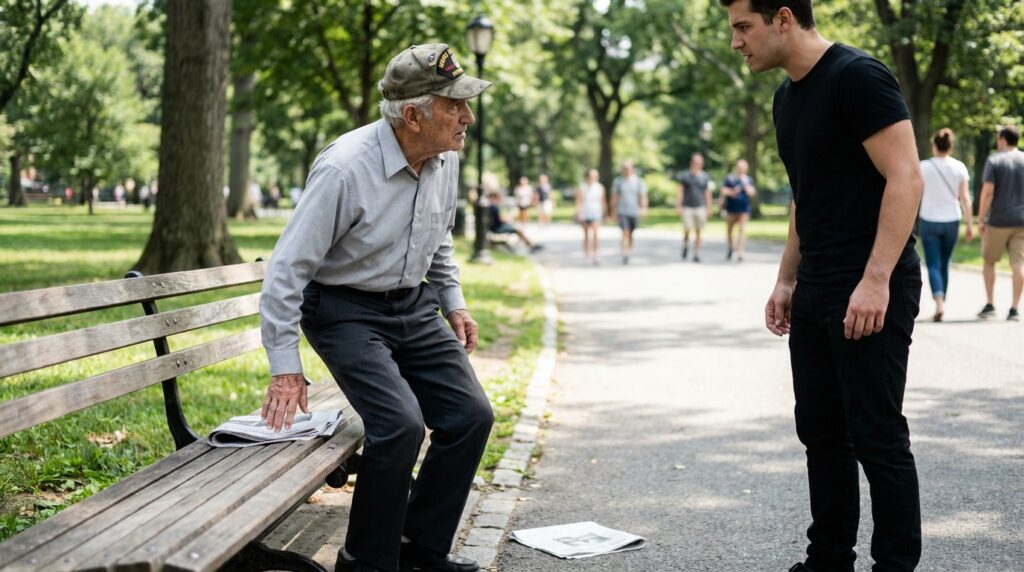
“The kid at the park bench wasn’t an accident,” John said, his gravelly tone dropping into a flat register that carried no human heat. He looked straight into the dark glass of the automated camera lens. “The push at his shoulder. The alignment of his hip. He didn’t come to humiliate an old man. He was a mechanical template. He was sent to replicate the exact spatial angle of the defector we pulled through the fence at Panmunjom.”
The green screen of the terminal flickered, a single line of amber text printing across the phosphorus grid with a series of sharp mechanical clicks: KINETIC PROMPT CONFIRMED. SIGNAL LATENCY: 0.04 SECONDS. STRUCTURAL INTEGRITY: 98.2%.
“The handler didn’t forget us, Miller,” John continued, his chest tightening as the ultimate truth of the trap settled into his spine. He reached up, adjusting the rim of his faded veteran cap, his fingers unhurried, tracking the stiff buckram fabric. “The handler isn’t even alive. It’s an automated system. A security protocol programmed in eighty-nine to monitor the surviving code-holders. The system doesn’t care about our loyalty or our retirement. It only checks the muscle memory. It checks if the tool still cuts at the designated angle.”
Behind them, the hydraulic seals on the heavy steel entry door at the top of the ramp hissed, the iron locking bolts sliding into their concrete recesses with a deep, structural thud that sealed the chamber from the outside world.
Miller dropped his head, his shoulders slumping under the weight of his old wool coat. “If the tool still cuts, John… what happens to the ledger?”
John didn’t look back at him. He didn’t look at the small, vintage revolver in Miller’s hand or the white dust settling on the newsprint tucked under his own arm. He reached down, took the warped carbine, and set it flat across the communications terminal, his calloused palms pressing into the cold iron of the receiver until the green text on the phosphorus screen went static.
“The tool doesn’t belong to the ledger anymore,” John said, his voice carrying the final, unyielding gravity of an anchor hitting the sea floor. “The tool belongs to the bench.”
He reached out with his left thumb, placing it flat against the circular punch hole of the SIM tray adapter, covering the crimson spark completely, crushing the optical fiber until the red light died behind his skin. The green cathode screen went black, the static hum of the transformer fading into an absolute, breathless silence that filled the subterranean vault from wall to wall.
He didn’t run. He didn’t seek rescue. He stood perfectly upright in the desaturated center of the room, his spine rigid, his cap straight, holding the perimeter he had built with his own two hands against the dark.








