
CHAPTER 2: THE GRAVITY OF AN ANCHOR
“Pick it up.”
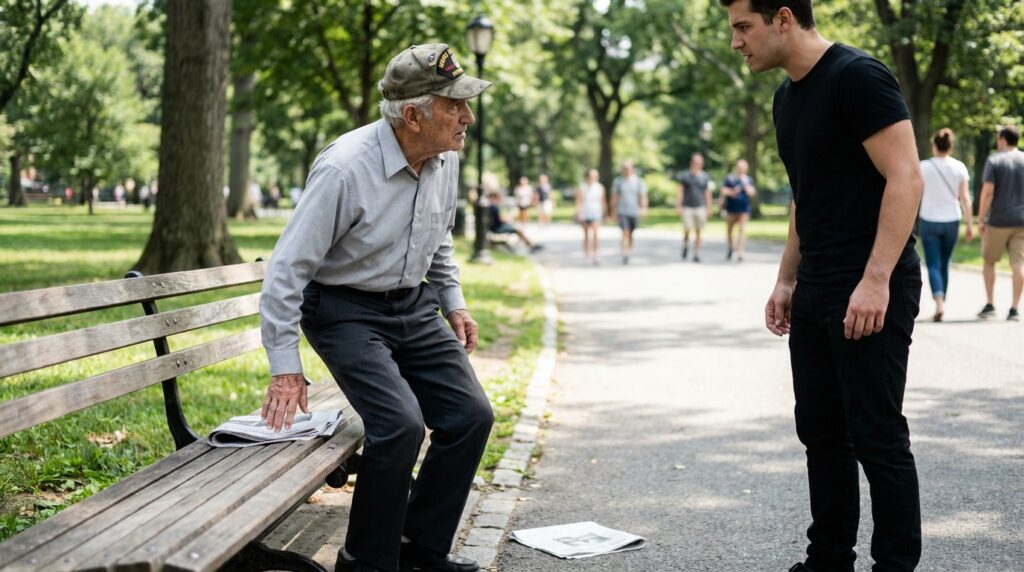
The command didn’t leave John’s throat so much as it fell from his jaw, flat and unyielding like a lead weight dropped into soft mud. He didn’t reach for the phone glowing against the gray stone. His boots remained anchored, his heels locked into the crack of the path, maintaining the exact vertical alignment that had just put two hundred pounds of athletic muscle on the ground.
The younger man was still on his back, his breath escaping him in a ragged, whistling hiss that signaled a bruised rib or a clean loss of wind. His black t-shirt was tore at the shoulder, the synthetic fabric smeared with a gray streak of park dust. The unearned confidence had drained from his eyes, replaced by the wide, empty white of a biological system experiencing sudden, total system failure. He looked at the glass screen, then up at John’s faded cap, his fingers twitching against the gravel.
“I said,” John repeated, his voice dropping into that low, gravelly register where the edges of his words scraped together like dry slate, “pick it up. And turn the face down.”
Around them, the park had gone completely cold. The jogger who had slowed down fifty yards back was now a static shape against the oak trees, her phone held out at chest level, capturing the frame but not the context. John didn’t look at her. He didn’t look at the stroller forty yards to his left either. His world had narrowed to the hard lines of the asphalt and the specific numbers flickering on the glass.
04-Alpha-09.
The characters were small, nestled in the top corner of an encrypted thread, but the syntax was unmistakable. It was the old Department of Defense routing string for the western sector of the Panmunjom corridor—a network that had been officially decommissioned and scrubbed from the active ledgers before the man on the ground was even a mark on a sonogram.
The challenger scrambled backward, his palms scraping against the grit as he reached out, snatched the device, and shoved it face-down into the grass. His athletic frame looked smaller now, his shoulders hunched as he tried to find his footing without breaching the invisible perimeter John’s posture had established.
“Alright,” the young man muttered, his teeth clicking together as he forced the words through a tight jaw. “Alright, I get it. I’m moving.”
“Who gave you the alignment?” John asked. He didn’t move an inch. His hands were loose at his sides, fingers hooked slightly, the brass coin in his pocket cold against his thumb. He was calculating the distance to the treeline, the visibility from the perimeter road, the exact seconds it would take for a standard municipal patrol car to answer a disturbance call if the girl with the phone hit the three-digit dial.
“Nobody,” the kid said, his voice rising a fraction as he found his balance, his knees shaking slightly within his black pants. “It’s just an app. A job. Some guy on the forum paid five hundred bucks to see if the guy on the third bench on Saturdays was still an active placeholder. That’s it. Just a check-in.”
“A check-in doesn’t use sector routing from eighty-four,” John said. He stepped forward—one short, heavy stride that closed the distance by twelve inches. The movement was so deliberate, so devoid of hesitation, that the younger man instinctively flinched, his heel catching on the iron rim of the flower bed behind him. “And a check-in doesn’t send a runner who knows how to drop his weight before a shoulder check. You were testing the brace.”
The kid didn’t answer. He couldn’t. His mouth stayed shut, but his eyes darted toward the phone hidden in his palm. He was a contractor, a low-tier asset bought with digital scrip and a generic description, but the hand that had programmed the interface knew exactly which nerve to poke.
John looked down at his own light gray sleeve. The fabric was unwrinkled, save for the single small smudge where the kid’s fingers had almost found a grip before the redirection took his balance. His joints didn’t ache yet—that would come in the late afternoon when the dampness from the lake crawled into his lower lumbar—but right now, the old adrenaline was working like grease in a dry transmission.
“Leave the park by the north gate,” John told him, his words clipped and transactional. “If I see your shadow on this path before the sun hits the treeline next week, we won’t use the asphalt. We’ll use the iron.”
The younger man didn’t wait for a third warning. He turned, his rubber soles slurring against the gravel as he broke into a clumsy, uncoordinated jog, his head down, his phone tucked deep into his pocket where the screen couldn’t reflect the light. He didn’t look back at the witnesses. He didn’t look at John. He just ran toward the concrete stairs leading up to the street level, his black shirt a fading dot against the gray limestone walls of the park boundary.
John stayed in the lane for exactly sixty seconds, letting his heart rate drop back into the double digits by counting the gray slats on his bench. One. Two. Three.
When the air in his lungs tasted like old dust instead of iron, he reached down and picked up his newspaper. The front page was torn near the bottom margin, a jagged white scar running through the local real estate listings. He smoothed it out with the palm of his hand, pressing the paper against his thigh until the crease was straight again.
But as he lifted the ledger to tuck it under his arm, he noticed something else. Where the kid’s phone had hit the asphalt, a small, square piece of plastic had broken away from the cheap protective casing. It was a gray SIM tray adapter, the kind used for old-generation satellite modules, and scratched into the plastic with the point of a needle was a single five-digit number: 74412.
John’s thumb went static against the paper. That wasn’t a coordinate. It was an operator insurance policy number from the old corporate oversight division in Virginia. The desk that had handled his retirement—and his erasure—thirty years ago.
He tucked the plastic fragment into his shirt pocket, right behind his veteran cap’s shadow, and began walking toward the south exit. The park was still silent, but the edges of the trees felt closer now, like the walls of an approach trench narrowing down to a single lane.








