
CHAPTER 4: THE SILENT PERIMETER
“Don’t look at the window, John.”
The voice came from two stools down. It was low, raspy, and carried the heavy, rhythmic wheeze of a smoker who had spent too many years breathing sub-zero air in northern listening posts.
John didn’t pivot his neck. His fingers remained wrapped tightly around the cold porcelain of his coffee mug, his thumbs mapping the tiny glaze cracks near the handle. In the reflection of the stainless-steel napkin dispenser directly ahead, a face took shape through the greasy laminate glare. It was an old face, structured with sharp, broken angles, half-hidden beneath the collar of a heavy wool coat that didn’t match the June morning heat.
“You’re late, Miller,” John said, his gravelly tone barely clearing the edge of his own saucer. “The lane at the south gate was cleared ten minutes ago.”
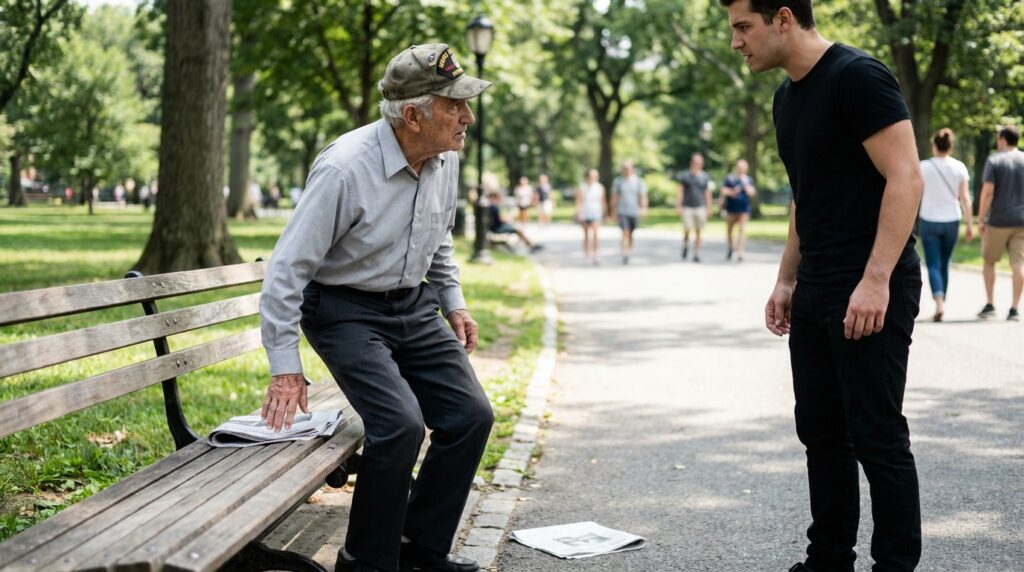
“The lane wasn’t cleared. It was rerouted,” Miller replied. He didn’t turn his head either. He kept his eyes locked on his own plate of untouched toast, his hands tucked deep inside his pockets. “The kid from the bench didn’t have an app, John. He had a transponder stitched into the waistband of those black pants. The fiber thread you’re looking at on that SIM tray? It’s not a relay link. It’s a proximity sensor. It didn’t just map your thumb lock—it broadcast your resting respiration rate and your weight-shift latency to an active satellite overhead.”
John’s internal calculation shifted instantly. The decoy secret—the five-digit insurance code 74412 pointing toward the old Virginia registry—was an intentional piece of meat dropped on the path to keep him looking down at the pavement. The true target wasn’t his past; it was his present operational capacity.
“They aren’t auditing the spreadsheet,” John muttered, his voice dropping into a flat, dangerous register. “They’re verifying the reflexes.”
“They’re verifying if you’re still a liability,” Miller said, his reflection in the napkin dispenser nodding slightly. “The old Panmunjom logs aren’t in Virginia anymore. They were migrated to a private server in a black-site bunker beneath the range in West Virginia three weeks ago. Someone is clearing the old names, John. Every single operator who carried the command codes for the eighty-four extraction is being run through a live field test. If you pass, you’re a threat. If you fail, you’re an obituary.”
A sudden, sharp click rattled through the diner’s old fuse box near the back kitchen. The buzzing fluorescent tube overhead flickered twice, casting long, erratic shadows across the grease-smeared laminate counter.
John didn’t wait for the third flicker. His strategic pursuit logic had already mapped the room’s physical layout: six paces to the heavy iron cash register, four paces to the basement stairs, and a single, unblocked exit route through the rear dishwashing scullery. He dropped two dollar bills onto the counter, his thumb brushing the torn edge of his newspaper as he gathered the ledger under his left forearm.
“Martha,” John said, his voice cutting through the low hum of the kitchen refrigerator with a clean, command-level authority. “Get behind the ice machine. Now.”
The older woman didn’t ask questions. She saw the sudden, rigid vertical alignment of John’s spine—the shift from a tired elder to an active weapon. She dropped her dish towel and stepped smoothly back into the dark recess of the pantry, her boots making no sound against the rubber floor mats.
The glass door at the top of the basement stairs didn’t open; it shattered.
A single, high-velocity projectile punched through the reinforced wire glass, showering the narrow concrete stairwell with a metallic spray of sharp fragments. The pressure wave didn’t carry the roar of a standard firearm; it was the dull, pneumatic cough of an internally suppressed tactical carbine, its cyclic rate optimized for enclosed urban spaces.
John dropped his center of gravity into the floorboards, his left hand snapping out to grab Miller’s wool collar before the older man could freeze on his stool. With a single, explosive burst of momentum, John dragged Miller off the vinyl top, using the heavy iron base of the counter stools as a partial ballistic deflector.
“They’re inside the perimeter,” Miller hissed, his breath coming in short, ragged gasps as his back hit the cold linoleum floor. His hands came out of his pockets, revealing a small, vintage revolver with a worn cylinder, its bluing completely scraped away by decades of friction. “The sedan didn’t leave. It was the blocking vehicle.”
A second projectile tore through the laminate counter six inches above John’s head, spraying a white cloud of pulverized particle board and hot grease across the newsprint. The physics of the trajectory were precise—the shooter was firing from an elevated position on the third step, using a thermal optic to trace the heat signatures through the thin wooden partition.
John looked at the gray SIM adapter lying in the dust near his boots. The tiny red spark inside the optical aperture wasn’t flashing anymore. It was solid, unblinking crimson—a complete lock. The sensor had guided the shooter directly to his seat.
He didn’t reach for a weapon; he didn’t have one. He had a faded cap, a torn newspaper, and forty years of ingrained, non-graphic tactical movement. He reached out and wrapped his calloused hand around the heavy, industrial-grade steel leg of the laminate counter table, his muscles tensing against the cold metal as the shadow of a tactical boot appeared at the top of the broken stairwell.
The decoy was gone. The survival line was narrowing to zero.








