
CHAPTER 5: THE TRANSACTION OF SILENCE
The steel stool leg groaned under the sudden allocation of John’s weight. He didn’t lift his upper torso; he drove his shoulder directly into the wood grain of the lower laminate trim, creating an immediate structural barrier between the shooter’s line of sight and Miller’s exposed ribs.
A third pneumatic cough vibrated through the basement air. The projectile punched a neat, circular aperture through the stainless-steel napkin dispenser, sending a sharp, glittering shower of paper scraps and torn chrome foil over the linoleum. The physics of the ricochet were precise—the shooter was moving down the steps with a slow, mechanical stride, the weight of a heavy tactical boot compressing the cracked concrete with calculated regularity.
“He’s using the center lane,” John whispered. His gravelly voice stayed underneath the high-pitched hiss of a punctured water line behind the dishwashing station. He didn’t look at Miller’s trembling hands. He focused strictly on the sharp shadow lengthening across the floor tiles near the broken doorframe. “He knows the layout. He’s not clearing corners; he’s tracking the fiber signature.”
“The revolver’s dry after five,” Miller muttered, his face pressed against the cold base of the counter. His fingers were locked around the old ivory grip of his weapon, but his wrist lacked the rigid tension needed to suppress a high-velocity recoil. “They didn’t give us five, John. They gave us forty-five seconds before the secondary blocking asset closes the alley.”
John didn’t answer with words. He reached out with his right hand, his thumb catching the edge of the torn morning newspaper lying in the dust. The paper was saturated with hot counter grease and pulverized particle board, but the structure was still coherent enough to serve as an environmental disruption tool. He rolled the ledger into a tight, dense cylinder, the black text of the real estate listings wrinkling beneath his calloused palm.
The shadow at the doorframe stopped. The matte-black muzzle of the carbine cleared the splintered wood, its laser guidance line a tiny, intense dot of crimson that danced across the vinyl stool caps before settling exactly on the gray SIM tray adapter on the floor.
John executed the movement before the crimson dot could shift three inches to the left.
He didn’t rise into a standing stance. He swung the heavy, rolled ledger in a short, horizontal arc across the floorboards, striking the shattered glass fragments with enough force to spray a glittering cloud of sharp debris directly toward the shooter’s low-angle visibility lane. At the exact micro-second the glass spray left the floor, John drove his boots into the linoleum, using his left hip to pivot his entire vertical column forward in a low-line tactical tackle.
The carbine discharged twice, the high-velocity rounds tearing through the back of the green stool cushions, releasing a white cloud of synthetic foam. But the momentum of the shooter was already compromised. The spray of glass fragments had forced a brief, instinctive retraction of the weapon’s hand-guard—a human flaw in a machine-like assault.
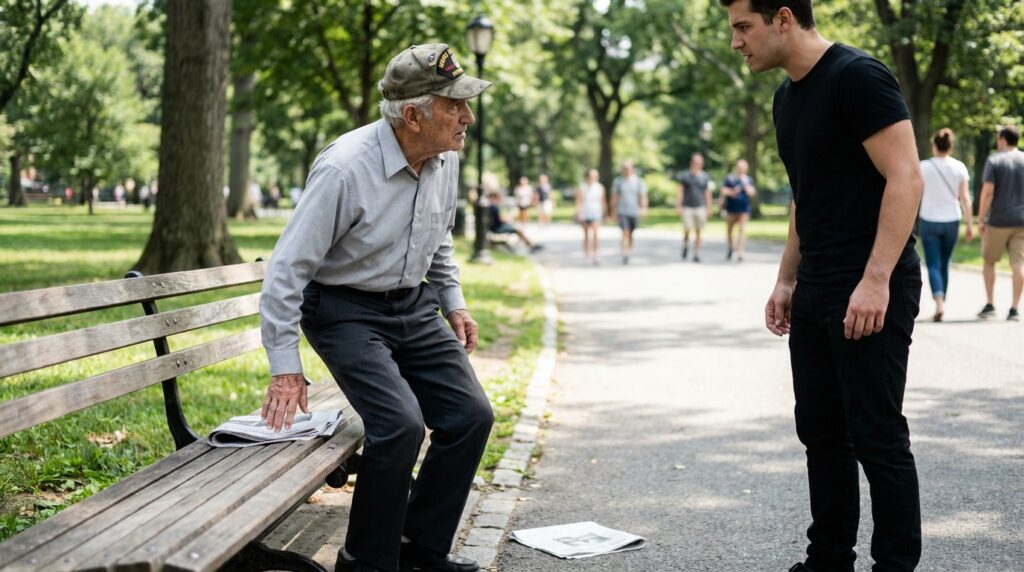
John’s left hand closed over the warm metal of the carbine’s suppressor, his thumb locking into the specific groove between the rail system and the gas block. It was the exact redirection mechanism he had used on the park path three hours earlier, expanded to accommodate the leverage of a long-gun system. He didn’t try to pull the weapon away; he added his own eighty years of mass to the shooter’s forward vector, driving the barrel down into the hard concrete edge of the lower counter step.
The steel met the concrete with a sharp, structural crack. The weapon’s bolt carrier group jammed mid-cycle as the frame warped under the weight of the impact, ejecting an unspent casing into the dust.
The shooter didn’t monologue. He didn’t drop his hands to reach for a secondary blade. He was an equal intellect—a modern asset who recognized the total failure of his primary system within a fraction of a second. He disengaged his fingers from the pistol grip, used his left knee to deliver a sharp, blunt strike against John’s anchored thigh, and used the recoil of the impact to launch himself backward through the broken doorframe.
The rubber soles of his tactical boots slurred against the concrete stairs as he retreated into the daylight above, his movements swift, silent, and entirely disciplined. He wasn’t running in panic; he was preserving his asset value for a secondary engagement lane.
John stayed on his knees for three long breaths, his fingers still wrapped around the warped barrel of the jammed carbine. His left thigh was throbbing where the knee strike had found the muscle tissue—a cold, deep ache that reminded him his system was operating far past its designed warranty date.
Miller rolled over, his old wool coat gray with linoleum dust. He looked at the disabled weapon, then up at John’s faded veteran cap, which had remained firmly on his head throughout the entire physical exchange.
“He left the transponder,” Miller said, pointing a shaking finger toward the gray SIM adapter on the floor. The crimson spark inside the microscopic aperture had vanished, replaced by a steady, dead amber light. “The satellite link is broken. But the failure code just logged in West Virginia.”
John rose slowly, his spine clicking like an old clock winding down. He reached down, picked up the warped carbine by the sling, and set it flat on the grease-stained counter beside his ruined coffee mug. He didn’t feel vindication. He felt the cold, creeping reality of a sovereign protector who had just discovered his fence lines were completely compromised.
He walked over to the pantry door and knocked twice with the back of his knuckles. “Martha. The counter is clear. Call the municipal line and tell them a grease fire shattered the front glass.”
He turned back to Miller, his gravelly voice dropping into a transactional whisper that left no room for old memory lane sentiment. “Get your coat. We aren’t going to the north gate. We’re going to the range.”
But as he pulled his hands from his pockets to adjust his cap, his fingers brushed against a secondary item that had been slipped into his pocket during the struggle—a small, laminated identification card belonging to the shooter. The photograph on the plastic wasn’t a modern contractor. It was an old portrait from the eighty-four deployment, and the face staring back through the scratches was John’s own younger self.








