
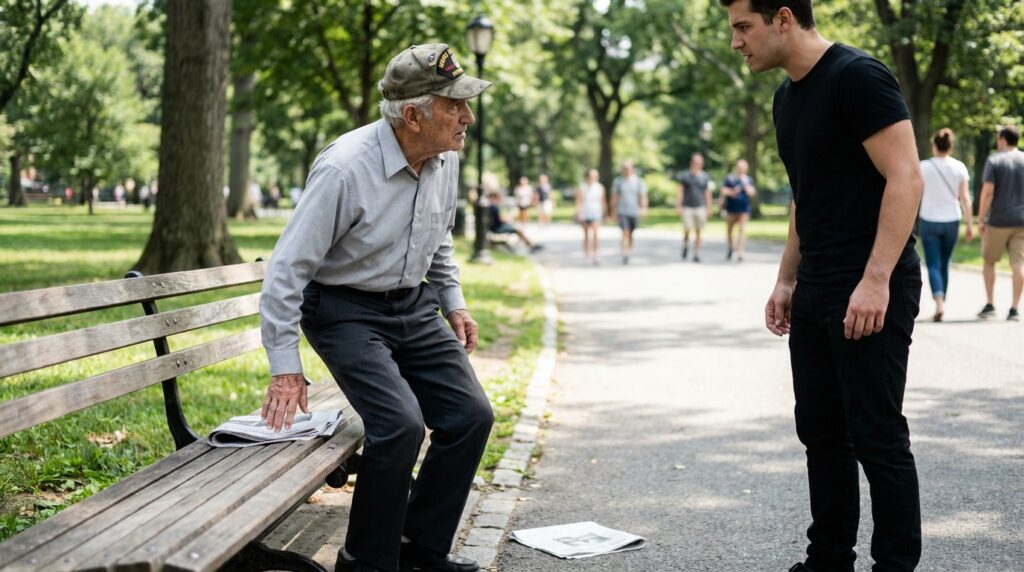
CHAPTER 3: THE BREADCRUMB ANCHOR
The limestone archway of the south gate met the street at a sharp, ninety-degree intersection. John stopped beneath the shadow of the stone, his back pressed into the cold, rough-hewn seam where the mortar had cracked over thirty winters. He folded the newspaper under his left arm, his hand resting directly above the shirt pocket containing the tiny gray piece of shattered plastic.
A silver sedan sat idling forty yards down the curb, its exhaust casting a light, rhythmic tremor through the damp morning air. The front windows were tinted to a dark, featureless sheen that defied the unfiltered sunlight. John didn’t stare at the vehicle. Instead, he watched the side-view mirror of a parked delivery truck across the asphalt lane, using the curved glass angle to track the reflection of the sedan’s front wheel alignment. The tires were turned outward toward the roadway at precisely fifteen degrees—the standard orientation for an emergency getaway or an immediate pursuit loop.
He turned the gray SIM adapter over inside his pocket with his index finger, feeling for the distinct, sharp imperfection he had noted earlier. It wasn’t just scratched with a number. Near the bottom corner, the plastic had been intentionally pierced by a circular punch—a micro-aperture used exclusively by field technicians in the late eighties to verify wire-tap integrity on analog lines before the data reached the Virginia relays.
The kid back on the path had been a crude weapon, but the hand that had packed his kit possessed an engineering signature that John could identify blindfolded.
He left the shadow of the archway, his gait even, his posture maintaining that rigid, unyielding vertical column. His boots struck the concrete pavement with a dull, rhythmic cadence. He wasn’t running; running changed the atmospheric baseline of a street, drawing the eyes of bored drivers and municipal cameras. He walked with the heavy, unhurried certainty of a man who belonged to the concrete.
The silver sedan didn’t accelerate as he moved past the bumper, but the faint, mechanical whine of an electric window motor cut through the engine noise. The glass dropped three inches. No face appeared in the gap, only the matte-black barrel of a compact directional microphone, its foam-padded tip angled directly at his left flank to catch the scrape of his boots and the rustle of his newspaper.
“The registry is closed, John,” a voice spoke from the interior darkness of the car. It wasn’t the voice of a kid from an online forum. It was dry, precise, and entirely devoid of regional inflection—the sanitized dialect of an analyst who spent decades in windowless basements reading transcripts. “You should have dropped the hat.”
John didn’t break his stride. He kept his eyes on the path ahead, his peripheral vision locked onto the sharp reflection of the car’s chrome trim. “The hat belongs to the uniform. The uniform is on the ledger.”
“The ledger was burned in ninety-four,” the voice replied, flat and transactional. “The assets were reallocated. You’re an unaccounted-for balance on an old spreadsheet, and the auditors are getting thorough.”
“Tell your operator that the runner he sent needs to work on his balance,” John said. His gravelly tone didn’t rise. It carried the solid, unhurried weight of a man who had already calculated the distance to the next brick corner. “His weight distribution is soft. If he comes back, I’ll take the leg next time instead of the shoulder.”
“He wasn’t sent to take the bench,” the voice murmured as the silver sedan began to roll forward, keeping perfect pace with John’s footsteps. “He was sent to see if you still use the left thumb lock when someone crowds your collar. You did. The sensor under his t-shirt mapped the kinetic signature in real-time. The system recognizes your signature, John. It always will.”
The window slid back up with a muted hiss, sealing the dark interior. The vehicle accelerated smoothly into the center lane, its tires humming against the asphalt as it integrated into the city traffic, leaving a faint smell of burnt premium fuel behind.
John reached the corner of Fourth and Elm, his hand going deep into his pocket to press his thumb against the hard, grooved edge of his challenge coin. The metal was warm now, heated by his skin, but it offered no comfort. The confrontation at the bench hadn’t been an act of random disrespect. It had been a calibration exercise—a physical interrogation disguised as a public humiliation attempt to force his nervous system to reveal its old training.
He turned into the narrow entryway of a basement-level diner, the door’s rusted brass latch clicking sharply under his fingers. The air inside smelled of old grease, chicory coffee, and damp wool. A row of low stools with cracked vinyl tops lined the laminate counter. He took the third stool from the end—the one that allowed a clear, unobstructed line of sight to both the street-level windows and the rear dishwashing exit.
He laid the torn newspaper on the counter, the jagged white tear on the front page exposing the blank margins underneath. He pulled the gray SIM adapter from his shirt pocket and set it down directly on top of the real estate columns, the five-digit number 74412 facing the light.
The counter clerk, an older woman with a faded blue apron and tired eyes, set a thick ceramic mug of black coffee down beside his ledger without asking for an order. She looked at the veteran cap, then at the scarred piece of plastic on the newsprint.
“Bad day at the park, John?” she asked, her voice carrying the dry, familiar cadence of someone who had seen twenty years of neighborhood regulars come and go.
John didn’t answer immediately. He picked up the coffee mug, feeling the intense, dry heat of the ceramic against his calloused palms. He looked through the low window at the street above, where the feet of anonymous pedestrians moved past in an endless, rhythmic blur.
“The park is fine, Martha,” John said, his voice dropping into the low, gravelly baseline of the room. “The ground just doesn’t hold its shape the way it used to.”
He reached down, turning the SIM adapter forty-five degrees to the right until the circular punch hole aligned perfectly with a grease smudge on the laminate counter. As the light hit the inner lip of the tiny aperture, he realized the hole wasn’t empty. Tucked inside the microscopic recess was a translucent thread of optical fiber, still pulsing with a faint, intermittent red spark that matched the cadence of his own heartbeat.








