
CHAPTER 8: THE THIRD BATTALION COVENANT
The noon siren from the waterworks didn’t sound like a warning; it sounded like an engine running out of water. It vibrated through the zinc roofing of the market stalls, causing the condensation drops along the iron eaves to break and fall into the rain-washed gravel below.
Miller stood by the central winch assembly, the green canvas logbook pressed flat against his ribs by his left elbow. The rain had picked up, turning the gray slurry around his boots into a uniform sheen that reflected nothing but the dark, rectangular outlines of the cargo flatbeds parked across the street lanes.
They weren’t city trucks anymore. Two black commercial vans sat behind the concrete jersey barriers, their diesel engines idling with a low, hydraulic hum that made the iron support pillars thrum against Miller’s shoulder.
The Colonel did not step from a vehicle. He came out from the narrow breezeway behind the dry-goods stall, his heavy wool overcoat open down the front, his hands deep in the pockets. Beside him walked the city surveyor—a small, sharp-featured man with an aluminum clipboard tucked beneath his arm like an old ledger. The surveyor’s shoes were thin-soled leather, already turning dark and soft from the puddle water.
“You’re thirty minutes ahead of the permit shift, Sergeant,” the Colonel said. His voice was perfectly level, carrying through the damp air with the dry, flat authority of a master-roll call. He stopped five feet from the concrete edge where the zinc tables began.
Miller didn’t take his hand out of his pocket. His thumb was still hooked into the hem of his trousers, holding his weight centered over his heels. “The ledger from Vance’s safe lists the individual parcel shares, Colonel. It has twenty-two names from the third logistics guard attached to the corporate option. Your signature is on the clearance voucher from ninety-eight.”
The surveyor stepped forward, his pencil tapping against the aluminum lip of his clipboard with a small, frantic tack-tack-tack. “The property duplicate sheet has been certified by the district office, friend. The tenant lease for room four-B was terminated for structural instability at eleven o’clock. You don’t have a locus standi on this concrete. If you don’t clear the winch lane, the municipal code team executes the eviction under section nine.”
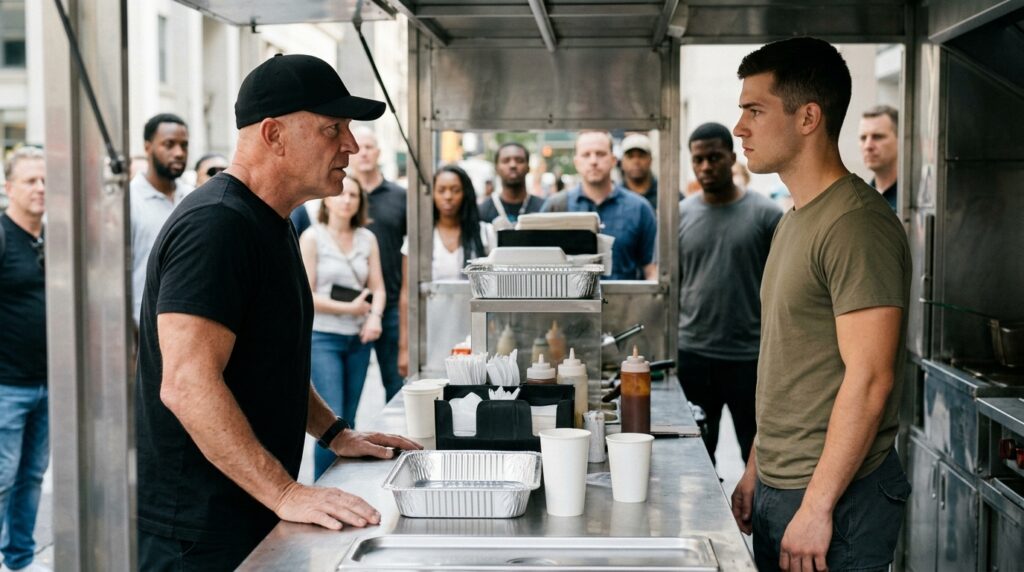
Miller looked at the surveyor. His eyes were small, gray points under the brim of his black cap. He didn’t speak to the clerk; he kept his gaze fixed on the center button of the Colonel’s coat, where the wool was worn shiny from the friction of a seatbelt.
“The brickwork under Artie’s counter isn’t hollow,” Miller said, his rasp dropping low, cutting through the hydraulic hum of the vans. “The limestone shelf runs straight through to the river wall. You didn’t file the core drillings with the state land bank. You filed the duplicate sheets from the old rail foundation.”
The Colonel pulled his right hand from his coat pocket. He wasn’t holding a weapon. He held a rusted, rectangular steel plate—an original serial tag from an M-series water-pump trailer, the kind issued to the logistics reserve during the winter of the foundry shut-down. He laid the plate down on Artie’s wet zinc counter, right where the pork skewer grease had congealed into white rings.
“The ledger doesn’t change the tonnage, Miller,” the Colonel said, his eyes tracking the red rust dust that flaked off the plate onto the zinc. “The fund pays out sixty-four thousand dollars to the retirement pool every quarter. That’s twenty-two widows in the north-end tenement block who eat because Vanguard clears the freight lanes through these squares. You aren’t protecting a neighborhood, Sergeant. You’re trying to stop an oil pump with an old boot.”
“The vendors built the stalls with their own iron,” Miller said.
“The vendors used the salvage we left behind when the tracks were lifted,” the Colonel replied. He stepped closer, his wool coat smelling of cold rain and tobacco smoke. “The company paid for the gravel under your boots, Miller. Every grain of it. You spent twenty-five years watching the gate because you didn’t want to see what was inside the trucks. Now you’re looking inside, and you don’t like the inventory. But you still take the three hundred and twelve dollars on the first of the month.”
The silence that followed was heavy, filled only by the rhythmic drip-drip of the rain against the green canvas book under Miller’s arm.
Miller looked down at his own hand. The rust from Vance’s safe had worked its way into the small cracks around his knuckles, matching the gray coloration of the skin. The Colonel was right about the ledger—the machine didn’t have an external fuel supply. It ate its own parts to keep the pistons moving.
“The winch has eighty feet of line,” Miller said, his voice flat as a slab of cold iron. He reached out with his left hand and took the rusted serial plate from the counter, his fingers closing around the metal until the flaking corners bit into his palm. “And the flatbed chassis is tied to the central pillar. If your team starts the saw, we find out how much iron is left in the foundation before the state inspector arrives.”
The surveyor looked at the Colonel, his pencil dead against the aluminum board. “Colonel… the timeline. If the winch pulls the column, the roof collapse voids the insurance exemption.”
The Colonel didn’t look at the clerk. He stayed fixed on Miller, his head tilted slightly, measuring the tension in the veteran’s jaw. He had seen that look before—on the river docks, when the logistics guard had held the perimeter against the union crews for fourteen days without a fresh water delivery. It was the rigidity of a structural beam that had been loaded past its tolerance limit, waiting for the crystal structure to snap.
“You’re going to lose the room anyway, Sergeant,” the Colonel whispered.
“I’ve got the bag on the step,” Miller said.
He turned his back on the black vans, his heavy boots making a wet, crunching sound in the gravel as he walked toward the winch lever. He didn’t look back to see if the surveyor was signing the clearance order or if the drivers were stepping down from their cabs. He took his place against the central iron column, his hand resting on the rusted handle of the recovery line, his body becoming nothing but another static fixture in the gray, industrial rain.








