
CHAPTER 6: THE PERIMETER FENCE
The headlights of the flatbed arrived at exactly three minutes past midnight. They didn’t use high beams; they ran on low-set yellow fog lamps that cut through the market’s river mist, turning the wet vinyl tarps into a row of shiny, black humps.
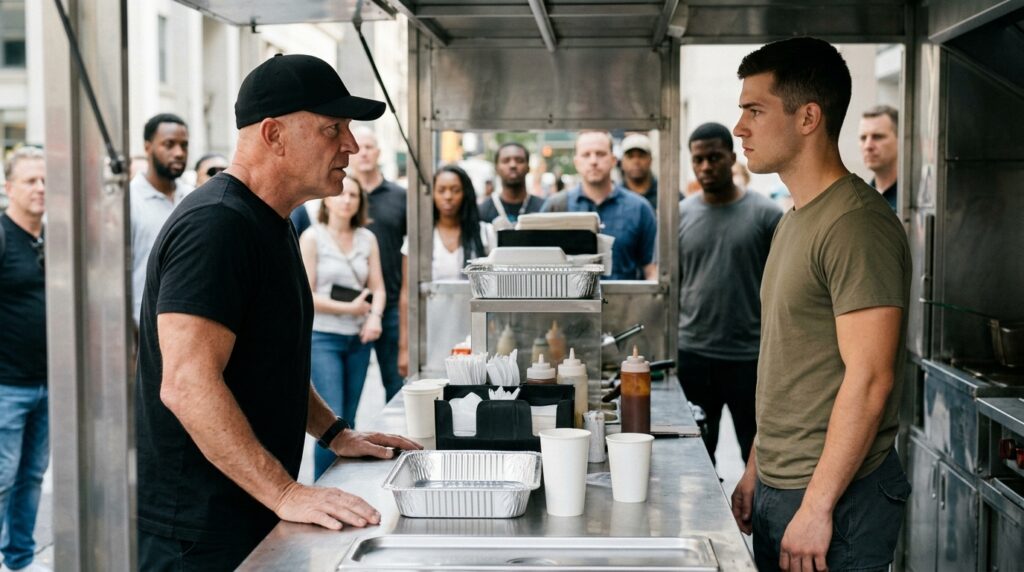
Miller stood beneath the awning of Artie’s stall. His black cap was pulled low enough to shelter his eyes from the glare, his shoulders pinned against the main iron support beam. He hadn’t slept. His skin felt like old parchment that had been left near a dry stove, and his hands were tucked into the waist seam of his trousers, right above the pockets where his fingers could stay flat.
The truck air-brakes let go with a wet, flat pfft-shhh that shook the soot from the corrugated iron roof overhead. Behind the first flatbed came a second—a three-ton utility rig carrying six pre-cast concrete jersey barriers, their gray flanks still damp from the casting molds, smelling of wet lime and aggregate.
A man stepped down from the utility cab. He wore a heavy canvas jacket with the Vanguard Logistics patch sewn flat across the shoulder blade, but he didn’t have the ledger this time. He carried a heavy, gas-powered rotary saw with a diamond-grit blade meant for chewing through reinforced street slabs.
“Clear the flagstones,” the driver shouted into the dark. He didn’t see Miller in the shadow of the pillar yet. He was looking at the wooden structural stakes he’d driven into the gutter an hour before—pegs wrapped in high-visibility orange tape that marked where the chain-link enclosure was supposed to anchor.
Miller didn’t shout back. He moved out from the pillar, his boots making no more noise than a dry sack of grain sliding across a plank. He had an eighty-foot length of seven-eighths industrial steel cable coiled over his right shoulder, the heavy copper sleeves at the terminal loops glinting like old teeth in the yellow fog glare.
The saw-operator stopped ten feet from the first stall, his fingers resting on the pull-cord of the engine. “We’re on the clock, old man. The city waiver is active as of twelve-and-one. This square is quarantined for structural reinforcement.”
“The cement hasn’t cured on your pegs,” Miller said. His rasp was thin, carrying the dry, scraping quality of iron filings in an ungreased axle. He dropped the coil of steel cable onto the concrete at the driver’s feet. The metal met the stone with a heavy, multi-layered clink that sounded like a shovel hitting stone. “And the woman who owns the dry-goods stall still has forty cases of salt-pork under the floorboards. Turn the truck around.”
The driver from the second rig—a wire-tight man with the short, scarred haircut of an institutional guard—stepped into the light. He didn’t look at Miller’s face. His eyes went straight to the cable at his feet, then to the iron winch frame Miller had bolted into the base of the central market pillar during the four o’clock shift.
“That’s a logistics recovery line,” the guard said, his voice level and transactional. “That’s third battalion property, Sergeant. The serial numbers are stamped on the sleeve.”
“The sleeve belongs to the yard behind the tracks,” Miller told him. “And the yard had an open gate tonight. If you start that saw, the torque from the central winch is going to take the front axle off the utility rig before the blade touches the mortar. I’ve got the return loop anchored through the chassis of your own flatbed.”
The saw-operator looked back at the truck, his face turning the color of wet cement as his eyes tracked the dark line of the cable. It ran low, grease-blackened and nearly invisible against the wet concrete, winding through the rear dually wheels of the flatbed and back up to the iron winch on the pillar. Miller hadn’t built a defense; he’d laid a structural trap. If the truck moved forward to drop a barrier, the cable would draw tight across its own transmission housing.
“He’s bluffing,” the saw-man muttered, though his hand stayed clear of the starter cord. “The old man’s a tenant. He isn’t going to pull down the roof he sleeps under.”
“The roof isn’t mine,” Miller said, his thumb tracking the rusted edge of the iron winch lever. “The pension isn’t mine either. The Colonel made that clear at the butcher shop. Since I’m using spent coin anyway, I don’t need to count the change.”
The guard took two steps back, his right hand slipping into the interior pocket of his canvas coat. He didn’t reach for a pistol; he pulled a small, black tactical radio with a reinforced antenna. He didn’t look at Miller while he spoke into the grille.
“Vance,” the guard said, his breath fogging the plastic casing. “The ghost is on the flagstones. He’s got the yard cable wrapped around the utility chassis. If we drop the lime blocks here, we lose the oil pans on both rigs.”
A voice came back through the radio—small, jagged, distorted by the iron frames of the overhead railway line a block away. “Don’t split the line. The surveyor is at the pasha-office until two. If the Sergeant wants to sit on the concrete, let him sit until the grease goes cold. We don’t need the saw to clear the permits. Tell him his room at four-B just had the latch changed.”
The radio went dead with a dry, static hiss.
The guard tucked the radio away and looked at Miller, his face completely smooth under the yellow fog lamps. “You’ve got twelve hours of grease left in those stalls, Miller. When the sun comes over the foundry wall, the vendors won’t show up. They’re small-holding people. They know the difference between a broken window and a closed ledger.”
“They know the smell of a clean floor,” Miller said.
The flatbed engines didn’t turn off, but the driver shifted the utility rig into reverse, the gears whining in the narrow street as the trucks backed away from the orange-taped stakes. The yellow light receded, leaving the square in the dirty, indigo dark of the early morning.
Miller didn’t drop his hand from the winch lever. He stayed against the pillar, his boots pinned to the seam where the concrete met the old stone, his skin catching the gray damp as the river fog began to turn into rain. The rust on the cable was already bleeding onto his shoes, leaving two dark, orange crescents in the dust at his feet.








