
CHAPTER 5: THE LINES IN THE DUST
The dark did not stay still. Miller moved through the exit frame before the heavy door of the locker could seal its vacuum completely. His boots found the grease-crusted gravel of the rear alleyway, his lungs rejecting the lard-soaked interior air for the dry, iron-heavy scent of the evening block. The neighborhood was settling into its twilight gray, the color of a wet slate shingle.
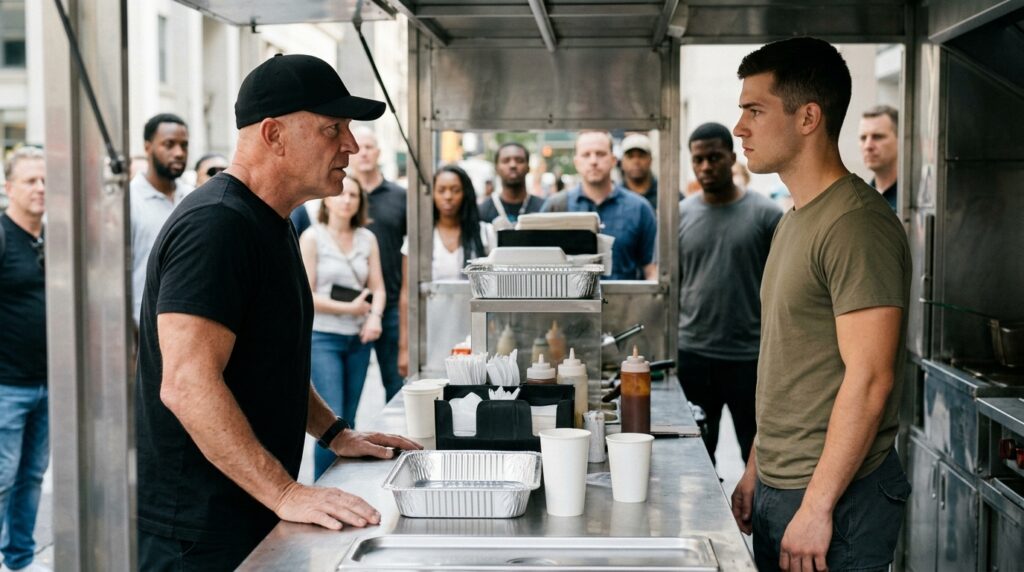
He did not pack a bag. He did not go to the rent office to pull his name from the ledger. A man who learns that his own shelter is bought with the teeth of his neighbors doesn’t negotiate for an extra night. He went back to the open square, his large hands buried deep in the pockets of his black t-shirt, his thumb still holding the cold edge of the 0-4-1-2 brass casing against his thigh.
The market stalls were turning off their low-wattage bulbs. Artie was pulling a heavy, blue vinyl tarp over the zinc food counter, his old knuckles white where he knotted the hemp rope to the iron eyelets. The rope was frayed, shedding tiny, pale fibers into the grease-stained concrete.
“Artie,” Miller said.
The vendor flinched, his shoulder blades hitching beneath his faded flannel shirt. He didn’t turn around until the third knot was cinched down. When he finally faced Miller, his face looked like a field that had been plowed too many times in a dry year.
“You shouldn’t be on the flagstones, Miller,” Artie said, his voice dropping into the small space between the tarps. “Vance’s people came through after you left the counter. They weren’t broken up about the boy. They were looking at the posts. Measuring the distance between the support beams.”
Miller leaned his bulk against the corner pillar of the stall. The iron was cool now, its coat of industrial primer peeling off in stiff, dark scales that looked like scabbed skin. He reached down and ran his finger over the structural column. Two inches above the concrete base, someone had scratched a set of three intersecting lines into the iron with a hardened steel file.
It wasn’t a surveyor’s mark. It was a grid-marker from the river docks. Three crossed keys. The battalion’s boundary language, laid down on the market floor twenty years after the weapons had been put into oil.
“They’re coming on Wednesday,” Miller said. It wasn’t a question.
“They said Wednesday midnight,” Artie whispered, his hand drifting toward his empty apron pocket. “The city team signed the structural failure notice two hours ago. They posted it on the laundry door. We’ve got forty-eight hours before the barriers go up. My family has had this zinc since forty-five, Miller. My father sold boiled lard here when the trains were still running on coal.”
“They aren’t going to fix the gas lines, Artie.” Miller’s rasp was low, flat, carrying the mechanical clarity of a dead reckoning. “They’re going to put a gravel yard here for the logistics trucks. The money that’s buying this block belongs to the people I guarded the river with.”
Artie looked at him for a long beat, his old eyes shifting from Miller’s black cap down to the heavy, scarred boots pinned to the pavement. He didn’t ask for an explanation. In this neighborhood, people didn’t ask how the rust got into the well; they just knew when the water tasted like nails.
“What are you going to do with your five days, Sergeant?” Artie asked.
Miller looked across the empty square. The younger elements were gone from the corners, but the silence they left behind wasn’t peace. It was the specific, hollow stillness that happens when a perimeter is being cleared for an incoming mortar bracket. He could feel the old architecture clicking back into place inside his skull—the weight of objects, the width of the lanes, the time it took for an iron door to swing shut against a frame.
“We don’t give up the counter,” Miller said. “Get the others. Tell them to leave the tarps off tomorrow. We wash the zinc.”
He walked away before Artie could answer, his boots rhythmic against the concrete. He didn’t head toward his room. He went to the gravel lot behind the railway line where Vance kept the salvaged industrial machinery and the old iron pipes from the foundry floor.
The gate was a six-foot span of chain-link, held together by a single rusted padlock that had lost its branding to the weather. Miller didn’t look for a key. He inserted the short, thick brass casing he had carried from the counter directly into the latch mechanism, using the hardened base of the cartridge as a lever against the frozen tumbler. With a short, heavy twist of his wrist, the brass bit into the internal pins. The lock gave way with a dry, metallic tink, the shackle falling clear into the dry dirt.
He pushed the gate open. The iron rollers ground against the gravel, leaving a deep, raw furrow in the dust.
Inside, the machinery sat like dead horses in the gray dark—heavy, cast-iron lathes, rusted boilers with their copper piping ripped out, and stacks of reinforced steel road-mats used for stabilizing heavy vehicles in soft mud. The Vanguard emblem was stenciled on the side of every crate in faded yellow lead-paint.
Miller walked to the center of the yard, his hand coming to rest on the cold, pitted flank of an old diesel generator. The iron was dry, smelling of old kerosene and long storage. He knew this machine. He had maintained its filters during the winter of ninety-eight when the river docks froze over.
He wasn’t a civilian anymore. He wasn’t a tenant in four-B waiting for his pension check to clear. He was the sovereign protector of the concrete square three blocks down, and he knew exactly how much weight an ungreased hinge could bear before it ripped the frame out of the brick.
He reached into his pocket, pulled out the small laminated deed he had taken from the butcher’s island, and dropped it into the oil-catch basin beneath the generator. Then he struck a single wooden match against his thumbnail. The small, orange flame illuminated the three crossed keys on his palm for one micro-second before he dropped it into the grease.
The fire didn’t explosion; it took its time, a low, blue crawl that fed on the old tallow and the dry dust, slowly warming the iron until the metal began to smell of its own history. Miller didn’t stay to watch it burn. He turned back toward the market, his shadow stretching out long and jagged across the rusted yard, his boots already finding the rhythm of the next deployment.








