
CHAPTER 2: THE GRAIN IN THE CORROSION
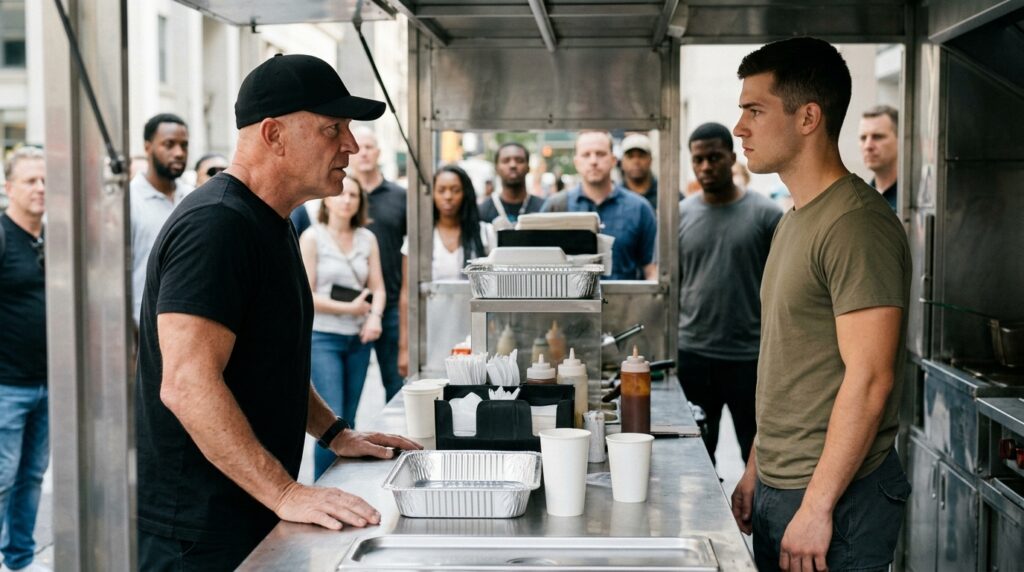
The brass casing was cold, far colder than the sticky afternoon heat hanging beneath the food vendor’s tarp. The veteran’s thumb traced the tiny, stamped numbers on the rim. 0-4-1-2. It was a lot number he hadn’t seen since the winter the smoke stopped rising from the north-side foundry stacks. It was ordnance that shouldn’t exist in a neighborhood market, wrapped in the lining of a civilian coat pocket he’d worn every day for three years.
He didn’t look down at his pocket. He didn’t blink. He smoothed the three wrinkled dollar bills across the grease-slicked zinc counter and let his hand drop to his side, the brass tucked securely beneath his calloused palm.
“Your pork, Miller,” the vendor muttered. The old vendor’s hand shook as he slid the white styrofoam container across the metal. He wouldn’t look Miller in the eyes. His gaze kept dipping down toward the concrete behind Miller’s boots, where the boy in the olive shirt was still dragging his ribs across the grit, trying to find his feet without vomiting.
“Thanks, Artie,” Miller said. His voice was a flat rasp, completely unhurried.
The market was still dead quiet, but it was an active silence now. It was the kind of quiet that happens right after a structural beam cracks in a basement—nobody moves because everybody is waiting to see which way the roof slants. Miller turned away from the counter, his heavy boots making a dull, gritty sound against the pavement. He didn’t look at the boy. He didn’t look at the small group of teenagers hovering near the corner of the alley, their hands jammed into the pockets of their oversized jackets, their phones held low to record the aftermath.
He walked. The neighborhood didn’t open up for him; it simply thinned out, the people receding into the shadows of the blue-tarped awnings, their faces blurred by the low-wattage glare of the food-stall bulbs.
Miller took the long way back, down the corridor behind the abandoned dry-cleaners where the brickwork was soft and white with salt-bloom. Every surface here was losing its grip on the world. The iron fire escapes overhead were shedding thick, dark flakes of rust that accumulated in the corners of the window sills like black sugar. This was the friction he understood—the slow, mechanical wear of time against materials that had never been given enough paint to survive.
He stopped at the mouth of the alley facing the old commercial block. A hundred yards away, two men in clean, heavy-canvas work jackets were standing by the reinforced back door of the abandoned butcher shop. They weren’t locals. Locals didn’t wear boots with Vibram soles that hadn’t been scuffed by iron filings or foundry dust. They stood with their weight distributed evenly, their heads turning in small, synchronized arcs that took in the sightlines of the entire block. One of them held a black leather ledger; the other was adjusting an optical device attached to the brickwork right beneath the rusted ventilation hood.
A surveillance tap. Commercial grade.
Miller slouched into the shadow of a commercial dumpster, his bulk vanishing into the dark space between the brick and the rusted iron. He didn’t reach for a weapon because he didn’t carry one; his weapon was forty pounds of dense, functional bone structure and a habit of noticing the sequence of small things.
The man with the ledger spoke, his voice carrying clearly over the empty alleyway. “The kid messed up at the counter. Some old timer dropped him.”
“Does it shift the timeline?” the second man asked. He was adjusting the lens on the brickwork. The small glass eye was pointed directly at the main entrance of the food market.
“No. The vendors are already behind on the seasonal permit fees. The surveyor signs off on the structural integrity failure for the south wall on Tuesday. By Friday, the code enforcement team shuts down the block. The kid’s crew was just supposed to keep the foot traffic down so the numbers look worse on paper. If they can’t handle a local senior citizen, we use the legal leverage early.”
“The old man used an institutional press-and-drop,” the second man muttered, his fingers clicking against the metal casing of the tap. “Artie’s customer log calls him Miller. No record of him buying property here. He’s a ghost in a rented room.”
“Ghosts don’t have deeds,” the ledger man said, closing the book with a sharp, dry snap that sounded like a small-caliber pistol shot in the narrow space. “Tell the boy’s brother to clean up the mess at the market. If Miller stays on the concrete, remove the concrete.”
They moved inside, the heavy metal door of the butcher shop clicking shut behind them with a heavy, oiled precision that didn’t belong to a bankrupt neighborhood.
Miller remained in the dark for five minutes after the latch caught. The pork in his hand grew cold, the grease congealing against the white styrofoam in a dull, yellow ring. He reached into his pocket and pulled the brass casing out again, holding it up to the faint gray light filtering between the buildings.
The serial number didn’t just match the foundry lot. It matched the high-pressure ammunition issued to the third battalion logistics guard during the defense of the river docks twenty-six years ago. His unit. The unit he’d signed the retirement ledgers for before taking his pension and searching for a town where nobody asked about the limp or the missing skin on his forearms.
The casing hadn’t been dropped in his pocket by accident. It had been slipped there during the crowd’s confusion at the counter, or earlier, while his coat hung from the peg in his communal hallway. Someone was playing a very specific game with the boundaries, using pieces that had been cut from his own bone.
He didn’t go back to his room. He walked toward the rear entrance of the butcher shop, his hand sliding along the rough, flaking iron of the drainage pipe. The rust came off in dry powder, staining his palms the color of dried blood. He had spent ten years trying to forget how to map an interior layout from the position of the external vents, but the old architecture didn’t require memory. It was just a reflex, waiting for the tooth to catch the gear.
He reached the back door. The lock was a heavy, five-pin tumbler, but the frame was ancient—the wood around the strike plate had rotted down into soft, gray fiber that smelled of damp earth and old lard. He placed his heel against the iron trim, his knee flexing slightly to lock the joint.
He didn’t look around to see if the alley was clear. He knew exactly who was watching from the windows above, and he knew they wouldn’t say a word.
With a single, controlled drop of his weight, he drove his boot into the seam. The wood gave way with a low, wet groan, the screws pulling free from the soft rot like nails out of lard. Miller stepped into the dark interior before the splinters hit the floor, his head low, his cap pulled down until his eyes were nothing but two cold points in the gray dark.








