
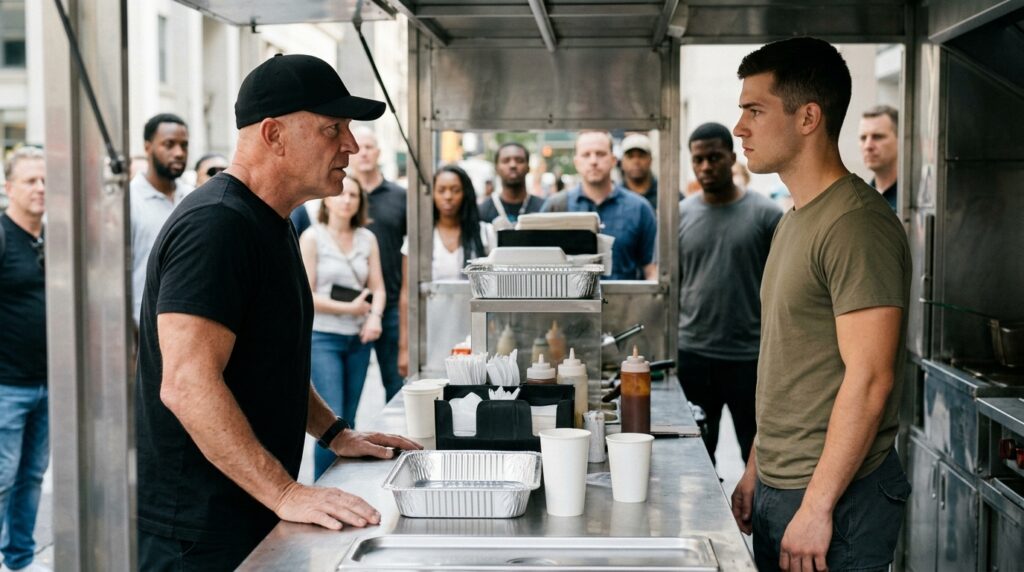
CHAPTER 1: THE WEIGHT OF THE COLD COUNTER
“Step back from the tray, son.”
The words didn’t travel far. They were heavy, flat, and lacked the performative volume of a man looking for an audience. They belonged to the desaturated afternoon heat of the market, where the smell of burnt grease and old iron sat thick in the throat.
The boy in the olive shirt didn’t move his hand from the stainless steel rail. He was twenty, twenty-two at the absolute limit, with the lean, wire-tight muscle of someone who ate poorly but worked hard at keeping a grudge. His fingers stayed balanced next to a sweating plastic cup of ice water. Around them, the murmur of the open-air market dropped three octaves until the only remaining sound was the rhythmic, metallic thunk of a cleaver three stalls down hitting a dense plastic cutting board.
“You’re an old man,” the boy said. His voice had the raw, jagged edge of a local turf claim, a needle scraping a dry groove. “You don’t own the square footage. My people have been on this concrete since the factories turned off the lights.”
The veteran didn’t lean in. His bald head was slick under the lip of his black cap, reflecting the gray, industrial glare of the overcast sky. His plain black t-shirt hung tight across a pair of shoulders that had spent forty years learning how to carry heavy metal without shifting balance. To his left, a white styrofoam container of pork skewers remained perfectly still on the zinc counter.
“The grease here stays in the pores for a week,” the veteran thought, his eyes tracking the minute twitch in the boy’s right jawline. It was a maintenance calculation. He didn’t see a villain; he saw an ungreased hinge that was bound to snap if someone kept kicking the door. He noticed the red, raised scar across the boy’s second knuckle—fresh, poorly cleaned, smelling faintly of cheap antiseptic.
“Three inches,” the veteran said, his gravelly tone dropping lower, direct and transactional. “Move your hip three inches to the left, clear the lane for the woman behind you to take her bag, and we can leave the air inside this tent exactly the way we found it.”
The boy laughed, but his feet shifted. It was the wrong shift—weight dropping back onto the left heel, the shoulder pocket tightening to telegraph a short, lifting hook. He wanted the crowd to see the leverage. He wanted the neighborhood to watch the obsolete machine get moved out of the path of the new traffic.
The movement was too loud. To a man who measured life by the tension of tripwires and the predictable click of a firing pin, the boy’s aggression was an unformatted ledger.
The veteran didn’t wait for the fist to clear the hip. He didn’t even drop his head.
His left hand shot out like a hydraulic piston, catching the boy’s olive sleeve right at the meat of the tricep, anchoring him to his own bad balance. Before the boy’s boots could find purchase on the grease-filmed concrete, the veteran’s right palm drove directly into the center of the boy’s collarbone—not a punch, but a heavy, sweeping shelf of bone and momentum.
There was a dry, hollow whump as the boy’s spine met the hard pavement.
The service items on the counter didn’t dance. The plastic cup of ice water didn’t spill a single drop across the zinc. The veteran remained completely upright, his boots pinned to the exact same seam in the concrete, his chest rising and falling in a slow, metronomic rhythm that didn’t demand an extra ounce of oxygen.
The silence that followed was rusted solid. Nobody moved to help the youth up. Nobody called out. The neighborhood just watched the old man stand over the dirt, his black cap casting a long shadow across the boy’s wide, unblinking eyes.
“Stay down,” the veteran said. The words were cold iron. “Think about the price of the repair before you break the tool.”
The boy breathed in short, ragged gasps, his fingers clawing at the rough grit of the floor. He didn’t reach for his pocket. The survival instinct had finally overridden the pride, leaving him small against the gray sky.
The veteran turned back to the counter, his large hand sliding into his t-shirt pocket to pull out three wrinkled dollar bills for the vendor. As his fingers brushed the coarse cotton, his thumb caught on something small, hard, and metallic tucked deep in the seam—a small, brass casing that shouldn’t have been there, cold to the touch and stamped with a military serial number he hadn’t seen since the year the local foundry closed down.








