
CHAPTER 7: THE SHADOWED BALANCE
The unpainted brass key lay flat against the wax-coated manifest, its raw edges catching the sharp, green glare of the fluorescent tubes until the metal looked grey as zinc. It didn’t possess a registration notch. Its surface was scored with thin, longitudinal lines from a manual file—the coarse, jagged teeth marks of a workshop modification meant to bypass the master cylinder pins in the administrative lockers.
Miller didn’t pick up the key. He reached down with his bare right hand, his fingers spreading across the rough pine edge of the desk to anchor his weight.
The third lumbar vertebra didn’t spike with pain this time; it went entirely cold, a dead, stone-like block that seemed to sink through his tactical trousers toward the concrete foundation. The silence coming from the open doorway was total now. The sub-basement generators had settled into a low, harmonic drone that vibrated the glass inkwell on the ledger desk, making the violet ink ripple in small, concentric rings that never hit the lip.
He looked up at the reinforced observation window across the hall. The reflection of the overhead fluorescent panels didn’t shift, but the heavy iron frame of the balcony door directly above the gym floor gave a single, muffled clack as the hydraulic seal was released from the inside.
A figure stood on the metal gantry, his boots making a dull, ringing sound against the rusted steel mesh as he walked to the railing. It wasn’t Vance. The silhouette was taller, the shoulders curved slightly forward beneath a standard-issue green flight jacket that lacked any rank insignia or name tapes. The fabric at the elbows was worn down to the white weave, frayed from decades of leaning over the chart tables of littoral combat ships.
It was Henderson.
The old commander didn’t call down to the floor. He kept his hands tucked into the deep pockets of his jacket, his gaze tracking the line of the heavy punching bags until it settled on the unseated recruit, who was finally pulling his gear out of the training lane. Up close, from forty feet below, Henderson’s face looked like a block of salt-cured wood—the lines around his eyes split and deep from the glare of northern oceans, his jawline motionless beneath a thin layer of grey stubble.
Miller took the square of folded carbon paper from his waistband. His fingers moved slowly, the puckered, white skin of his palm catching on the dry edges of the sheet until it opened with a loud, paper-crisp snap that echoed down the narrow terrazzo corridor. He didn’t use Hauer’s brass key to unlock the storage cases. He didn’t need to change the registry entry.
The decoy secret—the file Vance had carried to prove Miller was a medical liability—was nothing but wastepaper. The violet ink signature from the division office hadn’t been stamped to force a retirement; it had been logged to provide an administrative blind. If a man was officially marked as broken on the base ledger, his name disappeared from the electronic satellite tracking system used by the regional command structure.
The true ledger was the wax-coated sheet on Hauer’s clipboard. It was a mobilization order for an unlisted vessel currently sitting three miles outside the salt marsh at the ammunition pier—a run that required an operator whose spinal column was already dead enough to pass a mechanical sensor scan at the border checkpoint. Henderson hadn’t been trying to clear an old liability off the books. He had been trying to build a wall of paper around the only man left who could pull the trigger without leaving an electronic footprint in the defense network.
“The shift is cycling, John.”
Vance’s voice came from the foot of the gantry stairs, but it lacked the sharp, administrative edge it had carried twenty minutes ago. He was standing near the rubber mats, his low-quarters covered in the thin grey foam dust from the recruit’s fall. He looked up at Henderson, then back at Miller’s bare hands, his fingers twitching against the side of his utility trousers where the medical reassessment folder had been tucked away. He had realized, too late, that he was the only person in the bay who had been reading the public version of the log.
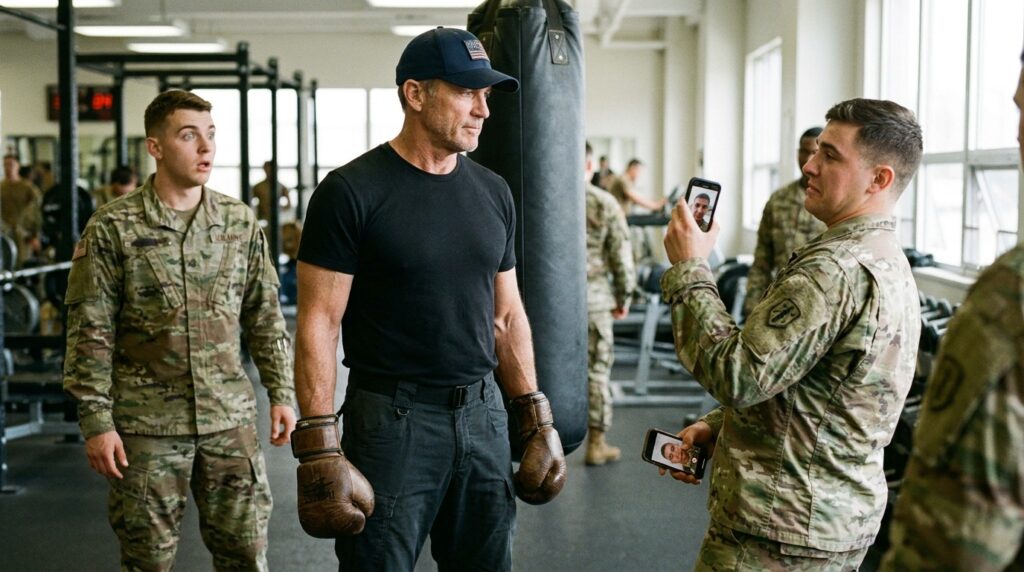
Miller walked out of the office, his smooth-soled boots making that regular, dragging skitch against the concrete floor until he reached the heavy bag station. The smell of the raw cotton and the salt fog drifting through the high louvers was stronger here, cold enough to make his sweat-damp t-shirt stick to the skin between his shoulder blades.
He stood beside the bag, his bare right hand catching the iron chain link to stop its final, microscopic sway. The metal was grease-black, cold enough to leave a dark ring across his calloused palm. He didn’t look up at the gantry railing again. He looked down at the younger recruits, who were now standing in a tight, silent semi-circle near the gear lockers, their modern camouflage uniforms looking too bright against the rotted grey foam underfoot.
“Pack your kits,” Miller said. His voice didn’t rise, but it had the specific, iron weight of a command that had already been settled before the ink was dry on the carbon paper. “The lane is closed for the day.”
The arrogant recruit didn’t look at his teammate. He picked up his training gloves from the matting, his fingers slightly unsteady as he stuffed them into his canvas bag. He didn’t offer a salute, but his shoulders remained dropped, his frame curved in a submissive line that acknowledged the distance between his youth and the man holding the chain.
Above them, the green indicator light inside the observation glass didn’t turn back to red. It died completely, the darkness behind the panes swallowing the silhouette of the green flight jacket until there was nothing left but the reflection of the fluorescent tubes, burning white and steady across the rusted iron rafters of the bay.
Miller reached down, his bare hand wrapping around the handle of his steel water flask. The metal was cold, but the weight of it was solid in his grip—the only thing on the floor that hadn’t changed its classification when the sun went behind the marsh.








