
CHAPTER 3: THE LINE OF TRANSMISSION
The dark glass of the observation window remained opaque, but the tiny, regular flicker of an indicator light on an encryption hub inside the wall died precisely as Miller’s gloved fingers stopped the chain’s vibration. The sudden absence of that electronic hum left only the heavy, low-frequency thrum of the floor fans.
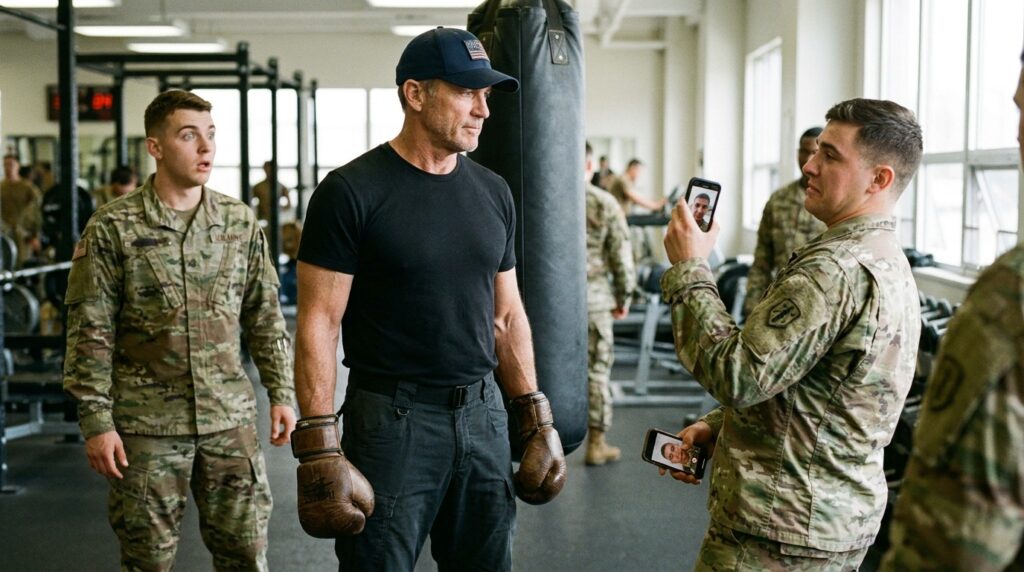
Miller looked down at his right glove. The leather across the knuckles had cracked into a web of pale, dry fissures, exposing the grey canvas backing beneath. He didn’t unlace them. He didn’t give the boy on the floor the benefit of seeing a bare hand shift or a knuckle rub against a sore joint.
“Get up,” Miller said. He didn’t raise his voice; he let the weight of it drop straight down through the damp air, heavy as an anchor chain settling into salt mud.
The boy didn’t move immediately. His palms were still flat against the rubber mat, his fingers curled into the rotted edge where the grey foam bled its dry, chemical dust onto the concrete. A thin thread of dark saliva hung from his lower lip, swinging slightly with the movement of his lungs before it snapped against the matting. His chest was still hitched, the modern camouflage pattern of his blouse jumping with every short, shallow intake of air.
The second recruit—the one whose vest buckle had clicked against his chest—took a single half-step forward. The rubber soles of his modern issue boots made a dry, sharp skitch against the concrete floor. It was a conditional movement, an instinctive reaction to the sight of an officer or an instructor holding a line too long.
Miller’s gaze shifted to him before the heel could fully settle. “Did I tell you to alter your interval?”
The second recruit froze, his chin tilting up by an inch, his eyes locked on the front seam of Miller’s faded navy cap. His jaw muscles clenched, the skin tightening over his cheekbones until the pale, uniform scars from his own survival phase showed like white salt lines. “No, sir.”
“Then reset it.”
The boy shifted backward, his heels hitting the boundary line of the next drilling lane with a precision that had been beaten into him over eighteen months of advanced training. He didn’t look back down at his teammate on the mats. In this pipeline, an unseated man was a hazard until he cleared the floor under his own power.
The fallen recruit finally untwisted his legs. He didn’t use his hands to push off; he swung his hips with a violent, awkward jerk that spoke of a lower back already locked with spasm—a carbon-copy reflection of the exact injury Miller carried in his own third lumbar. The boy stood up, his knees making a dry, cracking sound that seemed too loud for an empty bay. His face had gone from dark flush to an uneven, pasty grey, the sweat on his forehead picking up the fine grey dust from the floor.
He was looking at Miller’s left wrist now, his eyes tracking the silver corner of the lifting tape. The initials stamped into the leather beneath—J.M. 04-B—didn’t exist in the current logistics registry for the Special Warfare Center. They belonged to a detachment that had been officially stricken from the budget parameters during the first winter of the dry border incursions.
“Your left hand is heavy, sir,” the boy said. His voice was lower now, stripped of the brittle edge he’d brought into the pocket three minutes ago. He was trying to find a professional footing, a way to reframe his collapse as an instructional assessment. “The modern manual says the lead should stay high to mask the pivot. You didn’t mask it.”
“The manual assumes your heel is clear,” Miller said, his gloved hand sliding down the canvas of the heavy bag until his thumb rested against the fat seam at the bottom. The smell of the old stuffing—dried corn hulls and chopped rag—was sour with age. “You were standing on your own weight before you even initiated the drop. If I hadn’t caught your chin, that casing would have put your forehead into the iron bracket.”
He let his eyes drop back to the fresh surgical scar under the boy’s ear. Up close, the pink, raised ridge didn’t look like a standard laceration. The stitch-marks were microscopic, spaced with the specific, mechanical regularity of an automated closing tool used only in high-tier neurological reconstructions.
“Who cleared your line for this block?” Miller asked.
The recruit’s shoulder blades tightened beneath his camouflage blouse. He didn’t look at the observation window, but his chin drifted by less than a millimeter toward the reinforced door at the back of the gym floor—the one that led to the administrative annex where the operational logs were kept behind cipher locks. “The command master chief signed the sheet, sir. Standard fitness-for-duty validation after the second deployment.”
“Your charts aren’t standard,” Miller said. He stepped out of the pocket, his smooth-soled boots sliding across the rubber with a quiet, regular scraping that sounded like a shovel hitting dry earth. He passed within six inches of the boy’s shoulder, not waiting for a salute or an acknowledgment. “Your left foot is dragging by two ounces because the nerve behind that scar hasn’t settled into the sheath yet. They’re rushing your rotation.”
He didn’t look back to see if they were following. He walked toward the grey metal locker at the edge of the training floor where his water flask sat on top of an unpainted pine bench. The concrete beneath the bench was damp, stained dark by decades of salt fog drifting through the high, unsealed louvers of the gym’s eastern wall.
Behind him, the boy hadn’t reset his stance. He remained beside the heavy bag, his head tilted slightly down as if he were still calculating the precise microsecond his balance had vanished into the matting.
An iron latch clicked at the back of the bay. The heavy, reinforced door to the administrative annex swung inward by six inches, the old rubber gasket along its edge dragging against the concrete with a wet, heavy hiss. A man in clean, unissued khaki utility uniform stood in the shadow of the frame, his face hidden by the angle of the overhead fluorescent tubes, but his right hand was visible—his thumb was hooked into a heavy brass belt buckle that bore the distinct, three-pronged crest of a command officer who hadn’t seen a blue-water deck in ten years.
Miller didn’t lift his flask. He stopped three feet from the bench, his taped wrist resting against his hip as he watched the shadow in the doorway expand across the damp floor toward his boots.








