
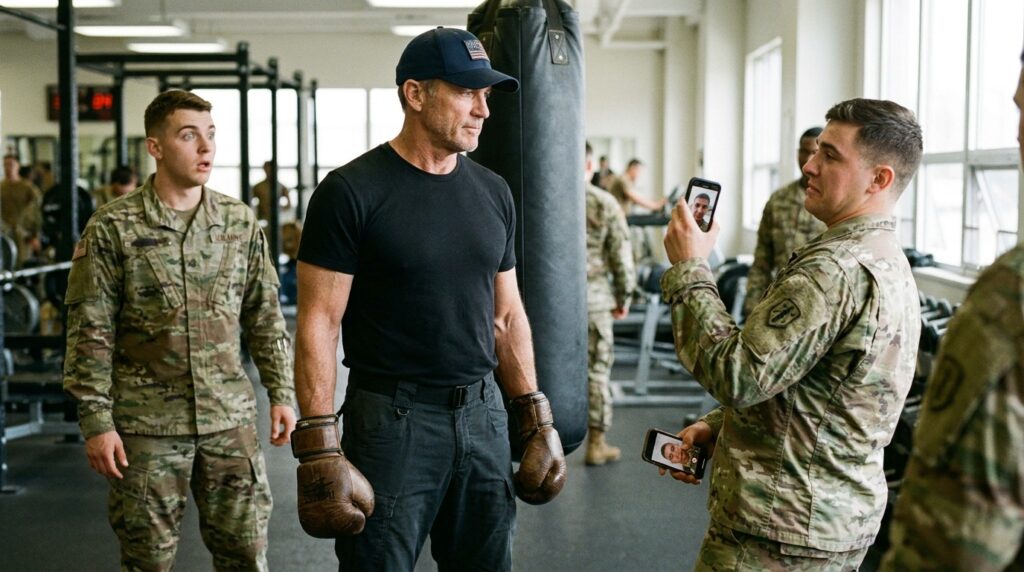
CHAPTER 4: THE MEASURED POCKET
“You’re still stepping left to shield the lower lumbar, Miller. A sharp eye picks that up from the gantry before you even drop your chin.”
The man in the khaki utility uniform stepped fully out of the doorway’s grease-stained shadow, his starched collar sharp against the salt-bleached concrete wall. It was Vance. The brass trident on his belt buckle didn’t have the dull patina of a working diver’s gear; it had been buffed until the ridges were smooth, a desk-man’s ornament that had spent a decade scraping against the mahogany edge of briefing tables.
Miller didn’t take his gloves off. The leather inside was hot, slick with his own sweat, but he kept his fingers curled tightly into the canvas palms. He reached down with his right hand, his thumb catching the dented steel lip of his water flask on the pine bench. The cold metal left a wet semicircle across his taped wrist.
“The boy was light on his heels,” Miller said. His voice was a dry rattle that barely lifted above the dull hum of the industrial floor fans. “He would have broken his own ankle on the seam if I hadn’t taken the lane.”
“The boy is twenty-three, and his reaction times are six percent higher than the baseline for the third-tier deployment group,” Vance said. He stopped four feet away, precisely at the edge of the rubber matting where the raw concrete began. His leather low-quarters were clean, free of the grey foam dust that covered Miller’s boots. He didn’t look at the recruits down the line, but his hand remained flat against his utility pocket, where the stiff white corner of an official medical reassessment log peeked through the buttonhole. “We didn’t bring you out of the retirement cadre to redesign the close-quarters curriculum, Miller. We brought you here to certify the readiness logs.”
“The readiness logs are fiction if the legs don’t hold,” Miller said. He unscrewed the flask lid with a single twist of his palm, the dry threads of the cap grating with a tiny, metallic shriek. He took a short sip, letting the lukewarm water clear the taste of the iron filing dust from his throat. He kept his eyes on Vance’s collar—not on the silver oak leaves of his rank, but on the small, grease-darkened smudge just below the lapel seam. It was hydraulic fluid, the specific low-viscosity grade used in the seal assemblies of hyperbaric insertion locks.
Vance didn’t look back at the glass window of the observation room, but his shadow on the concrete floor drifted by two inches to the right, narrowing the lane between Miller and the exit. “The command has parameters, Miller. The deployment schedules for the second quarter are already locked into the administrative annex. If a man has a signature on his fitness-for-duty sheet, he belongs in the rotation.”
“The boy has an automated closing wire behind his ear,” Miller said. He set the flask down on the pine bench with a dull, heavy clink that traveled through the wood. “The skin hasn’t even turned white yet. He’s carrying four pounds of fluid in his left calf because the neural pathway is firing thirty milliseconds behind his hip. You didn’t run a standard audit on him.”
Vance’s jaw muscles tightened, the skin along his throat turning the same dull, pasty grey as the rotted matting beneath the punching bags. He didn’t answer immediately. He reached into his utility pocket, his fingers drawing out a small, steel-rimmed magnifying lens—the kind used by field armorers to check the sear engagement on a worn firing pin. He held it between his thumb and forefinger, the glass catching the green glare of the overhead fluorescent tubes.
“The pipeline isn’t a museum, Miller,” Vance said, his voice dropping into a flat, transactional cadence that didn’t carry past the heavy bag station. “We don’t keep people around just because their names are stamped into the leather of the old gear. If a tool doesn’t meet the mechanical tolerance for the next cycle, we clear the bench.”
Miller looked down at his own left wrist, where the grey tape was peeling further back from the J.M. 04-B stamp. The physical secret was sitting right there on the leather, but Vance’s eyes weren’t tracking the serial number. They were watching the subtle, involuntary twitch in Miller’s left thumb—the small, rhythmic tremor that always came whenever his lower back sustained more than three minutes of sustained torque on the rubber floor.
“You didn’t come down here for the recruits, Vance,” Miller said.
“I came down to see if the machine still runs when you put weight on it,” Vance said. He turned his head slightly, his gaze finally tracking the long, regular shadows of the younger soldiers who had stopped their drills down the line. They were standing in their lanes, their camouflage blouses dark with sweat, their eyes locked on the old man and the officer who had divided the floor between them. “The command master chief wants the signature on the readiness sheet by sixteen hundred. If the signature isn’t there, the entire cohort stays on the base for another ninety days.”
He stepped backward into the shadow of the administrative doorway, his leather shoes making no sound against the clean concrete. He didn’t shut the door. He left it open by six inches, the wet hiss of the administrative air conditioning unit seeping into the hot, salt-crusted air of the gym floor like oil pouring into a well.
Miller didn’t move toward the door. He reached down, his taped fingers wrapping around the leather laces of his left glove to check the knot. The canvas was fraying at the eyelet, a small thread of white nylon coming loose under the strain of his grip. When he looked back up at the observation window, the green indicator light on the wall inside had turned red, blinking twice in a short, regular sequence that meant the line was still open, and someone was still counting the seconds between the strikes.








