
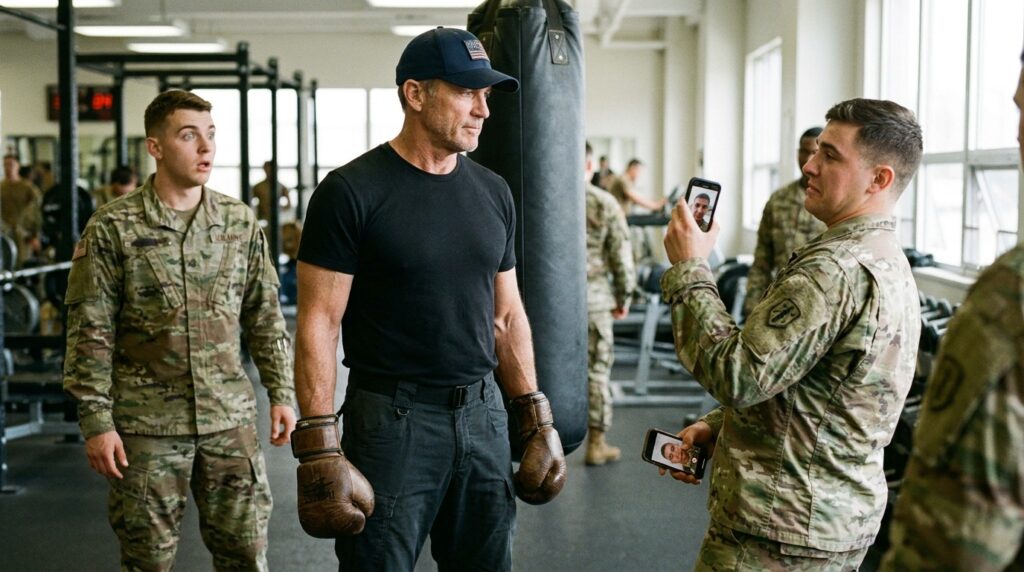
CHAPTER 2: THE ROTATION OF THE AXIS
The brass casing beneath the recruit’s left heel flattened into the split seam of the rubber matting with a sharp, metallic ping that was instantly swallowed by the roar of the ventilation fans. The boy’s ankle rolled inward by less than three degrees, but in the closed geography of the pocket, three degrees was an eternity. His center of gravity, which had been driving in a straight line through Miller’s chest, dipped toward the damp floor.
Miller didn’t retreat. Retracting a foot on this oil-slicked rubber meant inviting the boy’s bulk to collapse over him like a falling bulkhead. Instead, he let his hips pivot inside his dark tactical pants, his weight shifting onto his trailing right heel where the tread of his old boots had long since worn smooth. The friction was a dry, scraping heat that traveled up his shin. He allowed his left glove—the one stiffened with grey adhesive tape around the wrist—to drop into the hollow space just beneath the boy’s lead elbow.
It wasn’t a strike. It was an interception of mass.
The boy’s camouflage jacket, heavy with the starch of unwashed factory finishes, hissed as it scraped against Miller’s black t-shirt. The smell of the raw cotton was thick, mixed with the sudden, metallic tang of the boy’s breath as his lungs contracted from the unexpected change in trajectory. Miller felt the vibration through his own spine—the dull, grinding reminder of the third lumbar vertebra that had been crushed in a sub-zero riverbed twelve years ago. The pain was old, dry, and familiar, like the rust on the chain links holding the heavy bags behind them. He locked his core, suppressing the spasm before it could reach his shoulders, and let his right glove rotate upward along a tight, short arc.
The boy’s chin was precisely where the muscle memory said it would be.
Miller stopped the strike an inch short of the jawline, his knuckles merely grazing the short, stiff stubble of the recruit’s high-and-tight haircut. He didn’t need the impact; he needed the leverage. His thumb hook caught the soft tissue directly under the boy’s jaw, utilizing the momentum of the recruit’s own forward rush to tilt his head back toward the corrugated ceiling. The boy’s eyes, which had been narrowed into a calculated glare of youthful dominance, widened until the whites showed completely around the dark iris.
To the left, the observing recruit didn’t move. The adjustment buckle on his vest clicked once against his chest as his entire frame went rigid, his breath caught in his throat like water in a narrow pipe. The rhythmic, hollow thumping of the other training bags down the line seemed to fade into a distant, metallic rattle.
Miller’s left leg snapped round. It was a low, short-axis kick that traveled no higher than the boy’s shin—a blunt, heavy placement of his boot heel against the thick tendon just above the recruit’s combat boot. There was no theatrical flash, no cinematic snap of broken bone. It was simply the application of weight against an unstable pillar. The leather of Miller’s boot met the stiff nylon of the camouflage trousers with a dull, heavy thud that vibrated through the floorboards beneath the mats.
The boy’s forward drive ceased instantly. The kinematic chain broke at the knee. His frame didn’t fly backward; it dropped vertically, his knees striking the rubber seam with a wet, heavy impact that jarred the dust loose from the iron frame of the punching bag station above them.
Miller didn’t follow him down. He didn’t step over him like a conqueror in an arena. He simply drew his right glove back to his ribs, his chest rising and falling in the same unhurried cadence he had kept since entering the bay. His fingers inside the canvas gloves were warm, the sweat starting to pool in the palms, but his grip remained loose. He looked down at the pale scar beneath the boy’s ear, noticing for the first time that the tissue was fresh—too fresh for a standard pipeline injury. It had the precise, neat margins of a surgical excision, the kind performed at the tier-one hospital in Bethesda, not a field clinic.
The boy stayed on his knees, his hands pressed flat against the grey foam of the mats to stabilize his chest. His breath came in jagged, whistling gasps that rattled through his teeth, his face flushed dark with the humiliation of a target that had vanished before it could be hit. The sweat was already breaking through the short hairs at his temples, dripping down to the salt-crusted collar of his uniform.
“Technique doesn’t age,” Miller said, his voice dropping into the quiet gravel of a man who had spent decades speaking beneath the roar of twin-prop engines. “People just forget to respect it.”
The boy didn’t look up immediately. His fingers twitched against the rubber, his knuckles whitening as he tried to find the leverage to reset his frame. He was evaluating the risk of a second rush, his internal calculations spinning against the reality of the floor he was currently holding with his knees. But his eyes remained fixed on the small patch of grey tape wrapped around Miller’s left wrist—the silver-grey adhesive was lifting at the corner, revealing a dark, initials-stamped serial number on the leather beneath that didn’t belong to standard base inventory.
The industrial fans continued to slice through the heavy air, throwing long, regular shadows across the three men. The silence between them had become a physical thing, a wall of cold iron that the younger cohort down the line was beginning to notice. Two more pairs of boots stopped their drills, their shadows lengthening across the wet concrete floor as they turned toward the heavy bag station.
Miller reached down, his taped glove catching the top loop of the heavy bag’s chain to stop its slight, rhythmic sway. The iron links were cold, the grease on them black and thick enough to stain the canvas. He didn’t look at the boy’s face; he looked toward the small, reinforced observation window set into the reinforced concrete wall forty feet away, where the reflection of the overhead fluorescent tubes obscured whatever was moving behind the glass.








