
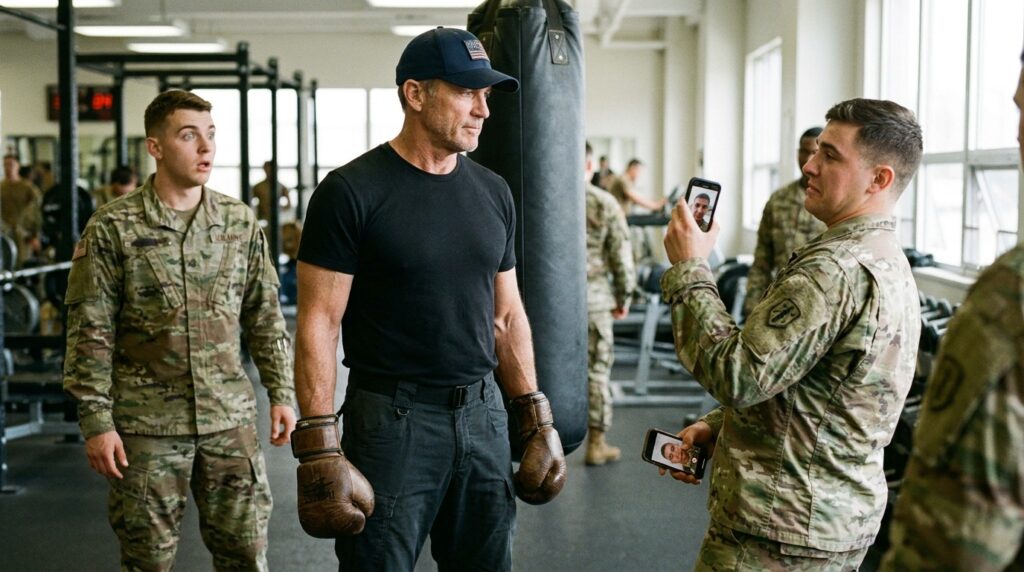
CHAPTER 5: THE GRAIN OF THE FRICTION
The iron frame of the bench didn’t yield when Miller leaned his thigh against it to brace his lower lumbar. The cold from the unpainted metal cut straight through his dark tactical trousers, a sharp, local point of contact that ground directly into the scarred nerve tissue above his hip.
The door to the administrative annex remained cracked by six inches, the wet, chemical smell of its recycled air cooling the edge of the gym floor like rain hitting hot scrap iron. From down the line, the regular, rhythmic thumping of the heavy bags didn’t restart. The recruits remained fixed in their lanes, their sweat-darkened camouflage blouses looking gray under the high fluorescent tubes. They were waiting for an order that had been delayed in transit.
Miller unlaced his right glove first. He didn’t use his teeth; he caught the loose, nylon thread at the eyelet with his left thumb hook and pulled until the salt-crusted leather parted with a short, dry hiss. When he slid his hand out, the skin of his palm was white, puckered from four hours of contained moisture, the raw smell of old canvas and iron oxide filling the space between his chest and the bench.
He didn’t touch the water flask again. He walked past the unseated recruit, who was still standing beside the punching bag with his head down, his fingers tracing the flat indentation where his boot had struck the matting. The boy didn’t look up when Miller’s shadow crossed his boots.
The corridor behind the administrative door was narrow, the walls covered in a thick layer of industrial enamel paint that had bubbled from the humidity of the coastal salt marsh outside. The floor here wasn’t rubber; it was raw terrazzo tile, cracked into grey, irregular segments that rattled whenever the compressor for the hyperbaric lock cycled in the sub-basement.
Miller’s boots made a distinct, dragging sound against the stone—the old, two-ounce discrepancy in his stride sounding like a loose iron tire on a cart. He reached the master chief’s administrative office at the end of the hall before the air conditioning unit could cycle down.
The door wasn’t locked. The electronic bolt had been held open by a flat piece of lead wire wedged into the latch assembly—the standard field trick used by teams running quick rotations between the armory and the transport trucks. Inside, the desk was cleared of everything except an unpainted aluminum logistics case and the triple-carbon readiness logs Vance had been carrying.
Miller reached for the logs with his bare hand. His skin left a faint, greasy smudge against the top sheet, where the name Miller, J. had been stamped in violet ink beside the validation block.
The sheet didn’t contain the standard training evaluation code. It had been routed through the third-tier logistics center under an Operational Status Audit tag—the specific designation used to clear old inventory before a facility was turned over to the naval base authority. But beneath the violet ink, hidden by the cross-hatching of the command seal, was a second signature line that had been filled out with a heavy grease pencil.
The handwriting belonged to Hauer.
Miller’s thumb came down on the carbon paper, the texture of the dry sheet feeling thin, almost brittle under his callous. Hauer’s stroke hadn’t changed since the winter they spent at the refueling terminal in Kittery—the bottom loop of the H was always dragged low, a signature cut short by a broken wrist that had never been reset by a military surgeon.
The physical secret on the paper was clear: the cohort wasn’t being held for ninety days because of a training deficit. The readiness sheets were already marked as Deficient in the master registry. The entire hand-to-hand module had been constructed as a physical stress-test for one man—not the young recruit with the surgical scar behind his ear, but the instructor holding the pen.
The old spinal injury in Miller’s lower back throbbed twice, a cold, sickening ache that traveled down his left thigh like water finding a crack in a concrete foundation. He had been cleared for this cycle under a false authorization code. If his thumb hadn’t stopped the recruit’s drive at the punching bag, the boy’s mass would have struck the exact structural weak point in Miller’s third lumbar, validating the medical retirement log that was already sitting in Vance’s utility pocket.
The industrial floor fans in the gym outside seemed to drop an octave as the primary power circuit shifted to the sub-basement generators. The red indicator light on the encryption hub in the wall behind the desk didn’t blink; it went black, the small glass lens reflecting nothing but Miller’s own weathered face and the blue-grey curve of his navy cap.
A step sounded in the terrazzo corridor behind him. It wasn’t the clean, silent pace of Vance’s low-quarters. It was a heavy, flat-footed stride that traveled with the clicking of an unhooked safety lanyard against an unarmored thigh.
Miller didn’t turn toward the doorway. He folded the top sheet of the triple-carbon log into a tight, hard square, the dry paper creaking under the pressure of his calloused thumb until the corner tore slightly along the violet ink line. He tucked it into the waistband of his tactical pants, beneath the grey adhesive tape that was still lifting from his left wrist.
“You always did spend too much time looking at the signatures, John.”
The man standing in the frame was broader than Vance, his khaki utility shirt unbuttoned at the throat to reveal a grey tangle of hair that rose up toward a thick, purple ridge along his collarbone. He held an unpainted steel clipboard against his hip, his fingernails split and black with the grease of low-pressure diesel injectors.








