
CHAPTER 8: THE LEGACY LINK
The small piece of metal didn’t roll when it slipped from the loose mesh pocket of the young man’s discarded hoodie. It fell with a flat, dead thwack into the wet shale, catching a single glint of yellow light from Arthur’s left headlamp before the rising mountain fog blanketed the ground.
Arthur did not rush. He did not let the cold air rattling through his radiator grate disturb the rhythmic expansion of his ribs. He waited until the final, low vibration of Jesse Miller’s utility truck completely died away behind the eastern curve of the ridge, leaving nothing but the sound of water dripping from the pine needles onto the rusted roof of his cab. The world was small now, bounded entirely by the white cones of his high beams and the gray limestone dirt beneath his soles.
He took three slow paces forward, his canvas coat-tail dragging with a heavy, sand-paper rasp across his boots. He bent his hips, his spine remaining a straight, horizontal timber as his right hand dropped into the dark. His fingers reached past a broken pine cone, their tips brushing against the grit until they closed over the small rectangle of weathered brass.
The weight was precisely three ounces. The edges were serrated, notched by an old industrial stamping machine that had been decommissioned before the highways were paved. When he turned it over, his thumb slid naturally into the smooth, hollowed-out reverse side, finding the permanent indentation where a mounting pin had been sheared off with side-action pliers. But it wasn’t the number 704 that caught the yellow light this time. It was the name hand-scratched into the soft zinc plating with the point of an armorer’s awl: M. MILLER — SGT.
Arthur’s thumb stopped on the lettering. His scar tissue—the white crescent from a blown firing pin assembly—throbbed with a dull, icy syncopation.
He knew Marcus Miller. He had known him on the last night in Sector Four, when the radio was spitting nothing but static and the registration fire was dropping four hundred yards short of the coordinates on the grid map. Marcus had been the line sergeant who had brought the final crate of navigation gears to the command tent, his fingers slick with grease as he hammered the latch pins into place. “They’re inspected, Captain,” Marcus had said through the rain. “They’re verified straight from the logistics pool.”
They hadn’t been inspected. They had been flawed from the factory floor, a batch of directional variances that Arthur had signed into the logbook because he was in a hurry to clear the staging area before the timberline caught fire. He had trusted the inventory stamps. He had trusted the paper. And because he had trusted them, he had given the command to lock the gate and fire the final trajectory based on a broken compass wheel.
Arthur stood up, his joints cracking once, a sharp, mechanical snap that sounded like dry twigs breaking under a boot. He didn’t look back at the road. He walked to the driver’s side of his truck, reached into the deep canvas pocket of his vest, and pulled out the single, worn brass key with the filed notch. He inserted it into the heavy padlock of the green footlocker bolted behind the cab.
The key turned with a dry, scratching grind. The brass tumblers inside dropped one by one, a small sequence of permissions that allowed the heavy iron lid to swing open against its rusted chain. Inside, sitting on a bed of dry burlap bags and grease-stiffened shop rags, was the original leather-bound field ledger from Sector Four.
He laid the dropped crest directly onto the scarred cover of the book. The zinc numbers of the badge matched the faded ink of the signatures on the final manifest page. For thirty years, Arthur had carried the weight of that night as a personal failure of nerve, a command error born from his own administrative haste. But looking at the stenciled codes on the crates Jesse Miller had hauled out of the ridge, and looking at the sergeant’s name scratched into the stolen brass, the ultimate reality clicked into place with the cold, absolute finality of an engine locking up from lack of oil.
The Miller family hadn’t been victims of that registration fire; they had been the ones who had hidden the logistics logs to cover the fact that the flawed navigation gears had been sold off the back of the supply trucks before the battalion ever reached the valley. His command hadn’t been a mistake of calculation. It had been an execution carried out with blank gears provided by men who preferred the price of salvage over the lives of the line companies.
Arthur didn’t tear the page out. He didn’t close the ledger with a slam. He took his oil-stiffened linen cloth from his pocket, wiped the zinc dust from his thumb, and laid his flat palm over the Sergeant’s name, his scar pressing into the leather until the pattern of the binding was stamped into his skin.
He had spent three decades using patience as a form of penance, letting the town believe he was just an old, broken-spirited captain who had lost his nerve in the mud of Sector Four. He had let the young men mock his slow steps and his frayed collar because he believed he owed them the silence. But the ledger wasn’t a memory anymore; it was an active manifest. The tools were still in the valley, the crates were still on the ridge, and Arthur was the only man left who knew exactly how to balance the shortage.
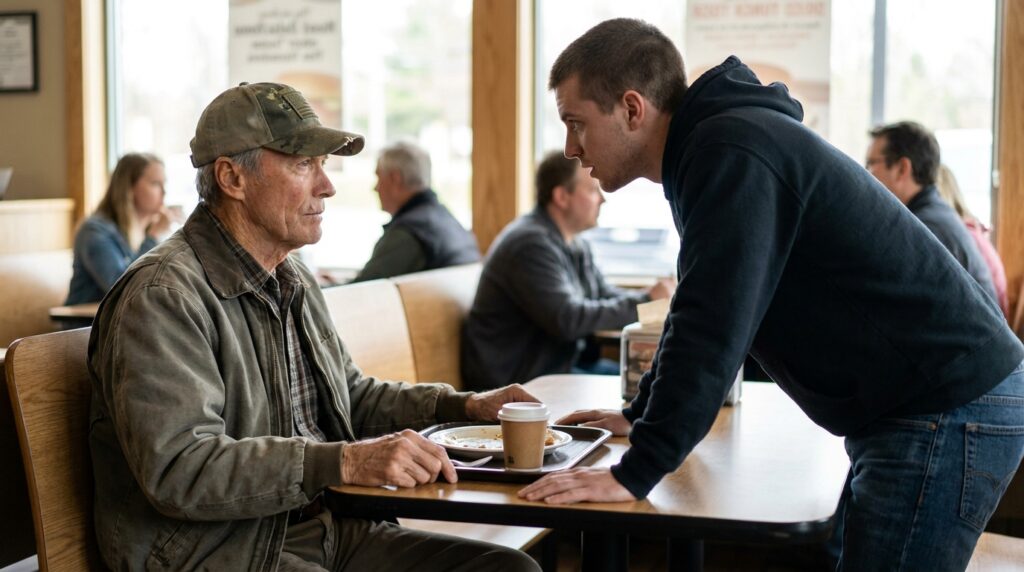
He turned the brass key back into the padlock, the iron loop catching with a single, ungreased chunk that signaled the close of the inventory. He climbed into the cab, his boots settling onto the floorboards as he shifted the heavy lever into first gear. The truck lurched forward into the purple dark of the state route, the engine chugging with a slow, mechanical certainty that carried him back toward the diner, where the coffee was still lukewarm and the lines on the formica table were already drawn.








